

Interstellar Mapping and Acceleration Probe (IMAP)
Syllabus :GS3/Science and Technology
In News
NASA launched the Interstellar Mapping and Acceleration Probe (IMAP) to map the heliosphere’s boundary, track energetic particles, and enhance space weather forecasting.
Interstellar Mapping and Acceleration Probe (IMAP)
- It is a space mission designed to explore the heliosphere—the Sun’s protective bubble around the solar system—and its interaction with interstellar space.
- It is positioned at the Earth-Sun Lagrange Point 1 (L1).
- It uses 10 instruments to study solar wind, energetic particles, magnetic fields, and cosmic remnants.
Features and Objectives
- It aims to uncover how solar particles are energized and how the heliosphere shields Earth from galactic radiation.
- It also provides real-time space weather data to protect astronauts and technology, while advancing our understanding of cosmic materials and the habitability of planetary systems.
Source :TH
India re-elected to ICAO Council with stronger mandate
Syllabus :GS2/IR
In News
India has been re-elected to Part II of the Council of International Civil Aviation Organization (ICAO) for the 2025-2028 term, reflecting increased global confidence in its leadership in international civil aviation.
Council of International Civil Aviation Organization (ICAO)
- It is a specialized UN agency established in 1944 that helps 193 countries collaborate for safe, efficient, and sustainable global air travel.
- Part II of the ICAO Council comprises States making the largest contribution to the provision of facilities for international civil air navigation
- The ICAO Assembly, held every three years, is the sovereign body of the organization and comprises all 193 signatory States to the Chicago Convention.
- The 36-member Council, elected during the Assembly, serves as ICAO’s governing body for a three-year term.
Progress
- It has played a key role in building a rapid and reliable international air network, connecting people and promoting economic growth worldwide.
- It is evolving by strengthening partnerships and providing expert guidance to shape the future of international air transport with sustainable and strategic solutions.
| Do you know ? – India has been a founding member of ICAO since 1944 and has maintained an uninterrupted presence on the Council for 81 years. – The country continues to play a pivotal role in shaping ICAO’s mission to promote safe, secure, sustainable, and inclusive international civil aviation. – For the 2025–2028 term, India has reaffirmed its commitment to strengthening aviation safety, security and sustainability; promoting equitable growth in global air connectivity; advancing technology and innovation; and supporting ICAO’s No Country Left Behind initiative. |
Source :PIB
Diamond Jubilee Silver Trumpet and Trumpet Banner to President’s Bodyguard
Syllabus :GS3/Defence
In News
President Droupadi Murmu presented the Diamond Jubilee Silver Trumpet and Trumpet Banner to the President’s Bodyguard (PBG), marking 75 years since it was designated as the elite regiment in 1950.
| Do you know ? – The tradition of presenting the Silver Trumpet and Trumpet Banner to the PBG began with Dr. Rajendra Prasad, the first President of India, who bestowed the honour on May 14, 1957 |
President’s Bodyguard
- The President’s Bodyguard is the oldest regiment of the Indian Army, tracing its origins back to 1773 when it was raised as the Governor-General’s Bodyguard, later known as the Viceroy’s Bodyguard.
- Following India’s transition to a republic, the regiment was renamed the President’s Bodyguard on January 27, 1950.
- The PBG is the only Regiment that is permitted two ‘Standards’, namely the President’s Standard of Body Guard and the Regimental Standard of The PBG.
India’s first Dugong Conservation Reserve in Palk Bay
Syllabus :GS3/Species
In News
The International Union for Conservation of Nature (IUCN) has officially recognized India’s first Dugong Conservation Reserve in Palk Bay, Tamil Nadu, at the 2025 IUCN World Conservation Congress.
Dugong Conservation Reserve
- It was established in September 2022, by the Tamil Nadu government under the Wildlife Protection Act, 1972.
- It covers 448.34 sq. km. in northern Palk Bay and is home to over 12,250 hectares of seagrass meadows, vital feeding grounds for dugongs (Dugong dugon)
| Dugongs(Dugong dugon) – They are relatives of manatees, have a similar plump look but a dolphin-like tail. – Dugongs are primarily herbivorous, grazing on 30 kg-40 kg of seagrass a day. – They are known as “sea cows,” and peacefully graze on seagrass in shallow coastal waters of the Indian and western Pacific Oceans. 1. They are often referred to as the “farmers or gardeners of the sea” for their important role in preserving the coastal ecosystems and aiding fish production. – Geographic Range: These gentle giants are found in warm waters along coastlines, mainly confined to seagrass beds which occur in calm sheltered habitats such as bays and lagoons. 1. They are found in the Gulf of Mannar, the Palk Bay, the Gulf of Kutch and the Andaman and Nicobar Islands in India. – Threats : Their population was on the decline over the past several decades owing to a variety of factors, including hunting for meat, commercial fishing practices leading to accidental drowning, and habitat degradation. – Protection status : The species is listed as Vulnerable to Extinction on the International Union for Conservation of Nature (IUCN) Red List. 1. Once abundant in Indian waters, dugongs are protected under Schedule I of the Wild Life (Protection) Act, 1972. |
Source :TH
Payments Regulatory Board (PRB)
Syllabus :GS3/Economy
In News
The Reserve Bank of India (RBI) has constituted a six-member Payments Regulatory Board (PRB) to oversee the country’s payment systems.
Payments Regulatory Board (PRB)
- The PRB replaces the Board for Regulation and Supervision of Payment and Settlement Systems (BPSS), a committee of the RBI’s Central Board.
- The new board derives its authority from the Payment and Settlement Systems Act, 2007.
- It will be supported by the RBI’s Department of Payment and Settlement Systems (DPSS), which will report directly to it.
Composition
- It will be chaired by RBI Governor Sanjay Malhotra, the PRB includes two other RBI officials—the Deputy Governor and Executive Director for Payment Systems—and three Central Government nominees: the Secretaries of Financial Services and Electronics & IT, along with former Telecom Secretary Aruna Sundararajan.
- Decisions will be made by majority vote, with the chairperson (or deputy governor in absence) holding a casting vote in case of a tie.
- The Board must meet at least twice annually, and decisions may also be made via circulation if directed by the chairperson.
- The RBI’s principal legal adviser is a permanent invitee to PRB meetings.
Functions
- The Board is responsible for the regulation and supervision of all payment systems including electronic and non-electronic, domestic and cross-border systems.
Source :IE
Accidental Deaths and Suicides in India: NCRB Report (2023)
Syllabus: GS2/Governance; Government Policy & Intervention
Context
- Recently, the National Crime Records Bureau (NCRB) released its Accidental Deaths and Suicides in India 2023 report, offering a snapshot of the India’s public health and safety landscape.
Key Findings of Report (2023)
- Age Groups: 30-45 Years (31.7%; 1,40,933 deaths); 18-30 Years (24.4%; 1,08,254 deaths).
- Road Accidents: India witnessed a staggering 1.73 lakh deaths and 4.47 lakh injuries due to road accidents in 2023—a 1.6% increase from the previous year.
- Over-speeding and careless driving: 82% of fatalities.
- Two-wheeler: 45.8% of total deaths, followed by pedestrians;
- Most incidents occur between 6 p.m. and 9 p.m., highlighting the need for better traffic enforcement and public awareness during peak hours.
- Accidents due to Forces of Nature: 6,444 deaths were attributed to natural forces like lightning (39.7%), heat stroke (12.5%), exposure of cold (11.4%) and floods.
- Under ‘Lightning’, Madhya Pradesh, Bihar, Odisha, Uttar Pradesh and Jharkhand are the biggest victim States/UTs.
- Accidents due to Other Causes: The major causes of accidental deaths were traffic accidents (45.2%), sudden deaths (14.5%), drowning (8.6%), falls (5.7%), poisoning, and electrocution (3.2%).
- Farmer Suicides: The agricultural sector saw 10,786 suicides in 2023 (declined by 10% from 2022), including 4,690 farmers and 6,096 agricultural laborers.
- It translates to nearly one farmer suicide every day, underscoring the deep-rooted agrarian distress.
- Maharashtra led with 2,518 farmer suicides, followed by Karnataka and Andhra Pradesh.
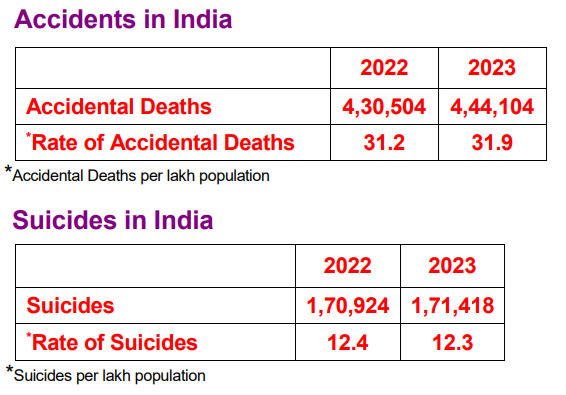
- Mental Health and Illness-Linked Suicides: Report highlights a 3.2% rise in suicides due to illnesses, with nearly 20% of cases linked to conditions like cancer, paralysis, and mental health disorders.
- Mental illness accounted for 13,978 suicides.
- Tamil Nadu, Maharashtra, and Karnataka reported the highest illness-related suicides.
- Alarmingly, suicides due to cancer rose by 14%, and abortion-related fatalities spiked by 59%.
Model Youth Gram Sabha initiative
Syllabus: GS2/Governance
Context
- The Union Government is set to launch the Model Youth Gram Sabha (MYGS) initiative from October 2025, inspired by the Model UN framework, to instill awareness about Panchayati Raj institutions among school students.
About Model Youth Gram Sabha (MYGS)
- The initiative will train rural and tribal students in grassroots democracy.
- Vision: To create a new generation of informed and responsible citizens who see local governance as central to development and social justice.
- The program involves students in mock Gram Sabha sessions, where they take on roles like sarpanch and ward members to discuss village issues and pass resolutions.
- Each school receives ₹20,000 financial support to conduct the activity.
- Implementing Ministries: Ministry of Panchayati Raj, in collaboration with the Ministries of Education and Tribal Affairs.
Implementation of the scheme
- Phased Rollout: The initiative began with a first phase covering about 1,100–1,200 schools.
- Participating Institutions in Phase 1:
- Over 600 Jawahar Navodaya Vidyalayas (JNVs) across the country.
- 200 Eklavya Model Residential Schools (EMRS) in tribal regions.
- Selected government schools in Maharashtra and Karnataka.
Source: IE
Bathukamma Festival Creates Two Guinness World Records
Syllabus: GS1/Culture
Context
- The Bathukamma festival set Guinness World Records for the largest floral arrangement and the most synchronized female dance participants.

About
- The Bathukamma was built by around 300 workers with metal, bamboo, and flowers, and the structure took 72 hours to complete.
- The Bathukamma festival is celebrated predominantly in Telangana.
- Women gather in large numbers to create intricate flower stacks, offer prayers, and dance in concentric circles, celebrating the goddess Gauri and the harvest season.
About Bathukamma Festival
- The term “Bathukamma” translates to “Mother Goddess Come Alive”, reflecting the divine feminine energy and protection.
- Folklore connects the festival to legends of Goddess Gauri as well as King Dhramangada and Queen Satyavati of the Chola dynasty.
- Bathukamma’s timing coincides with Navratri, celebrating life, devotion and the triumph of good over evil.
Source: AIR
RBI’s New Banking Norms to Enhance Policy Transmission
Syllabus: GS3/ Economy
Context
- The Reserve Bank of India (RBI) has introduced major reforms to ensure faster policy transmission, ease gold and silver-backed lending, and enhance banking sector flexibility with effect from October 1, 2025.
About
- Changes to Basel III: The RBI has amended the Basel III capital regulations.
- Under this, the eligible limit for Perpetual Debt Instruments issued abroad has been increased.
- This will provide banks with greater flexibility in raising Tier-1 capital from the foreign market.
- Reforms in Gold and Silver Lending: Earlier lending against primary gold or silver, including ETFs or mutual fund units, was prohibited.
- New Amendment: Banks and tier-3/tier-4 urban cooperative banks can provide working capital loans to borrowers using gold or silver as raw material for industrial or production purposes. Individuals holding gold for investment or speculative purposes are excluded.
- Flexibility in Floating-Rate Loans
- Spread Reduction: Banks can now reduce the spread on floating-rate loans even before the previous three-year lock-in period ends.
- Fixed-Rate Option: Borrowers may be offered the option to switch to a fixed rate at the time of interest rate reset, though this is no longer mandatory.
- Draft proposals include extending gold metal loan repayment from 180 to 270 days, allowing non-manufacturing jewellers to avail these loans, aligning large exposure norms for foreign bank branches, and requiring weekly credit data submissions to credit bureaus for improved accuracy.
- Public feedback on drafts is open until October 20.
| Do you know ? – Spread refers to the additional percentage that lenders add to the benchmark interest rate such as external benchmark rate or marginal cost of funds based lending rate (MCLR) by banks when determining the final lending rate to a borrower. – Banks typically factor in credit risk profile, operating cost and tenure of the loan while finalising the spread charged to a borrower. 1. Earlier the spread charged to a borrower could be altered once in three years. |
Significance of the Reforms
- For Borrowers:
- Reduced interest burden through faster pass-through of policy rate cuts.
- Access to working capital loans for industrial gold and silver users.
- Greater flexibility in choosing loan options.
- For Banks:
- Enhanced ability to manage spreads and credit exposures.
- Flexibility in raising Tier-1 capital from international markets.
Source: FE
Remission of Duties and Taxes on Exported Products (RoDTEP) incentive scheme
Syllabus: GS3/Economy
Context
- The Government has extended the Remission of Duties and Taxes on Exported Products (RoDTEP) incentive scheme for exporters until March 31, 2026.
About
- The scheme was started in 2021, and provides refunds to exporters for any embedded duties, taxes, and levies incurred by them not already refunded under other schemes.
- The revised rates under the scheme will be ranging from 0.3% to 3.9% and the same will remain in force for all qualifying export products.
- Ministry: Ministry of Commerce and Industry.
- As of March 31 , 2025, total disbursements under the RoDTEP scheme have crossed Rs. 57,976.78 crore, underscoring its significant role in supporting India’s merchandise exports.
- The scheme is compliant with World Trade Organization (WTO) norms and is implemented via a comprehensive end-to-end digital platform to ensure transparency and efficiency.
- Significance:
- Neutralizes the impact of domestic taxes that exporters cannot claim back.
- Encourages more exports by lowering costs.
Source: TH
