

Syllabus :GS1/Culture
In Context
- India’s ritual theatres are living cultural traditions that connect the divine and daily life through myth, music, and community participation.
Ritual theatre
- It is a traditional form of performance that blends sacred rituals with dramatic elements like acting, music, dance, and narration, often rooted in religious festivals and collective memory.
- These performances go beyond entertainment, serving as vital expressions of cultural identity, social cohesion, and continuity.
- UNESCO designates such practices as Intangible Cultural Heritage (ICH), promoting their preservation.
- ICH includes both traditional and evolving practices, shared across generations and communities.
- UNESCO defines ICH across five domains: Oral Traditions and Language, Performing Arts, Social Practices and Rituals, Knowledge of Nature and the Universe, and Traditional Craftsmanship.
Presently, 15 elements of Intangible Cultural Heritage (ICH) have been inscribed on UNESCO’s Representative List, granting them international recognition and a global platform.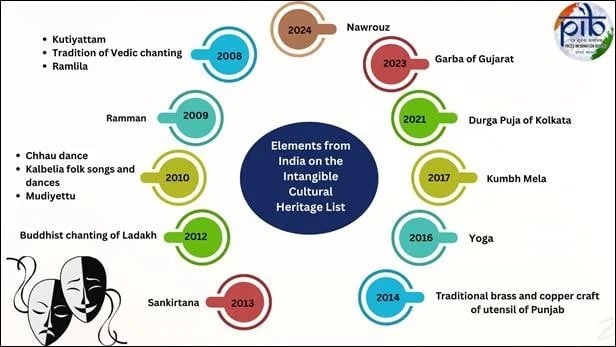 |
Indian Ritual Theatres in the ICH list
- UNESCO has inscribed Kutiyattam, Mudiyettu, Ramman and Ramlila ritual theatre forms on its Representative List of the Intangible Cultural Heritage.
- Kutiyattam : It is one of India’s oldest surviving theatrical traditions, dating back over 2,000 years.
- It is Kerala’s ancient Sanskrit theatre tradition, blends classical drama with local rituals, using intricate eye and hand gestures to convey deep emotion.
- Performed in temple theatres (kuttampalams), it retains a sacred character and involves intense training over 10–15 years.
- Kutiyattam fuses drama, music, and stylized acting, preserving ethical and aesthetic values across generations.
- Mudiyettu :It is a ritual dance-drama from Kerala that enacts the mythological battle between Goddess Kali and the demon Darika, performed annually in temple precincts (Bhagavati Kavus) after the harvest.
- Rooted in sacred rituals like kalamezhuthu (ritual drawing) and invocations, it involves collective village participation across castes—mask makers, performers, and artisans—fostering social cohesion.
- Blending dance, music, visual art, and drama, Mudiyettu is a vibrant, community-driven sacred performance.
- Ramman : Ramman is an annual religious festival celebrated in late April in the twin villages of Saloor-Dungra, Uttarakhand, in honour of the local deity Bhumiyal Devta.
- It features complex rituals, recitations of the Ramayana, songs, and masked dances, with each caste and group playing distinct roles.
- Some of the instruments documented include: Dhol (a type of drum), Damau (smaller percussion drum), Manjira (small hand cymbals), Jhanjhar (larger cymbals) and Bhankora (a kind of trumpet).
- Ramlila, literally meaning “Rama’s play,” is a dramatic re-enactment of the Ramayana epic, performed through a sequence of scenes that combine song, narration, recitation, and dialogue.
- Traditionally staged across northern India during the autumn festival of Dussehra, Ramlila follows the ritual calendar and varies in scale and duration. Some of the most renowned Ramlilas are staged in Ayodhya (birthplace of Lord Ram), Ramnagar, Varanasi, Vrindavan, Almora, Satna, and Madhubani.
Role of Sangeet Natak Akademi
- Sangeet Natak Akademi, the apex body in the field of performing arts in the country, was set up in 1953 for the preservation and promotion of the vast intangible heritage of India’s diverse culture expressed in forms of music, dance and drama.
- This institution acts as a guardian of India’s living heritage, blending tradition with modern preservation techniques to keep the ritual theatres vibrant
Source :PIB
Previous article
Sports as a Unifying Force, Not a Privilege: Supreme Court
