

Syllabus: GS3/ Economy
Context
- The U.S. President Donald Trump announced a 100% import tariff on branded and patented pharmaceutical products, including a 25% tariff on imports of all heavy-duty trucks and 50% tariff on kitchen cabinets.
About
- Exemptions: The EU and Japan benefit from a 15% tariff ceiling, under special trade agreements that cap duties on most goods, including pharmaceuticals.
- Companies establishing pharmaceutical plants in the U.S. are exempt, provided construction has begun or is under way.
- High Exposure: The U.K., Switzerland, and Singapore, being key hubs for branded drug manufacturing, face the prospect of a 100% tariff, which could severely increase the cost of their products in the U.S. market.
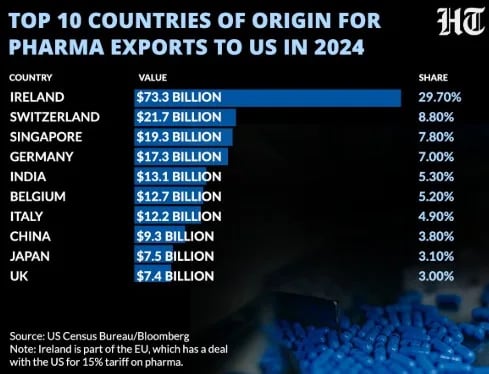
| Countries Protected by Trade Deals – EU Agreement: A framework deal finalized in July 2025 and reiterated in late September, sets a baseline 15% tariff on most EU goods, including pharmaceuticals. 1. The EU also committed to purchasing $750 billion in U.S. energy and making $600 billion in U.S. investments. – Japan Agreement: A similar agreement also capped tariffs at 15% on most goods. 1. Japan has committed to investing $550 billion in strategic U.S. sectors like energy, semiconductors, critical minerals, and pharmaceuticals. |
Implications for the U.S. Pharma Industry
- Domestic Manufacturing Incentives: The tariff may encourage U.S.-based production of branded drugs, potentially strengthening domestic supply chains.
- The industry could face higher costs for imported inputs, possible shortages of certain drugs, and a slowdown in innovation if resources are redirected from research to compliance and production adjustments.
- The Pharmaceutical Research and Manufacturers of America (PhRMA) warned that tariffs could increase patient costs without resolving underlying supply chain issues.
Implications for India’s Pharma Sector
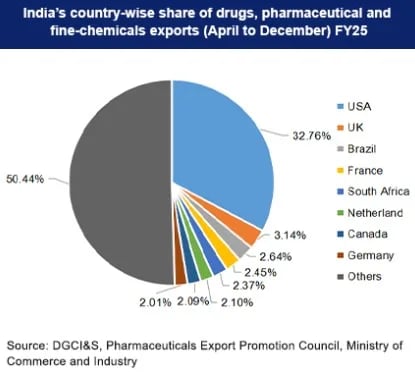
- Benefits: India exports over $10.5 billion worth of formulations annually to the U.S., mainly generic drugs, which make up 90% of U.S. prescriptions but just 13% of spending.
- Since the tariffs currently apply only to branded and patented drugs, India’s generics are not directly targeted.
- Risks Ahead: If tariffs expand to include generics, biosimilars, or Active Pharmaceutical Ingredients (APIs), India would face a major setback.
Way Ahead
- For the world, the move is a reminder that global supply chains forged in the post World War II order are being reshaped by new political realities.
- Countries heavily dependent on U.S. demand are now compelled to diversify export markets and strengthen alternative trade alliances.
Source: TH
Previous article
Food Loss and Waste
Next article
New Draft CAFE Rules
