

Syllabus: GS1/Culture; GS3/Economy
Context
- India celebrated World Tourism Day 2025, highlighting sustainable tourism and advancing the vision of a Viksit Bharat.
About
- World Tourism Day, observed annually on September 27, is an initiative of the United Nations World Tourism Organisation (UNWTO).
- It commemorates the adoption of the UNWTO statutes in 1970 and was celebrated for the first time in 1980.
- The theme for 2025 is “Tourism and Sustainable Transformation.”
Status of India’s Tourism Sector
- Contribution in Economy: India’s economy is $4 trillion, expected to reach $32 trillion by 2047.
- Tourism contributes 5–6% to India’s economy currently.
- Tourist Footfall: Till August 2025, India recorded about 56 lakh Foreign Tourist Arrivals (FTAs) and 303.59 crore Domestic Tourist Visits. However, outbound tourism from India stood at 84.4 lakh travellers in the same period.
- Global Recognition: India has 44 UNESCO World Heritage Sites and a diverse range of cultural and natural attractions.
- Global Ranking: According to the World Economic Forum’s Travel and Tourism Development Index 2024, India ranked 39th among 119 countries.
- Leading State and Tourist Attraction: Uttar Pradesh leads in domestic tourism due to attractions such as the Taj Mahal and Varanasi.
- The Taj Mahal remains India’s most visited ASI ticketed monument, attracting 6.10 million domestic and 0.68 million foreign tourists in 2023.
Significance of Tourism Sector
- GDP growth: Travel and tourism is the largest service industry in India. It contributed ₹15.73 lakh crore to GDP in 2023–24, which was 5.22% of the total economy.
- Foreign exchange: Tourism brought foreign exchange earnings of ₹51,532 crore as of June 2025.
- Employment: It generated 36.90 million direct jobs and 47.72 million indirect jobs, together accounting for 13.34% of total employment.
- Heritage Preservation: Tourism encourages the restoration and maintenance of historical monuments, temples, forts, and other heritage sites, ensuring their preservation for future generations.
- Soft Power Diplomacy: Tourism acts as a powerful instrument of soft power diplomacy by showcasing India’s rich culture, art, and history to the world.
Challenges in Tourism Sector
- High outbound vs low inbound tourism: India records far more outbound travellers than inbound visitors, leading to a tourism trade imbalance and loss of foreign exchange potential.
- Infrastructure bottlenecks: Limited last-mile connectivity, inadequate facilities, and overcrowding at popular destinations reduce the quality of the tourist experience.
- Environmental degradation: Over-tourism in ecologically sensitive areas, such as hill stations and coastal regions, leads to pollution, habitat loss, and resource strain.
- Safety and hygiene concerns: Issues of women’s safety, scams, sanitation, and cleanliness affect India’s global image and discourage foreign tourists.
- Seasonality: Many tourist destinations face seasonal fluctuations, with high tourist numbers during peak seasons and low numbers during off-seasons.
- Global competition: Despite its cultural and natural wealth, India ranks only 39th in the WEF Travel and Tourism Development Index 2024, highlighting untapped potential compared to global peers.
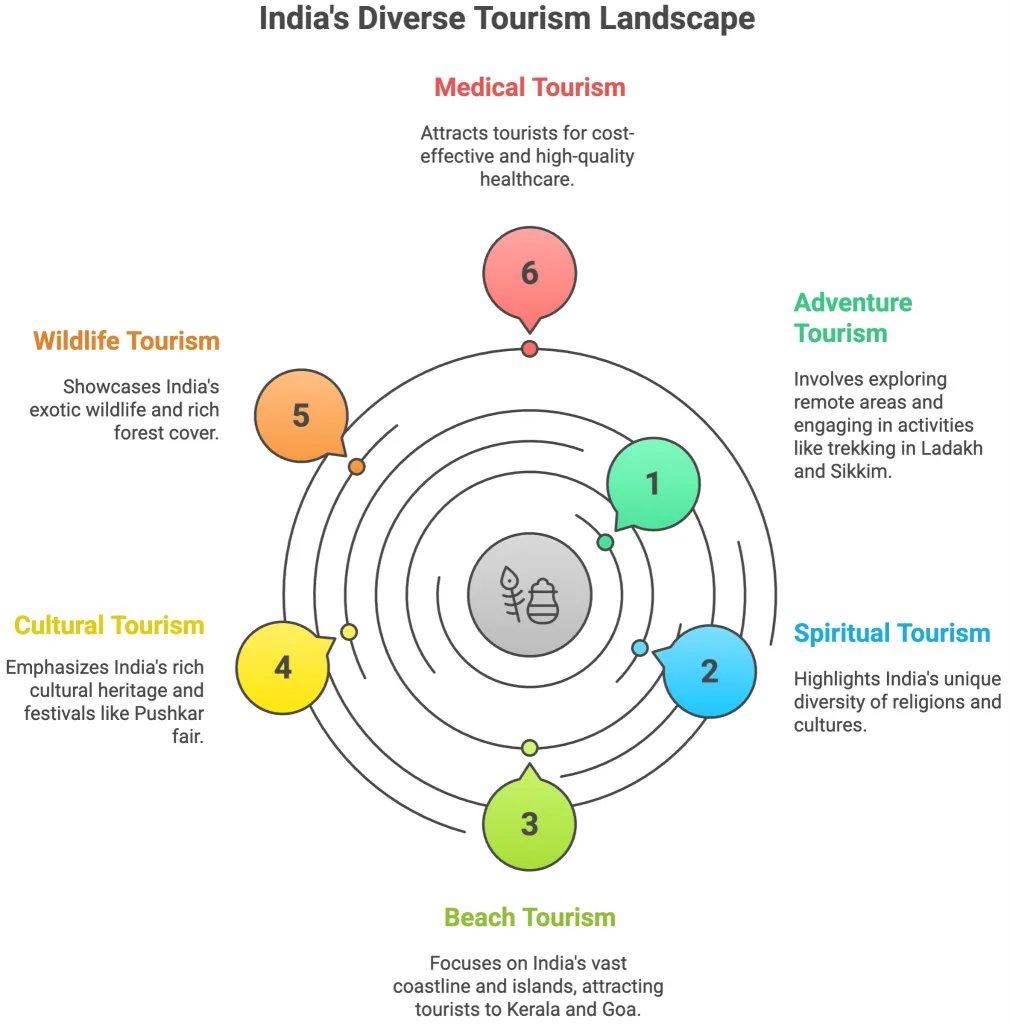
Initiatives taken
- Enhancing Connectivity and Investment: In the 2025 budget, the Finance Minister announced a landmark initiative to develop 50 top tourist destinations in partnership with states through a challenge mode.
- Swadesh Darshan Scheme: In 2014-15, the Ministry of Tourism launched the Swadesh Darshan Scheme (SDS) to develop thematic tourism circuits across the country. 76 projects worth ₹5,290.30 crore were sanctioned under identified themes, of which 75 projects have been physically completed.
- PRASHAD Scheme: The Ministry of Tourism launched the Pilgrimage Rejuvenation and Spiritual Heritage Augmentation Drive (PRASHAD) in 2014-15 to improve tourist convenience, accessibility, security, and cleanliness at pilgrimage centres.
- Dekho Apna Desh Initiative: The Ministry of Tourism launched the ‘Dekho Apna Desh’ initiative in 2020 to promote domestic tourism in the country.
- Special Assistance to the States for Capital Investment (SASCI): To develop an iconic tourist centre on a global scale, the SASCI scheme was launched by the Ministry of Tourism in July 2025.
- Visa Reforms: The introduction of e-visa facilities for citizens of many countries has simplified the process for obtaining a visa to visit India. This move aims to attract more international tourists.
- Measures to Facilitate Employment-Led Growth in the 2025-26 Budget:
- Providing MUDRA loans for homestays;
- Providing performance-linked incentives to states for effective destination management including tourist amenities, cleanliness, and marketing efforts and;
- introducing streamlined e-visa facilities along with visa-fee waivers for certain tourist groups.
Conclusion
- The rise of tourism in India over the past few years has been remarkable, making a significant contribution to the nation’s economy and its global image.
- From heritage sites to modern infrastructure, India’s diverse attractions continue to draw millions of visitors annually.
- With a strong emphasis on ‘Seva’ and ‘Atithi Devo Bhava,’ India is set to redefine its tourism landscape and establish itself as a world-class destination.
Source: PIB
