


Syllabus: GS1/ Geography
Context
- Researchers at the University of California, analysed 36 years of satellite data across 84 rivers worldwide to identify why some rivers maintain a single-thread channel, while others develop into braided or multi-thread systems.
Fluvial Processes and Channel Types
- Rivers are broadly classified as single-thread or multi-thread (braided/ anastomosing).
- In a single-thread river, lateral erosion of one bank is roughly matched by sediment deposition on the opposite bank.
- This balance keeps the channel width constant and lets the river meander across its floodplain.
- Multi-threaded rivers occur where bank erosion exceeds deposition.
- The extra sediment eroded from the banks accumulates mid-channel as bars and islands, forcing the flow to split into multiple shallow threads.
Factors influencing erosion and deposition balance
- Slope and discharge: Steeper slopes and high flows increase stream power, promoting bank erosion. Multi-thread channels “favour higher water discharge, coarser sediment, and steeper slopes”
- Many Himalayan and volcanic rivers are braided for these reasons.
- Sediment size and load: Rivers carrying a lot of coarse sediment (gravel, sand) tend to overload their channels and deposit bars, triggering braiding.
- Vegetation and bank material: Stable, vegetated banks resist erosion and encourage single channels.
- Human interventions: Dams, embankments and channelization constrain a braided river into one thread. In fact, many rivers that are single-thread today were braided before human interference
Examples of river braiding
- Amazon River (South America): Mostly single-threaded due to fine sediment and strong bank vegetation.
- Mississippi River (USA): Meandering single channel, controlled by fine sediment and engineering works.
- Indian rivers:
- Ganga in Plains: Single-thread with meandering, due to fine alluvium and flat topography.
- Brahmaputra in Assam: Multi-thread braided system, leading to frequent floods and erosion.
- Kosi River (Bihar): Known as the “Sorrow of Bihar” because its unstable, sediment-heavy channels keep shifting.
Significance of the Study
- The study helps predict flood risks in braided river regions, providing insights for disaster management, especially in flood-prone states like Assam and Bihar.
- Braided rivers constantly shuffle their channels, changing course across the floodplain. This makes them dynamic and unpredictable.
- It is useful in river engineering projects such as dams, barrages, and embankments.
- It assists in environmental conservation, since river splitting affects wetlands, fisheries, and livelihoods.
| What are Meanders? – Meanders are large bends or curves in the middle and lower course of a river, formed due to both erosion and deposition processes. – A meander is formed when the water flow velocity diminishes in the river, reducing its ability to cut downwards. Instead, it begins to erode laterally (sideways). 1. On the outer concave bank, the river’s current is stronger, causing erosion. 2. On the inner convex bank, the current is weaker, leading to deposition of sediments (point bars). – This combination of erosion and deposition creates a winding channel, forming meanders. 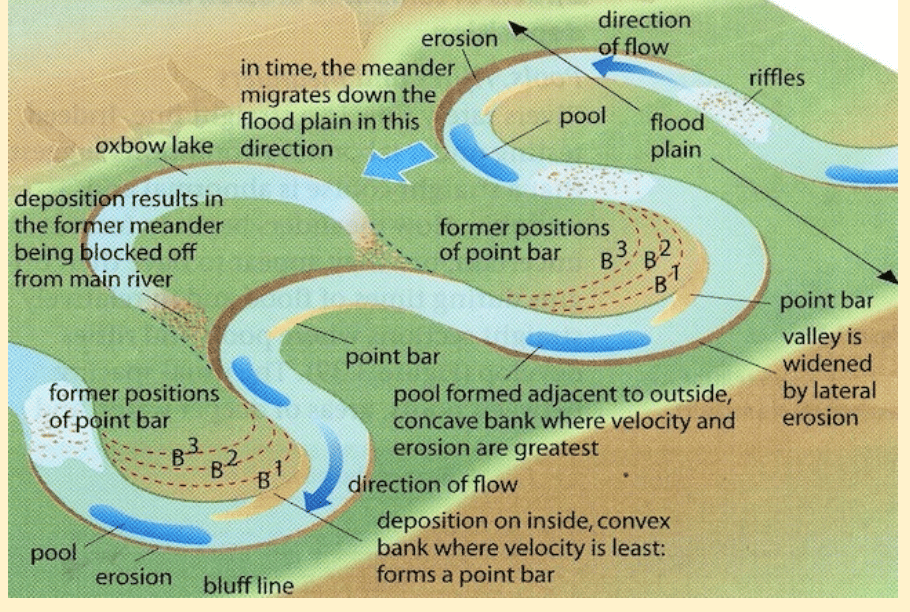 |
Source: TH
Previous article
Earthquake in Afghanistan
