



Syllabus: GS1/ Geography
Context
- The recent earthquake in Afghanistan, with a 6.0 magnitude, resulted in over 800 deaths and 2,000 injuries due to shallow depth and poor building structures.
What is an Earthquake?
- An earthquake is the shaking of the ground caused by movement beneath the earth’s surface when two blocks slip past each other along a fault.
- This sudden movement releases stored elastic strain energy in the form of seismic waves, which causes ground shaking.
- The location below the earth’s surface where the earthquake starts is called the hypocenter, and the location directly above it on the surface of the earth is called the epicenter.
- Earthquakes are measured using the Richter scale for magnitude and the Mercalli scale for intensity based on visible damage.
Reasons for Earthquake in Afghanistan
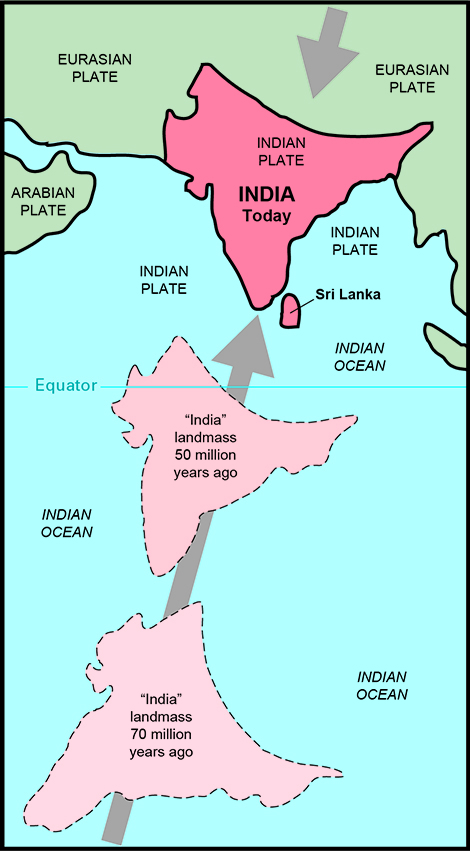
- The Himalaya and Hindu Kush mountains, and their foothills, where the impacted area in Afghanistan is located, are seismically active because of the ongoing friction between the Eurasian and Indian tectonic plates.
- The northward movement of the Indian Plate (approx. 5 cm per year) exerts immense pressure, creating multiple fault lines across Afghanistan, Pakistan, and northern India.
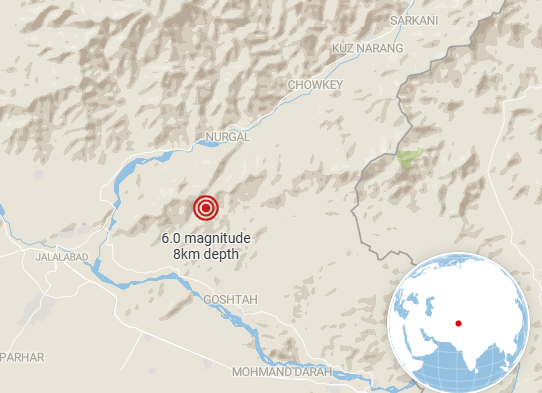
- The recent quake’s epicenter was shallow, approximately 8 km deep, which amplified the surface impact.
Impact of earthquakes
- Earthquakes cause large-scale casualties due to collapsing buildings, landslides, tsunamis, and fires triggered by shaking.
- Displacement of people, loss of community structures, and psychological trauma are common consequences.
- In the case of Afghanistan the quake struck at a shallow depth, intensifying ground shaking and damage.
- Fragile Construction: Use of mud-brick and stone in rural areas without engineering standards made buildings collapse-prone.
| Seismic Waves – Seismic waves are energy waves generated by an earthquake that travels through the Earth’s layers, causing ground shaking. – They are mainly classified into two types: body waves and surface waves. 1. Body Waves: These waves travel through the interior of the Earth. They are faster and arrive before surface waves during an earthquake. 2. Surface waves travel along the Earth’s surface and are slower than body waves but cause the most damage due to their larger amplitude. Types of Body Waves – P-Waves (Primary Waves): They are the fastest seismic waves and the first to be recorded by seismographs. They move in a compressional or longitudinal manner. 1. P-waves can travel through solids, liquids, and gases. – S-Waves (Secondary Waves): They move in a transverse manner, where particles move perpendicular to the wave’s direction of propagation. 1. S-waves can travel only through solids, as liquids and gases do not support shear stress. |
Source: DTE
Previous article
News In Short – 1 September 2025
Next article
Why Some Rivers Stay Single While Others Split?
