


Syllabus: GS3/Space Sector
Context
- The Indian National Space Promotion and Authorisation Centre (IN-SPACe) has facilitated the transfer of five technologies developed by ISRO to five Indian companies.
About
- The transfers are aimed at driving commercialisation, strengthening self-reliance, reducing imports, and enabling wider applications of space technologies in sectors such as automotive, biomedical, and industrial manufacturing.
Technologies Transferred
- For Biomedical Use: The Low-Temperature Co-Fired Ceramic (LTCC) Multi-Chip Module, developed by the Space Application Centre (SAC), enables the integration of multiple semiconductor chips into a single, compact module.
- This has been acquired for RT-PCR kits requiring high-volume production.
- For solar panel bonding: The RTV Silicone Single-Part Adhesive (SILCEM R9), developed by Vikram Sarabhai Space Centre (VSSC), is a room-temperature curable adhesive.
- It has been acquired for solar panel bonding.
- For industrial use: Another three technologies are transferred to three organisations for industrial use.
India’s share in the Space Industry
- India’s space economy stands at $8 billion, contributing 2-3% of the global space economy, and this is expected to rise to 8% by 2030 and further to 15% by the year 2047.
- With over 400 private space companies, India ranks fifth globally in the number of space companies.
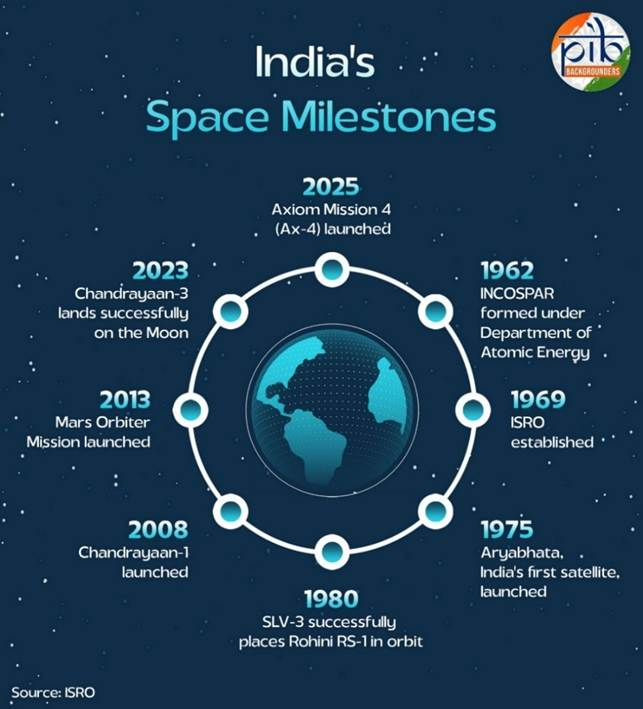
Private players in the Space Industry
- The number of space startups in India increased to nearly 200 in 2024 from just one in 2022.
- The funding received by these start-ups reached a total of $124.7 Mn in 2023 from $67.2 Mn in 2021.
- Skyroot has launched India’s first privately built rocket, Vikram-S, into space, with plans to revolutionise satellite launches.
Regulation of the Private sector in the Space industry in India
- National Space Promotion and Authorisation Centre (IN-SPACe): It is an autonomous and single window nodal agency in the Department of Space for the promotion, encouragement, and regulation of space activities of both government and private entities.
- NewSpace India Ltd (NSIL): Acts as the commercial arm of the Department of Space:
- Commercialises space technologies developed by ISRO.
- Manufactures and procures space assets.
- Serves both government and private sector clients on commercial terms.
Significance of the privatisation of the space sector
- Cost Reduction: Profit motive drives private companies to reduce costs in space missions and satellite launches.
- Competition & Innovation: Privatisation introduces competition, enhancing efficiency and fostering innovation.
- Commercialisation: Private players enable space applications in sectors like agriculture, disaster management, urban planning, navigation, and communication.
- Autonomy: Greater decision-making autonomy allows private companies to take on new projects more swiftly.
- Employment & Self-reliance: Privatisation generates jobs, supports modern technology adoption, and helps make the space sector self-reliant.
Challenges
- High Investment Costs: Space technology requires heavy investment, potentially leading to monopolisation by wealthy corporations.
- Specialised Expertise: Building and operating space tech demands specialised technical skills and resources.
- Protecting intellectual property rights (IPR): Safeguarding intellectual property rights is essential to encourage innovation and investment.
- International Competition: Indian private space companies face strong competition from established players like SpaceX and Blue Origin globally.
Steps Taken by the Government
- Space Sector Reforms (2020): The Government allowed private sector participation, defining the roles of IN-SPACe, ISRO, and NSIL.
- Space Vision 2047: Aims for Bharatiya Antariksh Station (BAS) by 2035 and an Indian Moon landing by 2040.
- Gaganyaan programme has entered its final phase, with the first human spaceflight now scheduled for the first quarter of 2027.
- Bharatiya Antariksh Station (BAS) first module by 2028.
- Next Generation Satellite Launch Vehicle (NGLV) by 2032.
- Chandrayaan-4 by 2027, to collect moon samples and demonstrate return technology.
- Venus Orbiter Mission (VOM) by 2028, to study Venus.
- Indian Space Policy, 2023: Ensures a level playing field for Non-Government Entities (NGEs) in space activities.
- Venture Capital Fund: Rs. 1000 crore fund for space startups under IN-SPACe over the next 5 years.
- SpaceTech Innovation Network (SpIN): SpIN is a one-of-its-kind public-private collaboration for start-ups and SMEs in the space industry.
- Under the amended FDI policy,100% FDI is allowed in the space sector.
- Up to 74% (Automatic route) for satellite-related activities; beyond that, government route.
- Up to 49% (Automatic route) for launch vehicles and spaceports; beyond that, government route.
- 100% (Automatic route) for manufacturing components and sub-systems for satellites and ground/user segments.
Way Ahead
- Private entities are now actively involved in crucial aspects of research, manufacturing, and fabrication of rockets and satellites, fostering a vibrant ecosystem of innovation. It is expected to integrate Indian companies into global value chains.
- With this, companies will be able to set up their manufacturing facilities within the country, duly encouraging ‘Make In India (MII)‘ and ‘Atmanirbhar Bharat’ initiatives of the Government.
Source: TH
Previous article
Deforestation and Heat-Related Mortality in Tropical Regions
Next article
15th India-Japan Annual Summit
