


Syllabus :GS3/Economy
In News
- The Reserve Bank of India’s Financial Inclusion Index (FI-Index) rose by 4.3% in FY25.
What is Financial Inclusion?
- It means that individuals and businesses have access to and use affordable financial products and services that meet their needs, which are delivered in a responsible and sustainable way.
Financial Inclusion Index (The FI-Index)
- It is a comprehensive index incorporating details of banking, investments, insurance, postal, as well as the pension sector in consultation with government and respective sectoral regulators.
- It captures information on various aspects of financial inclusion in a single value ranging between 0 and 100, where 0 represents complete financial exclusion and 100 indicates full financial inclusion.
- It comprises three broad parameters
- Access, with 35 per cent weightage: It reflects how easily financial services are available
- Usage with 45 per cent weightage: It indicates how frequently and effectively people are using these services.
- Quality with 20 per cent weightage: It includes aspects like financial literacy, consumer protection, and reduction in inequalities and service deficiencies.
Key Findings of Recent Data
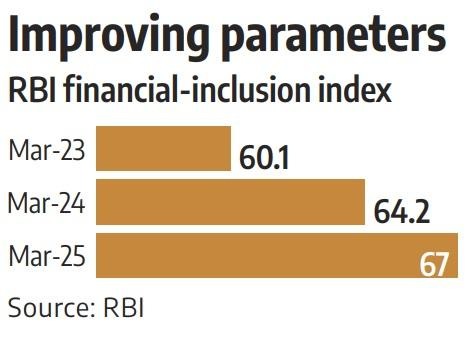
- The index value increased from 64.2 in March 2024 to 67 in March 2025.
- The growth was witnessed across all sub-indices – access, usage, and quality.
- The improvement in FY25 was mainly driven by gains in the usage and quality dimensions, highlighting deeper engagement with financial products and services and the impact of ongoing financial literacy efforts.
Importance
- Financial inclusion supports entrepreneurship and business growth.
- It is a catalyst for achieving seven of the 17 Sustainable Development Goals (SDGs).
- It fosters economic growth and employment, promotes economic empowerment of women, and contributes to eliminating poverty.
- It helps build resilience for people and businesses vulnerable to climate change and natural disasters
- The rise in the FI-Index signals India’s growing success in expanding financial access to underserved populations and enhancing the quality of financial services available.
- This progress supports the government’s broader agenda of economic empowerment and inclusive growth, contributing to the strengthening of India’s formal financial ecosystem.
| Related Initiatives – The Pradhan Mantri Jan Dhan Yojana (PMJDY) has opened over 54.58 crore accounts, with deposits rising to ₹2.46 lakh crore by January 2025. – The Atal Pension Yojana (APY) has seen a surge in enrolments, reaching 7.33 crore by January 2025, with more than 89.95 lakh new enrolments in FY 2024-25. – The Pradhan Mantri Jeevan Jyoti Bima Yojana (PMJJBY) has enrolled 22.52 crore individuals, with ₹17,600 crore disbursed for 8.8 lakh claims. – The Pradhan Mantri Suraksha Bima Yojana (PMSBY) has covered 49.12 crore people, processing ₹2,994.75 crore against accident claims. – The Stand-Up India Scheme has sanctioned ₹53,609 crore in loans for 2.36 lakh entrepreneurs, with a focus on SC/ST and women. – The Pradhan Mantri Mudra Yojana (PMMY) has sanctioned ₹32.36 lakh crore for 51.41 crore loans, with 68% of the loans benefiting women and 50% going to SC/ST/OBC categories. |
Challenges of Financial Inclusion
- Large gaps remain between high- and low-income countries in account ownership.
- Women, especially in developing countries, are less likely to have access to financial services.
- Inadequate digital infrastructure and low digital literacy hinder access to mobile financial services.
- Weak consumer protection leaves users vulnerable to fraud, misuse, and lack of transparency.
Suggestions and Way Ahead
- The Government of India’s Financial Inclusion (FI) initiatives serve as a cornerstone for empowering economically and socially marginalized communities by facilitating equitable access to formal financial services.
- There is a need to enhance regulatory frameworks and consumer protection to ensure safe and fair use of digital financial services.
Source :TH
Previous article
India Witnesses Surge in IP Filings Over Five Years
