

Syllabus: GS2/ International Relations
Context
- China officially commenced construction of a massive hydropower project on the Brahmaputra River in Tibet, near the Indian state of Arunachal Pradesh.
About
- The project is being hailed as the largest infrastructure development of its kind globally.
- Project Details:
- It comprises five cascade hydropower stations.
- Total estimated investment: 1.2 trillion yuan (approx. USD 167.8 billion).
- Expected power generation: 300 billion kilowatt-hours annually — enough to power 300 million people.
- Location: Situated in the Yarlung Tsangpo Grand Canyon (Brahmaputra in Tibet), where the river takes a U-turn near the India-China border before entering Arunachal Pradesh and eventually Bangladesh.
- The region is seismically active and ecologically sensitive.
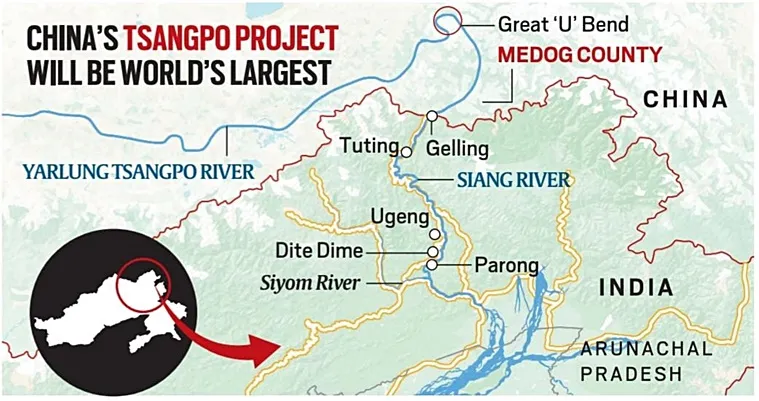
| Yarlung Tsangpo ( Zangbo) river – It originates from Chemayungdung Glacier in Tibet, and enters Arunachal Pradesh, where it is known as the Siang. – In Assam, it is joined by tributaries such as Dibang and Lohit, and is called the Brahmaputra. – The river then enters Bangladesh, and makes its way to the Bay of Bengal. – The basin spreads approximately 5,80,000 square kilometers across China (50.5%), India (33.3%), Bangladesh (8.1%) and Bhutan (7.8%). |
Impact of the Project
- Geopolitical Concerns: India and Bangladesh are lower riparian states.
- Both rely heavily on the uninterrupted flow of the Brahmaputra for agriculture, drinking water, and ecosystem stability.
- Concerns centre around disruptions to water flow, blocking of nutrient-rich silt, and potential ecological damage.
- It could also enable China to release large amounts of water flooding border areas in times of hostilities.
- Ecological Risks: Threat to biodiversity and river ecosystems, including aquatic species and wetlands.
- Seismic and Structural Risks: The Brahmaputra basin is seismically active, as evidenced by the 1950 Assam-Tibet earthquake.
- A mega-dam in this zone could trigger disasters like dam collapse and floods due to structural failure.
- Geopolitical Tensions: Control over water resources may heighten tensions between China and lower riparian countries (India, Bhutan, Bangladesh).
- Disaster Vulnerability: Increased risk of Glacial Lake Outburst Floods (GLOFs), as seen in the 2023 Sikkim floods.
Coordination Mechanism for Cooperation Between India and China:
- There is an umbrella Memorandum of Understanding on cooperation on transboundary rivers, and two separate MoUs on the Brahmaputra and Sutlej.
- The Brahmaputra MoU, renewable every five years, lapsed in 2023.
- The umbrella MoU was signed in 2013, and has no expiry date.
- China and India have the Expert Level Mechanism (ELM) since 2006 for hydrological data sharing, but lack a comprehensive treaty.
- None of the riparian nations (China, India, Bhutan, Bangladesh) are signatories to the UN Convention on the Law of the Non-navigational Uses of International Watercourses (1997).
Way Ahead
- Strengthen diplomatic dialogue: Between China, India, Bhutan, and Bangladesh for transparent water-sharing agreements.
- Institutional Mechanism: Establish a permanent transboundary river management authority for data-sharing on water flow, dam operations, and disaster forecasting.
- Disaster Preparedness: Enhance regional cooperation for disaster management, including shared resources for relief efforts.
- India’s Counter-Strategy: India is accelerating its own hydropower projects on the Brahmaputra in Arunachal Pradesh as part of regional infrastructure and border development.
Source: IT
Previous article
Birth Anniversary of Mangal Pandey
Next article
India’s Rising Abstentions at the United Nations
