


Syllabus: GS3/Energy
Context
- China’s transformation from the world’s largest polluter to a global clean energy superpower is the result of decades of strategic planning, massive state investment, and technological dominance across the renewable energy supply chain.
About the Green Energy
- It has emerged as a cornerstone of sustainable development, as the world confronts the climate crisis.
- It refers to energy generated from natural, renewable sources that have minimal environmental impact and produce little to no greenhouse gas emissions.
- These sources include solar energy, wind energy, hydropower, biomass and geothermal energy.
Global Landscape
- Globally, renewables provided 40.9% of electricity in 2024 — the highest share since the 1940s.
- Solar alone added 474 TWh, making it the fastest-growing source for the 20th consecutive year.
- The US and EU are investing billions to reshore clean energy industries.
- Brazil and Germany are expanding bioenergy and offshore wind.
- Africa is emerging as a new frontier, with China leading nuclear and solar investments.
China’s Green Energy Revolution
- China, once the world’s largest emitter, has rapidly transformed into a clean energy superpower — reshaping global supply chains, investment flows, and technological leadership.
- Policy & Legal Framework: 11th Five-Year Plan (2006–2010); Renewable Energy Law (2005).
- Massive Investment: $940 billion in renewables in 2024, up from $10.7 billion in 2006.
- State-Owned Enterprises (SOEs): Entities like State Grid and Huaneng execute national plans with speed and scale.
- China’s SOEs account for 55% of global renewable energy investment, turning clean energy into a tool of statecraft.
- Global Supply Chain Dominance: From raw material extraction (polysilicon, lithium) to manufacturing and exports, China has consolidated control over every stage of clean energy production.
- Using Next-Gen Tech: China is focusing on next-gen technologies like AI-powered smart grids, Green hydrogen, and Thorium-based nuclear reactors in its renewable energy push.
- Export Strategy: Through the Belt and Road Initiative (BRI), China builds solar parks, wind farms, and hydropower stations across 61 countries.
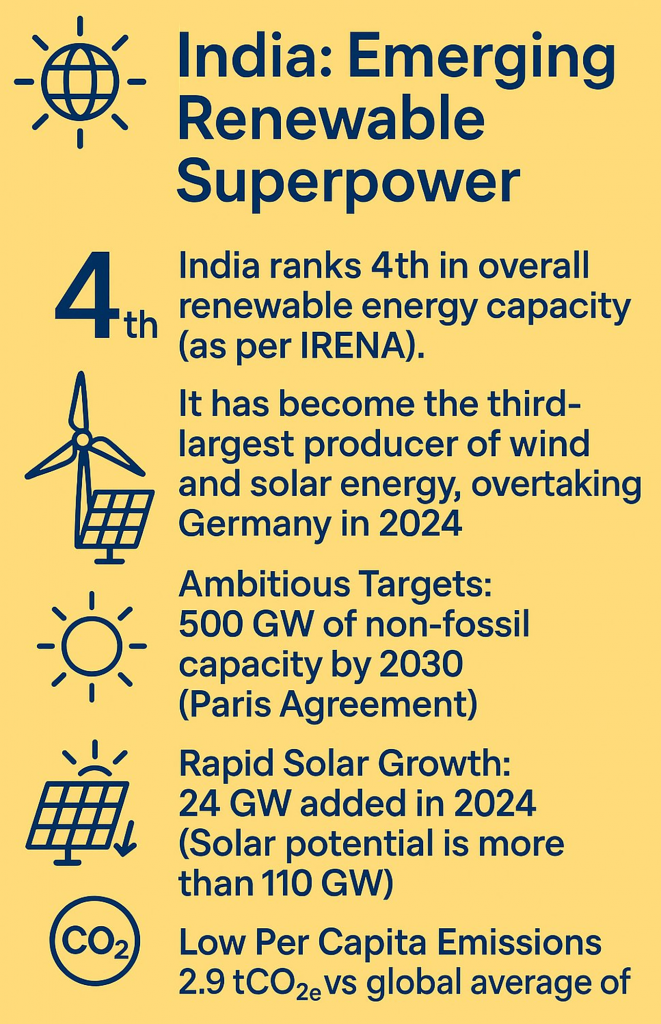
India’s Learning From China’s Green Energy Success
- Reducing Import Dependence: India slashed solar module imports from China by 76% in 2023.
- Imposed 40% customs duty on solar modules and 25% on solar cells;
- Boosted domestic manufacturing through the PLI scheme for solar and batteries;
- Strengthening Grid and Storage: Recognizing China’s early grid bottlenecks, India is investing in:
- Green Energy Corridors;
- Battery storage systems;
- Pumped hydro projects (51 GW expected by 2032).
- Decentralized and Inclusive Growth: Unlike China’s centralized SOE model, India is promoting:
- Rooftop solar through PM Surya Ghar Yojana;
- Agri-PV and PM-KUSUM for rural solar deployment;
- Hybrid tenders combining solar, wind, and storage for grid stability.
- Critical Minerals and Technology Independence: India is formulating a critical minerals framework to reduce reliance on China for lithium, cobalt, and rare earths.
- Exempted 12 critical minerals and 35 capital goods from import duties to support domestic innovation.
Previous article
Swachh Survekshan 2024-25 Rankings
Next article
News In Short 18-07-2025
