

Syllabus: GS3/Infrastructure; Cyber Security
Context
- As the world leans heavily into data-driven economies, India needs to safeguard its digital infrastructure and maritime interests as both a sovereign imperative and a technical necessity.
Global Overview of Undersea Cables
- Submarine cables are the silent arteries of the digital world, carrying over 99% of global internet traffic through these fiber-optic cables, supporting an estimated $10 trillion in financial transactions daily.
- These submarine cables are strategic assets essential for economic growth, national security, and geopolitical influence.
- 575+ active cable systems span the globe, covering over 1.4 million kilometers of ocean floor. (2024 Data).
- Compound Annual Growth Rate (CAGR): 5.6% (2025–30)
- Asia-Pacific Market Share: 38.6% (largest regional market).
Ownership & Infrastructure
- United States: Big Tech like Google owns 10,433 miles of cables directly and 63,605 miles in consortium. Facebook: 57,709 miles, Amazon: 18,987 miles, Microsoft: 4,104 miles.
- China: Belt and Road Initiative (BRI) to control global digital routes; China’s Digital Silk Road includes new systems like the Europe–Middle East–Asia cable.
- Chinese state-linked firms like China Telecom, China Unicom, and Huawei Marine are expanding aggressively across Asia, Africa, and Europe.
- India: India has only 14 Cable Landing Stations (CLSs) compared to 1,636 globally.
- It hosts 17 international subsea cables across 17 landing stations, with activation of new systems in 2025 expected to quadruple data transmission capacity.
Concerns & Challenges: Current Gaps in India’s Maritime & Cyber Strategy
- India’s Dependency: India’s undersea cable landscape is largely shaped by private players, expanding rapidly but unevenly.
- Critical chokepoints like the Luzon Strait and Malacca Strait pose enormous risks in times of crisis or conflict.
- India’s dependency on foreign vessels for cable laying and repairs exposes serious vulnerabilities in times of sabotage or war.
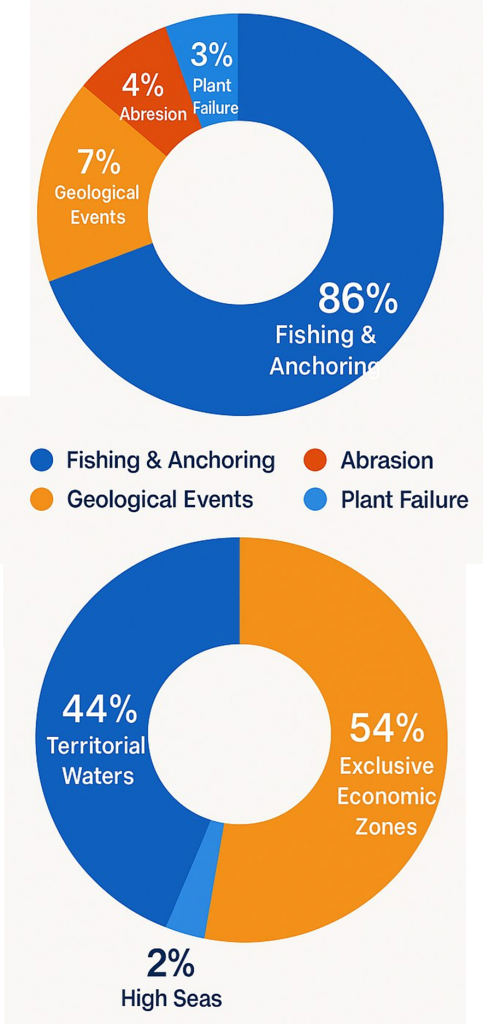
- Vulnerabilities & Disruptions: Nearly 200 faults per year occur on average across global subsea cable systems.
- India suffers 8–9 cable cuts annually, with repair costs reaching ₹15–20 crore per incident.
- India lacks its own flagged cable repair vessel (China has four to six cable repair vessels) and relies on foreign providers, causing 10–12 day delays in response time.
- Increasing Vulnerabilities: As geopolitical tensions rise, these cables become potential targets for espionage, sabotage, or disruption.
- Countries like China and Russia have shown strategic interest in cable networks, raising concerns over physical and cyber vulnerabilities.
- Subsea Cables as Strategic Assets: India’s internet connectivity relies on cables that land at hubs like Mumbai and Chennai.
- These cables, though mostly foreign-owned, handle enormous volumes of sensitive data — including government communications, financial transactions, and military logistics.
- Global Legal Vacuum: USA impose strict laws on submarine cable operations in their Exclusive Economic Zones (EEZs), however, international waters remain largely lawless:
- The United Nations Convention on the Law of the Sea (UNCLOS) only requires states to penalize cable damage by their flagged vessels.
- Enforcement relies on flag states—a major loophole, especially when state-sponsored actors are involved.
- International bodies like the ITU and ICPC offer only advisory guidelines and best practices, lacking real regulatory teeth.
Way Forward: Strategic and Legal Overhaul
- Expand Domestic Capabilities: Public sector shipyards should build India’s own cable repair fleet.
- Invest in tamper-proof design, deeper burial, and advanced encryption of cables.
- TRAI recommends a 10x expansion in India’s subsea cable infrastructure to meet rising demand.
- Strengthen Legal Framework: Amend laws to regulate all cable activities in India’s EEZ.
- Formally designate cables as Critical Information Infrastructure under the National Critical Information Infrastructure Protection Centre (NCIIPC).
- Enhance Monitoring and Defence: Use space and naval assets to track suspect vessels in the Indian Ocean.
- Accelerate development of underwater sensors, drones, and cable monitoring systems through the iDEX initiative.
- Build Strategic Redundancies: Develop redundant routes and new cable corridors.
- Cooperate with friendly navies—especially the QUAD (India, Japan, Australia, US)—for joint patrols and infrastructure protection.
- Establish a National Framework: Create a National Submarine Cable Security Framework, led by the National Security Council Secretariat, involving the Navy, Coast Guard, and private operators.
- National Cable Surveillance Program: Deploying autonomous underwater vehicles and satellite systems to track cable health and movement.
- Maritime Cyber Command: Creating a specialized unit that bridges defense, cyber, and telecom agencies for cohesive threat response.
Conclusion
- Submarine cables are no longer invisible infrastructure—they are the digital backbone of sovereignty and power.
- As geopolitical rivalries sharpen, India must recognize the strategic urgency of securing its undersea lifelines. Protecting them is not just about internet continuity — it’s about national survival in a hyper-connected world.
| Daily Mains Practice Question [Q] Discuss the strategic significance of submarine cables in the context of global geopolitics, with a focus on India’s vulnerabilities and policy imperatives. |
Previous article
Contesting the Future of Forest Governance
Next article
Discovering India’s Solar Goldmine
