


Syllabus: GS3/Energy
Context
- There is a need for data-driven reassessment of India’s solar energy potential to unlock investment, drive innovation, and accelerate the transition to net-zero emissions by 2070.
About Solar Power in India
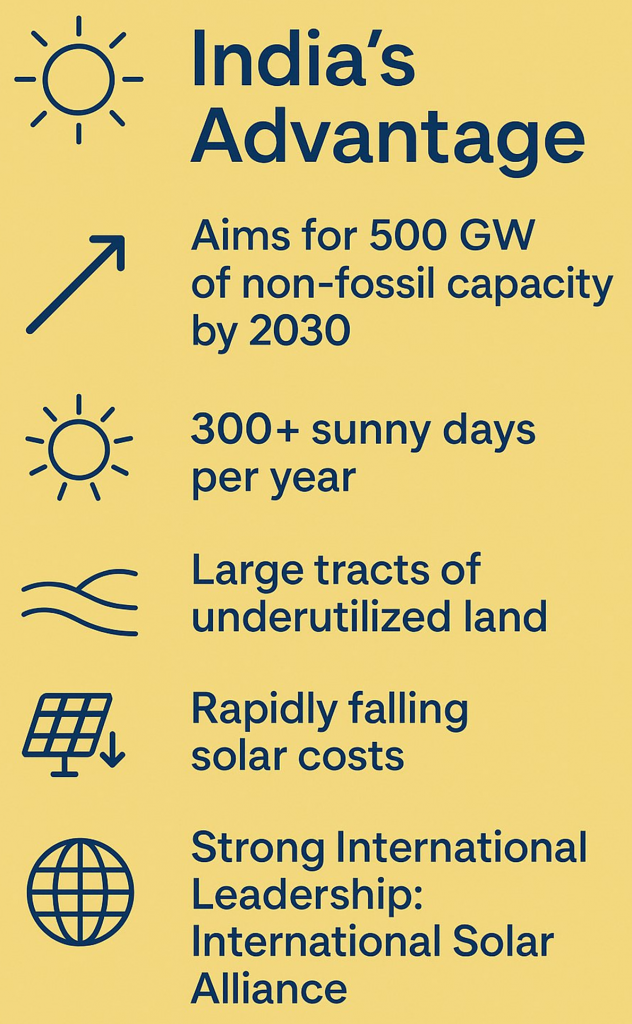
- India is rapidly emerging as a global leader in clean energy, with over 110 GW of installed solar capacity.
- India’s total renewable energy capacity reached 237.5 GW.
- India’s Solar Potential: According to The Energy and Resources Institute (TERI), India’s total solar potential is estimated at 10,830 GW. It includes:
- Ground-mounted solar on barren land: 4,909 GW;
- Agri-PV (on plantations): 4,177 GW;
- Rural and urban rooftop solar: 960 GW;
- Rail, road, and building-integrated PV: 684 GW;
- Floating solar PV: 100 GW;
- Global Comparison: According to the World Bank’s Global Solar Atlas:
- India ranks among the top countries with excellent solar PV conditions, with high irradiance and low seasonality.
- Namibia, Chile, Australia, and parts of the Middle East and North Africa boast high solar PV potential, often exceeding 4.5 kWh/kWp daily.
- China and the United States, while leading in installed capacity, have lower average solar irradiance compared to India.
| Global Solar Atlas (GSA) – It is a free, web-based tool developed by the World Bank’s Energy Sector Management Assistance Program (ESMAP) in collaboration with Solargis. – It provides high-resolution data and maps to assess solar energy potential across the globe, especially in developing countries. Key Features – Interactive Mapping: Zoom into any location worldwide with up to 1 km resolution. – Solar Resource Data: Includes Global Horizontal Irradiance (GHI), Direct Normal Irradiance (DNI), and PV power potential. – PV Calculator: Offers site-specific and regional assessments of photovoltaic energy generation. – Downloadable Maps: Country-specific poster maps and GIS layers for planning and analysis. – Hourly Profiles: Monthly summaries and 12×24 hourly averages for solar generation variability. |
Challenges in Harnessing India’s Solar Power Potential
- Outdated Estimates: India’s official solar potential estimate — 748 GWp — was based on 2010 wasteland data and 2011 census figures. It had limited strategic planning and investment in solar infrastructure.
- Lack of granular, geospatial data on irradiance, land use, and infrastructure proximity.
- Insufficient coordination between central and state agencies on siting and resource allocation.
- Changing India’s Land Use Pattern: Urbanisation, industrialisation, Agricultural land diversion and digitalisation are changing India’s land-use patterns.
- Grid Integration and Infrastructure Gaps: Transmission bottlenecks limit the evacuation of solar power from generation sites to consumption centers.
- Lack of smart grid systems hampers efficient load balancing and storage integration.
- Weak Domestic Manufacturing Ecosystem: India lacks backward integration in the solar value chain—no domestic production of wafers or polysilicon.
- Heavy reliance on imports, especially from China, and limited R&D and innovation in high-efficiency modules and recycling technologies.
- Low Adoption and Policy Barriers in Rooftop Solar: Net metering restrictions, bureaucratic delays, and inconsistent state policies discourage adoption.
- High upfront costs and limited access to concessional loans for small consumers.
Key Efforts and Initiatives
- Production Linked Incentive (PLI) Scheme: Launched to boost domestic manufacturing of high-efficiency solar PV modules.
- Solar Park Scheme: Aims to establish 50 solar parks with a cumulative capacity of ~38 GW by 2025–26.
- These parks attract investment and enable economies of scale.
- PM-KUSUM Scheme: Targets 30.8 GW of solar capacity by 2026 through decentralized solar for agriculture.
- Promotes indigenous manufacturing and rural energy access
- PM Surya Ghar: Provides up to 300 units of free electricity per month to 1 crore households via rooftop solar.
- ₹75,021 crore outlay includes subsidies, incentives for DISCOMs, and capacity building.
- Expected to add 20 GW of rooftop solar capacity.
- International Solar Alliance (ISA): India-led global initiative with 120+ member countries.
- Promotes solar deployment in developing nations, especially Africa.
- Programs include SolarX Startup Challenge, Green Hydrogen Innovation Centre, and Solar Data Portal.
- Grid and Storage Integration: Green Energy Corridor project enhances transmission infrastructure.
- Smart grid and energy storage solutions are being scaled to support intermittent solar supply.
- Policy and Regulatory Support: 100% FDI permitted under automatic route.
- Waiver of inter-state transmission charges for solar projects commissioned.
- Green Open Access Rules and net-metering reforms promote decentralized solar.
Way Forward: Utilising Full Potential Of Solar Energy
- Floating Solar PV (FSPV): It offers a solution to land scarcity and water body utilisation.
- Improved mapping of inland water surfaces, better understanding of regional evaporation losses, and localised performance data can unlock ~100 GW potential.
- Methodologies Reflecting Present-Day Realities: Modern, data-rich, and granular assessments need to incorporate solar irradiance and land gradient; proximity to substations and roads; ISRO’s remote sensing data; Global Solar Atlas & NREL radiation data and Transmission grid data from CEA.
- Economic Implications of Reassessing the Solar Potential: A robust demand pipeline will catalyse the solar panel recycling industry, especially for materials like silver, copper, and silicon.
- Attract larger domestic and foreign investments;
- Accelerate solar manufacturing ecosystems;
- Encourage production of cells, wafers, polysilicon, and metallurgical-grade silicon;
- Boost ancillary industries and generate thousands of green jobs
- Enabling Smarter Land and Resource Planning: It enhances India’s energy security and supports its vision of becoming a global solar hub. State and central governments can:
- Strategically allocate land, water, and transmission corridors;
- Promote shared infrastructure for roads, power lines, and worker townships;
- Achieve economies of scale and increase deployment efficiency.
- Global Leadership and Strategic Vision: India’s leadership in the International Solar Alliance and initiatives like ‘One Sun, One World, One Grid’ positions it to champion global solar transitions. A data-enabled approach will:
- Set new benchmarks for solar potential assessment;
- Drive equitable and sustainable energy access;
- Strengthen India’s role as a clean energy superpower
| Daily Mains Practice Question [Q] In what ways does the concept of ‘India’s Solar Goldmine’ reflect the country’s strategic potential in renewable energy, and how can it shape India’s role in global climate leadership? |
