

UNESCO World Heritage Status Granted to India’s 12 Maratha Forts
Syllabus: GS1/ History and Culture
Context
- UNESCO has added the ‘Maratha Military Landscapes of India’ — 12 iconic forts of the Maratha Empire — into the World Heritage List.
About
- This historic recognition was granted at the 47th Session of the World Heritage Committee in Paris.
- This marks India’s 44th UNESCO World Heritage Site, ranking the country 6th globally and 2nd in the Asia-Pacific region for the highest number of heritage sites.
About Maratha Forts
- Spread across the states of Maharashtra and Tamil Nadu, these sites include Salher, Shivneri, Lohgad, Khanderi, Raigad, Rajgad, Pratapgad, Suvarnadurg, Panhala, Vijaydurg, and Sindhudurg in Maharashtra, along with Gingee Fort in Tamil Nadu.
- Built between the 17th and 19th centuries, this extraordinary network of forts demonstrates the strategic military vision and architectural ingenuity of the Maratha Empire.
Major Forts of Chhatrapati Shivaji Maharaj
- Raigad Fort: It was the capital of the Maratha Empire from 1674 to 1818.
- It is located on a hilltop in the Sahyadri Mountains.
- Rajgad Fort: First capital of Shivaji Maharaj before shifting to Raigad.
- Pratapgad Fort: It is the site of the famous battle between Shivaji Maharaj and Afzal Khan in 1659.
- Sindhudurg Fort: It is located on an island off the Konkan coast.
- Vijaydurg Fort: It is known as the ‘Gibraltar of the East’ due to its strong coastal defense.
Source: PIB
Kailash-Mansarovar Yatra Resumes After Five Years
Syllabus: GS1/ Geography
In News
- The Kailash Mansarovar Yatra was resumed in June 2025 after a five-year suspension.
About
- Kailash-Mansarovar refers to the sacred region in southwestern Tibet encompassing Mount Kailash and Lake Manasarovar.
- Lake Manasarovar is one of the highest freshwater lakes in the world, situated at about 4,590–4,600 meters elevation in Ngari Prefecture, Tibet, just south of Mount Kailash.
Source: TOI
Sanchar Mitra Scheme
Syllabus: GS2/Governance
Context
- The Department of Telecommunications (DoT) has expanded its ‘Sanchar Mitra Scheme’ across India.
About
- Objective: To promote digital safety, cyber fraud prevention, responsible mobile usage, and electromagnetic field (EMF) radiation awareness through student volunteerism.
- Volunteer Engagement: Volunteers named Sanchar Mitras.
- Targeted students from telecom, electronics, computer science, and cybersecurity streams.
- Nominated via local Department of Telecommunications (DoT) offices.
- Training & Exposure: Provided by National Communications Academy–Technology (NCA-T) and DoT’s Media Wing.
- Focus areas: 5G, 6G, Artificial Intelligence (AI), cyber security.
- Incentives: Top performers may get internships, project work, and representation at events like India Mobile Congress and ITU conferences.
Source: PIB
Debate on UN Draft Declaration on Trans-Fatty Acids
Syllabus: GS2/ Health
In News
- The United Nations has circulated a draft declaration aiming to eliminate trans-fatty acids (TFAs) from global diets.
About
- Trans-fats, particularly industrially produced ones, are widely recognized as a major public health risk, linked to increased risk of heart disease and other non-communicable diseases.
- However, experts argue that a blanket elimination of all trans-fatty acids, without distinction between industrial and naturally occurring sources, could violate the rights of the world’s poorest populations to access affordable and nutrient-rich foods such as milk and meat.
Trans fats, or trans-fatty acids (TFAs)
- Trans fats are unsaturated fats that can be either naturally present in animal products or artificially produced in processed foods.
- Industrial Trans-Fats are produced from the partial hydrogenation of vegetable oils.
- Natural (Ruminant) Trans-Fat are found in dairy and meat from ruminant animals (cows, sheep, goats), and present in much lower quantities.
Source: TH
HtBt Cotton
Syllabus: GS3/ Agriculture
Context
- The Union Agriculture Minister said that the issue of herbicide tolerant BT cotton (HtBt) will be raised with the Union Environment Ministry as there are reports of farmers growing them illegally.
About
- HTBt cotton, also known as Herbicide Tolerant Bt cotton, is a genetically modified cotton variety that combines two important traits;
- Bollworm resistance: This is derived from the Bt (Bacillus thuringiensis) gene for resistance to bollworm pests.
- Herbicide tolerance: HTBt cotton is engineered to be resistant to the glyphosate, a widely used herbicide for weed control.
- Bt cotton was India’s first GM crop, introduced in 2002 (Bollgard I) and upgraded in 2006 (Bollgard II).
- HtBt cotton has not yet been approved by the Genetic Engineering Appraisal Committee (GEAC) for commercial cultivation.
- However it is illegally cultivated in states like Gujarat, Maharashtra, Andhra Pradesh, and Telangana.
Source: IE
RhoDIS India
Syllabus: GS3/Species in News
Context
- The Assam Forest Department has initiated DNA profiling of rhino horns, integrating the genetic data into the RhoDIS India DNA database to bolster efforts against wildlife crime.
About RhoDIS India programme
- It was started in 2016 as a collaboration among the Environment Ministry, the rhino-bearing States of India, the WII, and the World Wide Fund for Nature-India.
- The programme seeks to improve the crime investigations scientifically and provide technical support for the scientific management of India’s rhino population.
Great One-horned Rhinoceros
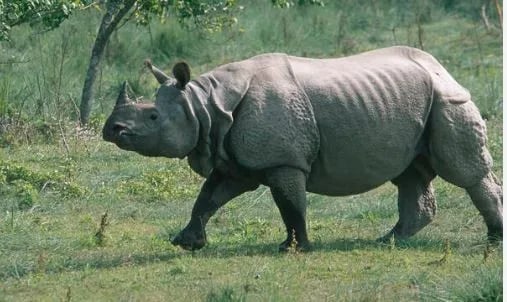
- The great one-horned rhino (or “Indian rhino”) is the largest of the rhino species.
- Appearance: Indian Rhinos are brownish-grey in colour and are hairless.
- Habitat: Grasslands and shrublands on the southern base of the Himalayas.
- Distribution: India, Pakistan, Bangladesh, Bhutan and Myanmar.
- In India, they are found in Assam, West Bengal and Uttar Pradesh.
- Conservation Status:
- IUCN Status: vulnerable.
- CITES: Appendix I (includes species threatened with extinction. Trade in specimens of these species is permitted only in exceptional circumstances).
Source: TH
Astra Missile
Syllabus: GS3/Defence
Context
- DRDO and the Indian Air Force have successfully conducted a flight-test of the indigenous Astra missile from a Sukhoi-30 MKI, engaging high-speed aerial targets off the coast of Odisha.
About the Astra Missile
- Developed by: Defence Research and Development Organisation (DRDO).
- Type: Advanced Beyond-Visual-Range Air-to-Air Missile (BVRAAM).
- Range: Capable of engaging aerial targets over 100 km away.
- Features:
- Advanced guidance and navigation systems for high precision.
- All-weather, day-and-night operational capability.
- Maximum speed: exceeds Mach 4.
- Operational ceiling: up to 20 km altitude.
- Significance: Enhances India’s indigenous air combat capabilities and aligns with Aatmanirbhar Bharat in defence production.
Source: TH
