
Artificial Intelligence (AI): Transforming the Manufacturing Landscape

Syllabus: GS3/Role of IT

Context

  • The manufacturing sector is undergoing a paradigm shift, powered not by steam or steel, but by smart algorithms and intelligent systems.

AI in Manufacturing
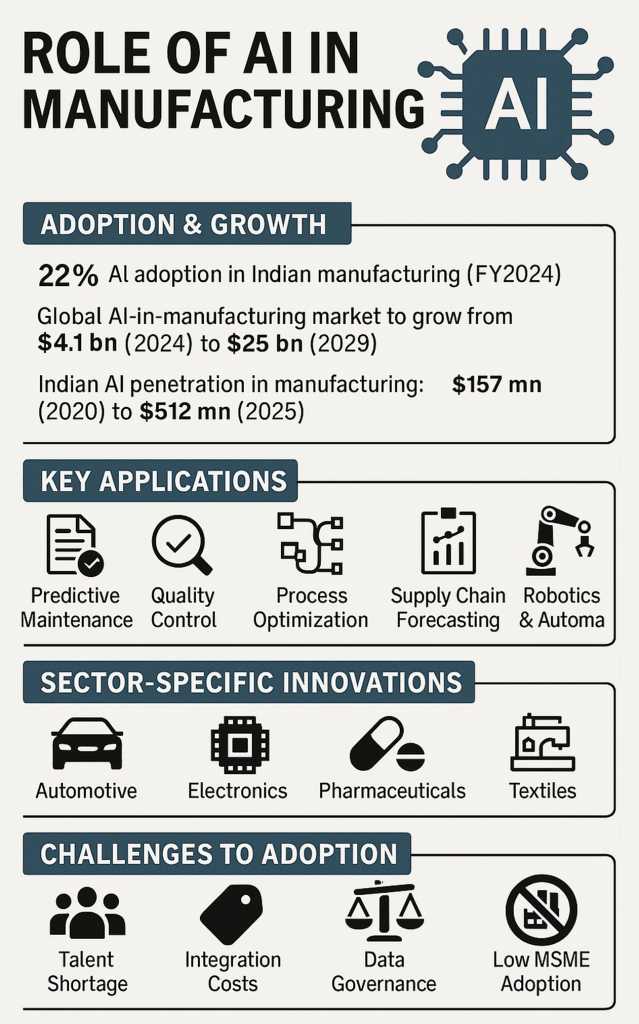
role of ai in manufacturing
  • AI is used to create a virtual replica of processes, production lines, factories and supply chains that are used to simulate, analyze and predict performance in real time.
  • AI is transforming operations from legacy facilities to state-of-the-art plants.
    • It enables higher output, lower waste, real-time adaptability, and smarter design.

Current Status & Projection

  • Globally, the AI-in-manufacturing market is poised to grow from $4.1 billion in 2024 to more than $25 billion by 2029.
  • In India, AI adoption in manufacturing jumped from 8% to 22% in just one year (FY2024).
    • Data and AI could add $450-$500 Bn to India’s GDP by 2025.

Key Applications of AI in Manufacturing

  • Predictive Maintenance: Reduces downtime by up to 30% using sensor data and machine learning (McKinsey).
  • Quality Control: AI vision systems detect micro-defects in real time.
  • Process Optimization: AI adjusts workflows dynamically to reduce waste and boost efficiency.
  • Supply Chain Forecasting: Enhances agility and responsiveness by over 20% (IBM).
  • Robotics & Automation: Cobots assist workers in repetitive or high-risk tasks, improving safety and productivity.
  • Sector-Specific Innovations:
    • Automotive: AI-powered robotics streamline assembly and inspection.
    • Electronics: Machine vision ensures precision in component assembly.
    • Pharmaceuticals: AI monitors large-scale production and ensures regulatory compliance.
    • Textiles: CAD/CAM systems optimize cutting, stitching, and inspection.

Challenges to Adoption

  • Talent Shortage: Need for upskilling in AI and machine learning.
  • Integration Costs: High initial investment slows adoption among MSMEs.
  • Data Governance: Concerns over transparency and explainability of AI models.
    • Reliable connectivity and cloud access remain uneven, especially in tier-2 and tier-3 cities.
  • Low MSME Adoption: Only about 15% of SMEs currently use AI in manufacturing.
  • Cautious Optimism: About 44% of manufacturing leaders hesitate to scale generative AI due to concerns about explainability and accuracy.

Government Initiatives

  • National Program on AI (MeitY): It promotes responsible AI use across sectors including manufacturing.
  • Samarth Udyog Bharat 4.0: Supports smart factory development and Industry 4.0 adoption.
  • IndiaAI Mission: ₹10,300 crore allocated to build AI infrastructure and indigenous models.
  • Centres of Excellence (CoEs): Focused on AI in healthcare, agriculture, education, and sustainable cities.

Source: TH


Other News of the Day

Syllabus: GS1/ Geography In News The seventh edition, Frontiers 2025: The Weight of Time – Facing a New Age of Challenges for People and Ecosystems, highlights emerging environmental threats and potential solutions. Key Highlights Heatwaves and Vulnerable Populations: Extreme heat events are increasing in frequency and severity, with older persons (65+) facing heightened mortality and...
Read More

Syllabus: GS3/ Security In News The Maharashtra Special Public Security (MSPS) Bill, 2024—commonly referred to as the ‘Urban Maoism’ Bill—was passed by the Maharashtra Assembly recently. Background and Rationale The Bill was introduced in response to the perceived inadequacy of existing laws (like the UAPA) to deal with the evolving tactics of Maoist organizations, which...
Read More

Syllabus: GS2/ Education Context The Union Education Minister inaugurated the two-day Vice-Chancellors’ Conference of Central Universities at Kevadia, Gujarat, to assess the implementation of the National Education Policy (NEP) 2020. Key Highlights of the Conference  Panch Sankalpa: It is the Five Guiding Resolutions of NEP 2020. Next-Gen Emerging Education,  Multidisciplinary Education,  Innovative Education,  Holistic Education,...
Read More

Syllabus: GS3/ Security,  Context India has reiterated its commitment to maritime safety and gender equality during the 134th session of the International Maritime Organization (IMO) Council, held in London. India’s Key Interventions at the 134th IMO Session Call for IMO-Led Investigation into Maritime Incidents: India highlighted recent accidents, which caused container losses, and release of...
Read More

Syllabus: GS1/ Society, GS1/ Human Geography In Context On 2025 World Population Day (July 11), the Population Foundation of India emphasized that India’s real challenge lies not in population size, but in justice, gender equity, and investing in human potential. Key Takeaways Shift the focus to reproductive rights, gender equality, and inclusive growth. Empower youth,...
Read More

Syllabus: GS3/Environment Context The Centre unveiled a scheme to provide financial incentives for purchase of electric trucks under the PM E-Drive initiative, where a sum of ₹500 crore has been set aside for 5,600 electric trucks. Of this financial outlay, a fifth is dedicated for vehicles registered in Delhi. About This is India’s first dedicated...
Read More

UNESCO World Heritage Status Granted to India’s 12 Maratha Forts Syllabus: GS1/ History and Culture Context UNESCO has added the ‘Maratha Military Landscapes of India’ — 12 iconic forts of the Maratha Empire — into the World Heritage List. About This historic recognition was granted at the 47th Session of the World Heritage Committee in...
Read More
scroll to top