


Syllabus: GS2/Governance/GS3/Infrastructure
Context
- The Prime Minister inaugurated the Rising North East Investors Summit 2025.
Summit Overview
- Objective: Position the North East Region (NER) as a land of opportunities for both domestic and global investors.
- Key Focus Sectors: Tourism & Hospitality, Agro-Food Processing, Textiles, Handloom & Handicrafts, Healthcare, Education & Skills, IT & ITES, Infrastructure & Logistics, Energy, Entertainment & Sports.
- Vision for North East: Emphasized the region’s crucial role in achieving a Developed India.
- Highlighted that the North East is transitioning from a frontier to a front-runner of growth.
- “EAST” Acronym: Empower, Act, Strengthen and Transform.
- Sectoral Opportunities: Urged investors to explore opportunities in Energy, Semiconductors, Eco-tourism, Bamboo and bio-economy.
- Tea, petroleum, sports, and skill development.
- Tourism Potential: The region is a complete tourism package, suitable for global conferences, destination weddings, and concerts.
- Infrastructure Development: Investment of thousands of crores in connectivity and infrastructure.
- Notable projects:
- Sela Tunnel (Arunachal Pradesh).
- Bhupen Hazarika Bridge (Assam).
- 11,000 km of new highways.
- Expansion of railways and airports.
- Waterways on Brahmaputra and Barak rivers.
- 1,600 km Northeast Gas Grid.
- Installation of hundreds of mobile towers.
North Eastern Region (NER)
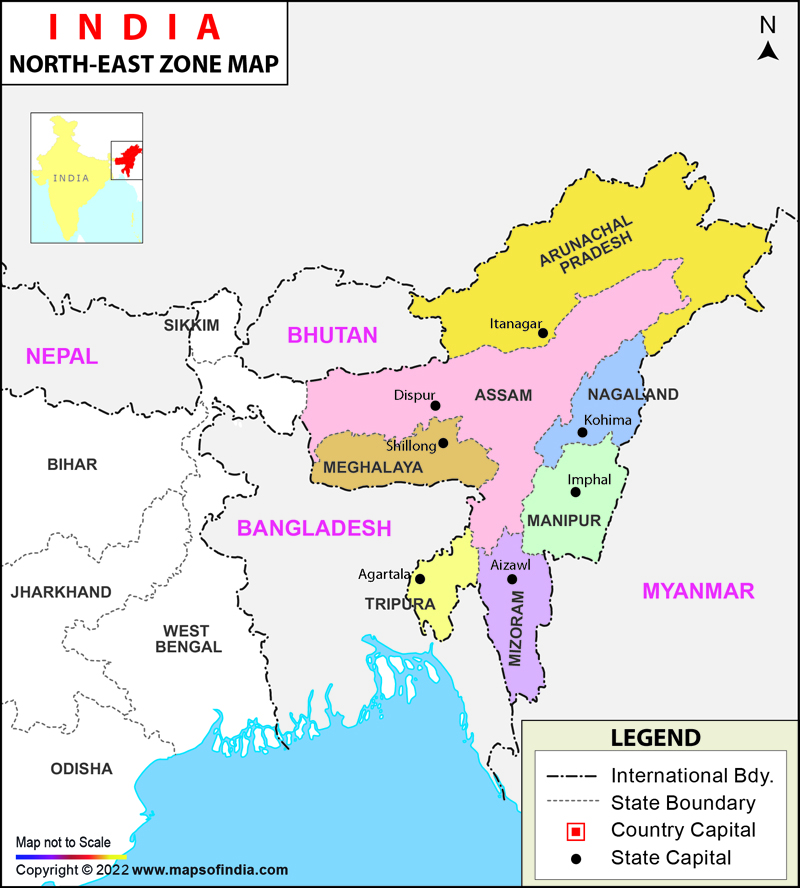
- The NER comprises eight States viz. Arunachal Pradesh, Assam, Manipur, Meghalaya, Mizoram, Nagaland, Sikkim and Tripura.
- This region is culturally and ethnically diverse having more than 200 ethnic groups which have distinct languages, dialects and socio-cultural identities.
- The Region covers 7.97% of the country’s geographical area and 3.78% of its population.
- It has 5,484 km of international border viz. Bangladesh (1,880 km), Myanmar (1,643 km), China (1,346 km), Bhutan (516 km) and Nepal (99 km).
Significance of the North East Region
- Geostrategic Significance:
- International Borders: The NER shares borders with five countries—China, Bhutan, Myanmar, Bangladesh, and Nepal which make it strategically important.
- Gateway to ASEAN: It is a critical link in India’s Act East Policy, serving as a bridge to Southeast Asia.
- Current India–ASEAN trade: ~$125 billion, projected to exceed $200 billion.
- Strategic Military Importance: Due to proximity to China, the region holds significant defense value for national security.
- Economic and Trade Potential:
- Cross-Border Trade: Projects like the Kaladan Multimodal Transit and India-Myanmar-Thailand Trilateral Highway boost trade with Southeast Asia.
- Untapped markets and natural resources make it ideal for early investors in sectors like energy, agriculture, tourism, and logistics.
- Health, Wellness & Tourism: Offers clean air, organic food, serene landscapes, and rich tribal cultures.
- Ideal for wellness tourism, eco-tourism, and adventure tourism.
- Rich cultural diversity (dance, music, festivals) promotes cultural diplomacy and soft power.
Challenges Faced by the Region
- Poor connectivity: Difficult terrain and underdeveloped road, rail, and air networks.
- Limited digital infrastructure: Though improving, internet and telecom connectivity are weaker compared to other parts of India.
- Insurgency and Internal Security Issues: Presence of militant groups and separatist movements in some areas.
- Cross-border infiltration and arms smuggling due to porous borders with Myanmar and Bangladesh.
- Although security has improved, periodic unrest still affects peace and progress.
- Geographic and Environmental Constraints: Hilly and forested terrain makes development of infrastructure and industries difficult and costly.
- Ethnic Tensions and Migration Issues : Inter-community tensions and demands for autonomy or separate states lead to uncertainty in the region.
- Illegal immigration from neighboring countries has altered demographics in some areas, creating social unrest.
Way Ahead
- Historically neglected, the northeast has gained prominence in recent decades.
- Its strategic value has increased due to India’s ‘Act East’ Policy and evolving Indo-Pacific geopolitical dynamics.
- The region is now seen as a vital gateway for India’s regional connectivity initiatives.
- Ongoing connectivity efforts require capacity-building for rail and road projects and improved border infrastructure.
- The overarching goal is to maximise the multi-dimensional potential of the northeast and cement its role as a regional connectivity hub.
Source: PIB
Previous article
News In Short-23-05-2025
