

Syllabus: GS3/Science & Technology
Context
- Recently, the Union Minister of State for Communications, at the Bharat 6G International Conference, said that India has emerged as one of the top six nations globally in 6G patent filings.
| India’s Leadership in 6G Patent Filings – 111+ funded research projects worth over ₹300 crore. – Global partnerships with Japan, Singapore, and Finland to accelerate innovation. – Breakthroughs in terahertz communication and AI-native networks. – The adoption of 6G is expected to create entirely new industries and revolutionize existing ones, potentially contributing US$ 1 trillion (Rs. 85,37,000 crore) to India’s economy by 2035. |
Bharat 6G Vision
- It aims to develop and deploy 6G infrastructure, ensuring India’s leadership in global digital connectivity by 2030.
- It aligns with broader policy goals that emphasize domestic innovation and international collaboration, and ensures that 6G technology remains affordable, scalable, and accessible, preventing digital exclusion and accelerating national development.
- Phased Approach to 6G Development:
- Research & Development (2023–2025): Focuses on developing foundational technologies, conducting pilot programs, and innovating new network architectures.
- Infrastructure Rollout (2025–2030): Supports large-scale deployment, ensuring seamless integration of advanced telecom solutions into India’s digital ecosystem.
Promise of 6G Technology
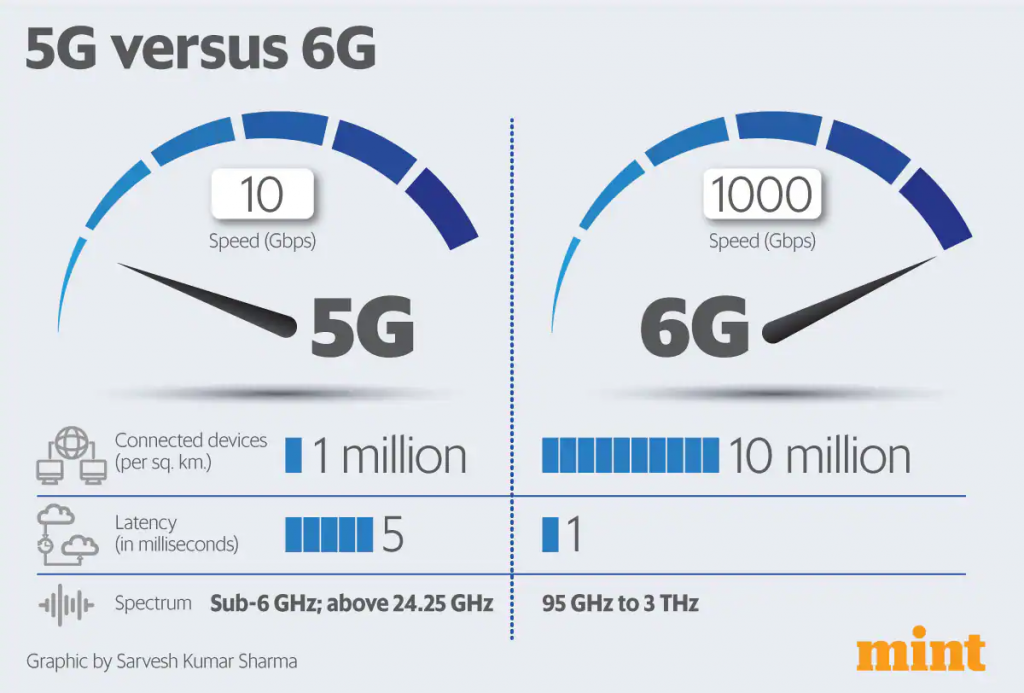
- Sub-millisecond latency for ultra-fast connectivity.
- Intelligent self-healing networks to enhance reliability.
- Volumetric connectivity, extending from underwater to aerospace applications.
- AI-native networks to enhance automation and efficiency.
- Terahertz communication breakthroughs for ultra-fast data transmission.
Technology Innovation Group on 6G (TIG-6G)
- It is a collaboration between industry leaders, academic institutions, and research organizations, established by DoT to drive innovation.
- It is responsible for drafting India’s 6G roadmap and shaping policies that aim to define India’s future telecom landscape.
Spectrum Allocation for 6G (IMT2030)
- India is actively engaged in global spectrum discussions, with the International Telecommunication Union (ITU) studying key frequency bands for IMT2030 (6G):
- 4400-4800 MHz
- 7125-8400 MHz
- 14.8-15.35 GHz
- The World Radiocommunication Conference 2027 will determine whether these bands will be formally identified for 6G deployment.
- India has already identified multiple frequency bands for IMT-based telecom services, including:
- 600 MHz, 700 MHz, 800 MHz, 900 MHz, 1800 MHz, 2100 MHz, 2300 MHz, 2500 MHz, 3300 MHz & 26 GHz
Oversight & Industry Collaboration
- A proposed Bharat 6G Alliance (B6GA) aims to further strengthen coordination among Indian industry leaders, researchers, and academic institutions, fostering a robust innovation ecosystem.
Previous article
Colombia Joins Belt and Road Initiative
Next article
Breakthrough in Making 2D Metals
