


Syllabus :GS 3/Science and Technology
In Context
- The National Geospatial Policy 2022 positions India as a global leader in geospatial technology, ensuring that location-based intelligence powers the nation’s progress and prosperity.
About National Geospatial Policy (NGP)
- It was announced by the Centre in 2022 and it replaces the National Map Policy, 2005.
- It builds on the Department of Science and Technology (DST) guidelines issued in February 2021.
- These guidelines deregulated the geospatial sector and liberalized the acquisition, production, and access to geospatial data.
- It outlines a strategic plan to develop geospatial infrastructure, services, and platforms at both national and sub-national levels.
- It aims to strengthen the location-centric industry to support the information economy.
- A key objective of the NGP is to establish a high-resolution topographical survey and mapping system by 2030, along with creating a highly accurate Digital Elevation Model (DEM) for the entire country.
- It aims to drive India toward its vision of a self-reliant “Viksit Bharat” by 2047.
| Do you know ? – Geospatial data are descriptions of events or occurrences with a location on or near the surface of the earth. – This location can be static – relating to earthquakes, vegetation, etc., or dynamic – a person walking on the road, a package being tracked, etc. – The location data obtained is usually combined with other characteristic attributes or recorded parameters to provide meaningful insights in the form of geospatial data. |
Features
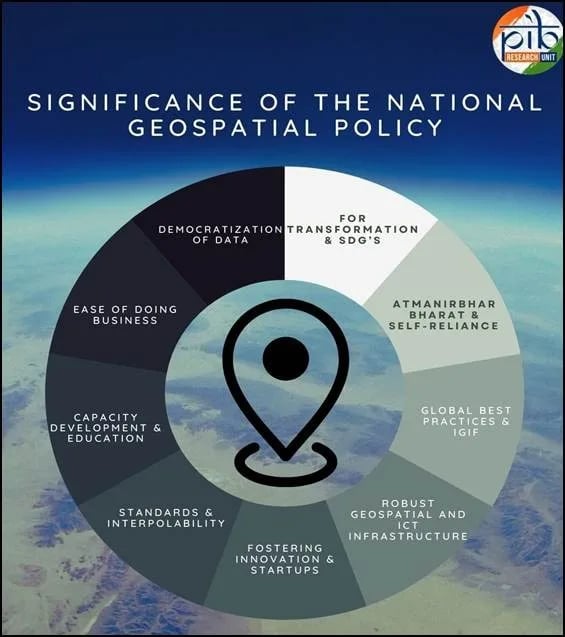
- It acknowledges the role of geospatial technology in governance, economic growth, and societal development.
- It promotes self-reliance by empowering Indian companies and reducing dependency on foreign geospatial data.
- It focuses on enhancing institutional frameworks, coordination, and a vibrant geospatial ecosystem.
- It emphasizes data-driven decision-making to modernize infrastructure and improve governance.
- It encourages open access to geospatial data and services via geospatial platforms.
- It is aligned with PM Gati Shakti, which aims to streamline infrastructure development across 16 Ministries.
Related Steps
- Operation Dronagiri: It was launched in 2024, as a pilot project to showcase geospatial technology applications in governance, business, and citizen services.
- Initially implemented in five states (Uttar Pradesh, Haryana, Assam, Andhra Pradesh, Maharashtra).
- It Integrates government, industry, and startups for geospatial innovation.
- It facilitates seamless access and sharing of geospatial data for urban planning, environmental monitoring, and disaster management.
Allocations and Trends from the Union Budget 2025
- The Government of India has allocated ₹100 crore for the National Geospatial Mission.
- This mission aims to develop foundational geospatial infrastructure and data, playing a crucial role in modernizing land records, urban planning, and infrastructure design
Conclusion
- The National Geospatial Policy 2022 is a significant step towards strengthening India’s geospatial ecosystem.
- By simplifying data access, promoting innovation, and fostering enterprise development, the policy is creating a robust and dynamic geospatial sector that supports governance, industry, and research.
Source :PIB
Previous article
National Science Day 2025
Next article
Nuclear weapons:‘One-Way Road to Annihilation’
