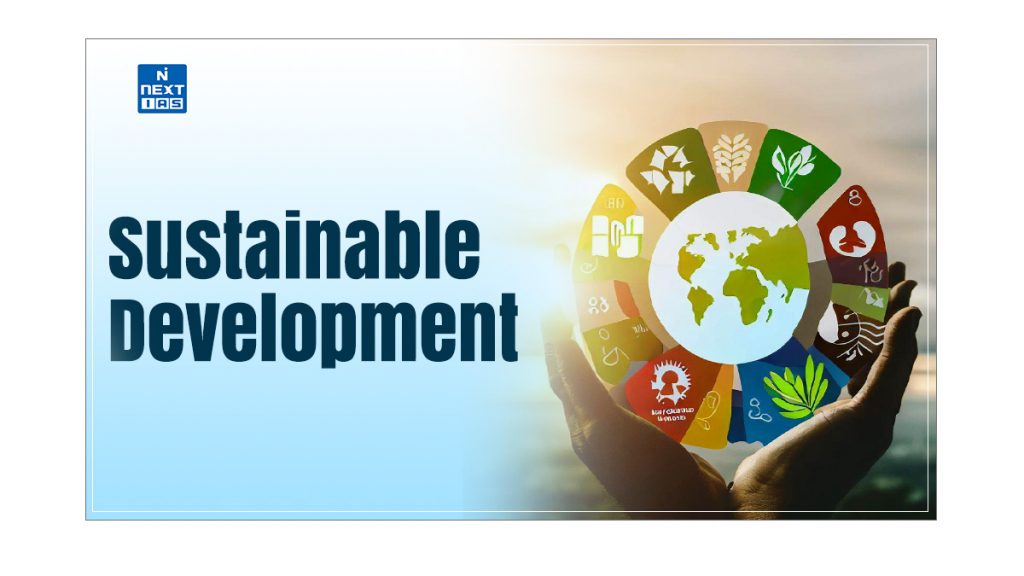
Sustainable Development refers to an approach to development that meets the needs of the present without compromising the ability of future generations to meet their own needs. Its significance lies in fostering long-term economic growth while ensuring social well-being and environmental protection. This article aims to study in detail the meaning, principles, and significance of sustainable development, highlighting the critical balance needed between development and environmental conservation.
Meaning of Sustainable Development
- “Sustainable Development” is a development that meets the needs of the present without compromising the ability of future generations to meet their own needs.
- The focus of sustainable development is far broader than just the environment.
- It’s also about ensuring a strong, healthy, and just society. This means meeting the diverse needs of all people in existing and future communities, promoting personal well-being and social inclusion, and creating equal opportunity.
- Sustainable Development has emerged as the guiding principle for long-term global development.
- Consisting of three pillars, it seeks to achieve balanced economic development, social development, and environmental protection.
Features
Sustainable development encompasses a range of features that aim to balance economic growth, social equity, and environmental protection. Some key features are:
- Intergenerational Equity: Ensures that the needs of the present are met without compromising the ability of future generations to meet their own needs.
- Integration of Environment and Development: This policy promotes the integration of environmental considerations into economic and social policies, recognizing that healthy ecosystems are vital for sustainable development.
- Inclusive Economic Growth: Focuses on creating economic opportunities that benefit all segments of society, reducing inequality and ensuring that economic benefits reach marginalized communities.
- Social Inclusion and Equity: Emphasizes the importance of social equity, aiming to ensure that all individuals have access to essential services, resources, and opportunities, regardless of their background.
- Sustainable Resource Management: Advocates for the responsible use of natural resources, promoting practices that ensure their availability for future generations while minimising waste and environmental degradation.
- Participatory Governance: Encourages stakeholder participation in decision-making processes, ensuring that the voices of local communities are heard and considered in development planning.
- Resilience and Adaptability: This promotes the development of systems that can withstand environmental, economic, and social shocks, enhancing communities’ ability to adapt to changing circumstances.
- Technological Innovation: Encourages using sustainable technologies and practices that improve efficiency, reduce environmental impact, and enhance the quality of life.
Read our detailed article on Sustainable Development Goals (SDGs).
Objectives
The aim of sustainable development are as follows:
- Their primary goal is to completely wipe out poverty while taking care of basic needs and providing individuals with good chances for self-improvement.
- They intend to create economic growth that is environmentally friendly and to develop the cities which will not only be good for the inhabitants but good to the environment and also help cope with the climate change.
- Equality in access to all resources, services, and opportunities will be guaranteed for everyone.
- They will also work towards making the world more eco-friendly and less dependent on fossil fuels by promoting clean energy.
- Emphasis will be on reducing waste and encouraging sustainable consumption and production patterns.
- Moreover, they will make the world a better place to live by developing urban areas that are inclusive, safe, resilient, and sustainable.
- Education will be inclusive and equitable in quality, and opportunities for lifelong learning will be given to everyone so that they will gain the skills and knowledge for living in a sustainable way.
- Striving for similar goals all over the world, the partnership will focus on joining forces among the governments, civil society, and the private sector to reach the sustainable development objectives.
- The health of various age groups will be taken care of along with wellness promotion through the combating of health disparities and making the healthcare essentials more accessible. ll-being for all ages, addressing health disparities and improving access to essential healthcare services.
Need and Importance of Sustainable Development
- The earth is our common home, and our survival and development depend on the resources provided by the environment. However, these environmental resources are limited.
- Despite increasing human needs, the earth cannot be made bigger and richer to supply our growing demands.
- Our development activities should be enabled to continue growth in the long term; future generations must get what we have. Consequently, we must prudently use resources to let our generation live comfortably.
- Sustainable development is necessary and important to balance our economic, environmental, and social needs, allowing well-being for now and future generations.
- Sustainable development encourages us to conserve and enhance our resource base by gradually changing how we develop and use technologies.
- Countries must be allowed to meet their basic needs of employment, food, energy, water, and sanitation.
- This implies ways in which development activities do not damage the environment. It undoubtedly sets certain limits on human activities. It must be understood that when supply cannot be increased, needs must be reduced.
Principles of Sustainable Development
The relevant bodies of the United Nations have formulated, clarified and adopted the basic principles at the highest levels. They are as follows:
- Holistic Approach: Most systems are interrelated elements that interact with one another. Any intervention may trigger ripple effects, even in remote systems. Relying on knowledge of the wider environment and global trends can adequately address local challenges.
- Social Justice: The right to adequate living conditions must be recognised, and fundamental human rights must be guaranteed. All people should have equal opportunities to acquire the knowledge and skills required to become worthy members of society.
- Inter- and Intra-generational Equity: Sustainable development interests are focused on people. The development and environmental needs of present generations must be addressed without compromising the ability of future generations to meet their own needs.
- Sustainable Resource Management: Sustainable resource management must consider the environment’s carrying capacity limitations. Biodiversity is also a natural resource, and we prioritise its conservation.
- Integration: To elaborate, evaluate, and implement sectoral policies, plans, and programmes, economic, social, and environmental considerations and their relationships must also be considered to ensure they mutually reinforce each other. Moreover, local, regional, and national activities must be coordinated.
- Utilization of Local Resources: Efforts should be made to supply communities’ needs on a local level from locally available resources. Local features and diversity should be preserved. Preservation and sustainable utilisation of the man-made environment and cultural heritage are also essential tasks.
- Social Responsibility: Unsustainable production and consumption patterns must be changed to enable sustainable development and ensure a higher quality of life. Businesses’ social responsibility and cooperation between the private and public sectors must also be strengthened.
- Public Participation: All must have adequate access to information affecting social and economic life and the environment. In addition, information on decision-making processes must be made available to the public.
- Polluters Pay Principle: Prices must reflect the real costs paid by society for activities involved in consumption and production and for their impacts, including the costs of using natural resources. Those engaged in activities that damage or pollute the environment must pay for damage caused to human health or the environment.
- Precaution and Prevention: Wherever the possibility of severe or irreversible damage is perceived, a lack of complete scientific certainty should not be used as an excuse for delaying effective action to prevent damage to the environment or endangering human health. Action must be taken in view of the gravity of the perceived threat.
Components
Sustainable development is often referred to as the marriage of economy and ecology, i.e. to attain economic growth without compromising the ecological balance. Some of the components of sustainable development are as follows:
- Environmental: Environmental sustainability deals with the carrying capacity of natural resources.
- It emphasises increasing forest cover, conserving biodiversity hot spots, protecting watersheds, and adopting a holistic approach.
- Environmental-friendly technologies should also be encouraged to mitigate local to global-level environmental problems such as climate change and biodiversity loss.
- Economic: Economic sustainability emphasises promoting self-sustaining development projects through adequate and transparent budgeting.
- It should alleviate poverty, increase per capita income, promote income-generating activities, including off-farm employment and green micro-enterprises, and establish a mechanism for fair benefit sharing.
- Prudence and equity should be considered when building a sustainable economy. However, considering only economic aspects may not promote sustainability.
- Social: Social sustainability focuses on public participation in developmental activity and fulfilling basic human needs, such as better education and improved health facilities.
- These can be ensured by increasing environmental awareness and through the capacity development of local communities, with an eye on economically and socially disadvantaged groups. Also, indigenous communities shall be made aware of sustainable ways of resource utilisation.
Sustainable Development in India
- The concept of sustainable development in India aims at a tripartite balance of economic growth, social inclusion and environmental protection.
- The approach is to satisfy current needs without affecting the needs of the future generations.
- India is successful in getting rid of poverty, improving health and education and providing access to clean drinking water.
- The renewable energy capacity is growing very fast and the social protection of more people is becoming a reality. But, still, there are challenges to tackle like reducing inequality, the sustainable management of natural resources and climate change.
- According to the 2025 SDG Index, India holds the 99th position out of 193 countries, which denotes a considerable uplift but also points to the necessity of the ongoing efforts to meet the United Nations Sustainable Development Goals by 2030.
Advantages
Sustainable development offers numerous advantages that contribute to the well-being of individuals, communities, and the planet. Some key benefits are:
- Environmental Protection: Sustainable development promotes the responsible use of natural resources, helping to protect ecosystems, conserve biodiversity, and reduce pollution.
- Economic Growth: By fostering sustainable industries and practices, it encourages innovation and job creation, leading to long-term economic stability.
- Social Equity: It aims to reduce inequalities by ensuring that all communities have access to resources, opportunities, and services, promoting social justice and inclusivity.
- Improved Quality of Life: Sustainable development focuses on enhancing living standards, providing access to clean water, healthcare, education, and safe housing.
- Resilience to Climate Change: It encourages adaptive strategies that help communities and ecosystems cope with the impacts of climate change, reducing vulnerability and enhancing resilience.
Strategies for Sustainable Development
- India’s approaches for sustainable development prioritize decarbonization, green energy expansion, and inclusive economic growth.
- The main activities include the use of renewable energy (solar, wind, and green hydrogen), bettering the energy efficiency, and the application of low-carbon technologies.
- Eco-friendly industries are encouraged by the Government schemes such as the Green Credit Programme (2025), National Solar Mission, and Production-Linked Incentives for clean tech.
- Sustainable agriculture is promoted which leads to crop diversification, regenerative farming, and water conservation, thus making the rural areas more resilient.
- Efforts go on the same lines with green infrastructure, waste management, and urban sustainability.
- These strategies facilitate India in the quest of reaching the net-zero target by 2070 and also assist in the implementation of the UN 2030 Sustainable Development Agenda.
Environment Development Trade-off
- Environment and Development are closely related issues. Inclusive development is only possible with adequate emphasis on environmental protection. Development and environment need to be seen as complementary and not antagonistic terms.
| – In the development process, we have failed to recognize that poverty and environmental damage are interlinked. We can’t lift people out of poverty if we don’t conserve the environment and the natural resources they rely on. Similarly, we can’t protect the environment if we don’t address the needs of people in poverty. – The poor depend most on natural resources for their livelihoods and suffer most from the impacts of climate change, deforestation, and other environmental problems. – Environment and development issues can’t be separated. The results of destroying rainforests ultimately lead to the removal of shelters for the native people, with only slums left to reside in. |
- The debate between environment and development is more intense now as India is on an ambitious growth path, due to which there is less regard for people’s rights and existing natural resources.
- Many countries have pushed forward their economies by developing national industries.
- However, there is a concern that the economic targets are being attained at the expense of the ecosystems. Admittedly, some countries may place economic developments ahead of environmental protection, thus ruining the local environment.
- As these needy countries lack adequate financial and human resources, advanced technologies, and experience, they have to rely on natural resources to maintain their living standards. Besides, people in poverty-stricken areas are not likely to be equipped with knowledge to preserve ecosystems.
- As a result, unchecked and reckless uses of local raw materials may occur, which can strain natural resources. In this view, economic development and environmental protection can be conflicting.
- Economic growth was regarded as central to development endeavours up until the 1980s. Gradually, development came to be interpreted as a multidimensional concept that should encompass material, social, environmental, political, and cultural components.
- However, it is not necessary that development always come at the expense of the environment. Many developed countries set perfect examples of progress made while considering environmental factors as well. For example, the compliance costs incurred by U.S. manufacturers for pollution control and abatement are among the highest in the world.
- There are commonly several trade-offs between the environment, food security and other aspects of development. Some of the trade-offs are avoidable, but others are not.
- The underlying issues were clarified and brought into prominence by the Brundtland Commission. Its report emphasised the difficult task of reconciling the short-term imperative of increasing food and agricultural production as well as incomes for the current generation with the longer-term, but almost unspecifiable, need to conserve natural resources to meet the requirements of future generations (World Commission on Environment and Development, 1987).
- Thus, while the long-term objective may be the sustainable development of agriculture and the whole economy, the pathways or processes involved may have to breach the environmental requirements of this goal in the short to medium term. Hence, it is vital to minimise the trade-offs.
Conclusion
In today’s society, while we recognise our reliance on Earth’s resources, we often overlook the deep connection between the economy and the environment. Unlimited economic growth is unsustainable due to the finite nature of these resources, and ignoring this will jeopardise the future. Pursuing material wealth has damaged the environment, but developing countries can balance coal with renewable energy in the short term. A global coalition for clean coal technology, alongside increasing renewable energy use, is crucial for climate change mitigation and sustainable development. Ultimately, we must take responsibility for fostering a more sustainable world.
FAQs
Why is the issue of sustainability important for development?
Sustainability is crucial for development as it ensures that resources are used responsibly, minimizes environmental impact, promotes social equity, and fosters economic stability, ultimately leading to a healthier planet and society for future generations.
How many sustainable development goals are there?
There are 17 Sustainable Development Goals (SDGs).