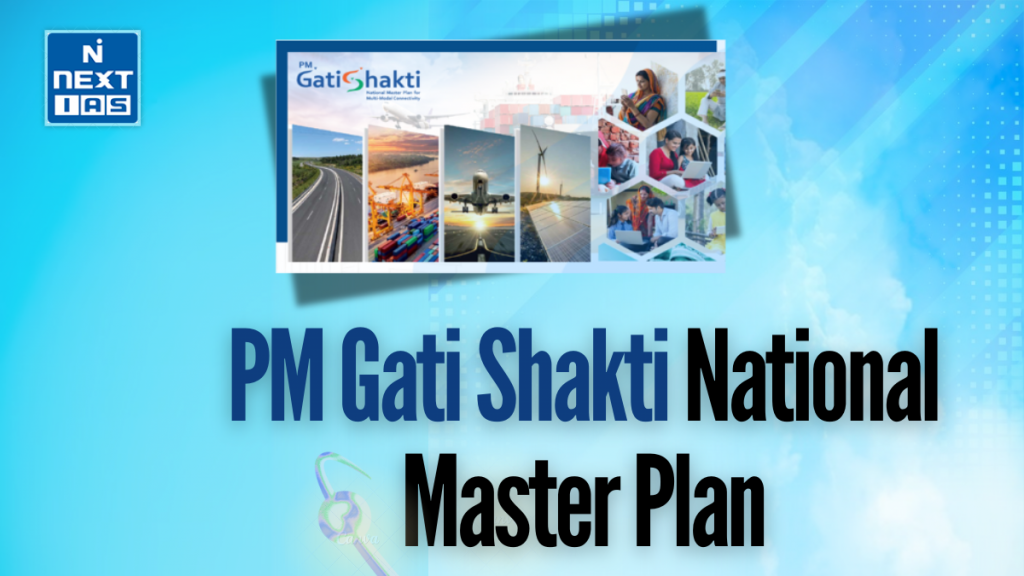
PM Gati Shakti National Master Plan is a transformative initiative to enhance India’s infrastructure through integrated planning and coordinated implementation across various sectors. It aims to boost multimodal connectivity, reduce logistics costs, and improve efficiency by leveraging technology, GIS-based mapping, and inter-ministerial collaboration for seamless infrastructure development and economic growth.
About the PM Gati Shakti National Master Plan
- PM Gati Shakti is an approach for growth accelerating trustworthy infrastructure through synchronized, holistic, integrated, and comprehensive planning based on knowledge, technology and innovation.
- This requires ministries to facilitate the relevant stakeholders including public and private entities which need various central/state approvals and NOCs (No Objection Certificates) to set up infrastructure projects.
- Under the vision for Gati Shakti, these approvals and NOCs should be available on a common portal for investors without any need to go to separate platforms to avail such approvals.
- As such the National Single Window System has been entrusted with the task of onboarding critical approvals and NOCs from a set of 9 ministries for end-to-end application and subsequent approval.
- Based on the information shared by the ministries, more than 427 approvals and NOCs have been mapped onto a Know Your Approvals (KYA) module for applicants to understand the list of approvals that they need for their infrastructure projects under PM Gati Shakti.
Pillar of the PM Gati Shakti National Master Plan
PM Gati Shakti is based on six pillars:
- Comprehensiveness: It will include all the existing and planned initiatives of various Ministries and Departments with one centralized portal. Each and every Department will now have visibility of each other’s activities providing critical data while planning & execution of projects in a comprehensive manner.
- Prioritization: Through this, different Departments will be able to prioritize their projects through cross-sectoral interactions.
- Optimization: The National Master Plan will assist different ministries in planning for projects after identification of critical gaps. For the transportation of the goods from one place to another, the plan will help in selecting the most optimum route in terms of time and cost.
- Synchronization: Individual Ministries and Departments often work in silos. There is lack of coordination in planning and implementation of the project resulting in delays. PM Gati Shakti will help in synchronizing the activities of each department, as well as of different layers of governance, in a holistic manner by ensuring coordination of work between them.
- Analytical: The plan will provide the entire data at one place with GIS based spatial planning and analytical tools having 200+ layers, enabling better visibility to the executing agency.
- Dynamic: All Ministries and Departments will now be able to visualize, review and monitor the progress of cross-sectoral projects, through the GIS platform, as the satellite imagery will give on-ground progress periodically and progress of the projects will be updated on a regular basis on the portal. It will help in identifying the vital interventions for enhancing and updating the master plan.
Objectives of the PM Gati Shakti National Master Plan
- PM GatiShakti aims to create Next Generation Infrastructure by learning from the past.
- PM GatiShakti National Master Plan is as an integrated plan which will address the missing gaps to ensure seamless movement of people, goods & services.
- It aims to enhance ease of living, ease of doing business, minimize disruptions and expedite completion of works with cost efficiencies.
- PM GatiShakti will help in achieving the objective of an ‘Aatmanirbhar Bharat’ by providing visibility to various stakeholders.
- Instead of planning & designing separately in silos, the projects will be designed and executed with a common vision.
- It will incorporate the infrastructure schemes of various Ministries and State Governments like Bharatmala, Sagarmala, inland waterways, dry/land ports, UDAN.
- Economic Zones like textile clusters, pharmaceutical clusters, defence corridors, electronic parks, industrial corridors, fishing clusters, agri zones etc. will be covered to improve connectivity & make Indian businesses more competitive.
- This will boost economic growth, attract foreign investments and enhance the country’s global competitiveness.
Significance of the PM Gati Shakti National Master Plan
- The PM Gati Shakti National Master Plan is a revolutionary initiative aimed at transforming India’s infrastructure landscape by enhancing multimodal connectivity and reducing logistical inefficiencies. Launched to accelerate economic growth, it integrates various modes of transport, including roads, railways, waterways, and airways, through a unified digital platform.
- One of the key significances of this initiative is its potential to reduce logistics costs, which currently stand at around 13–14% of GDP—higher than global benchmarks. By optimizing planning and implementation, the policy aims to bring down costs and improve India’s competitiveness in global trade.
- Additionally, PM Gati Shakti promotes inter-ministerial coordination, eliminating delays and ensuring timely completion of projects. With GIS-based mapping, various ministries can synchronize their efforts, preventing cost overruns and redundant infrastructure development. This enhances efficiency, benefiting industries such as manufacturing, agriculture, and exports.
- The plan also fosters sustainable and environmentally friendly infrastructure by encouraging the use of green energy and smart technologies. Moreover, it supports the vision of Atmanirbhar Bharat (Self-Reliant India) by strengthening supply chains and enhancing domestic production capabilities.
- For businesses, improved infrastructure means faster movement of goods, reduced transit time, and better market access. It particularly benefits small and medium enterprises (SMEs) and rural industries by connecting them to national and global markets.
Lacunae of the PM Gati Shakti National Master Plan
- The PM Gati Shakti National Master Plan is a significant initiative for infrastructure development and multimodal connectivity. However, it faces several challenges and shortcomings.
- Firstly, coordination and implementation bottlenecks remain a concern. Despite the plan’s emphasis on inter-ministerial collaboration, bureaucratic delays, overlapping responsibilities, and inefficiencies in execution could hinder progress. The success of the initiative relies on seamless coordination among various stakeholders, including central and state governments, which has historically been a challenge.
- Secondly, funding constraints pose a major issue. While the plan aims to integrate existing projects, large-scale infrastructure development requires substantial financial resources. Given India’s fiscal limitations, mobilizing adequate investments, especially from private players, remains uncertain.
- Thirdly, technological and data-related challenges could impact the plan’s effectiveness. The initiative relies on GIS-based mapping and digital platforms for real-time monitoring, but ensuring the accuracy, security, and standardization of such data across different departments is a complex task.
- Moreover, land acquisition and environmental clearances continue to be significant hurdles. Infrastructure projects often face delays due to land disputes, rehabilitation concerns, and environmental regulations, which may slow down implementation despite the plan’s integrated approach.
- Lastly, regional disparities could persist if the focus remains on high-priority economic corridors, potentially neglecting underdeveloped regions. Ensuring equitable infrastructure development across all states and rural areas will be crucial for inclusive growth.
PM Gati Shakti National Master Plan for UPSC CSE Prelims
- Launch Year – 2021
- Objective – Integrated infrastructure development for seamless multimodal connectivity.
- Approach – GIS-based digital platform for coordinated planning across ministries.
- Focus Areas – Transport, logistics, energy, IT, and urban planning.
- Key Targets – Reduce logistics costs, improve supply chain efficiency, and boost economic growth.
- Components – Includes roads, railways, ports, airports, waterways, and mass transport.
- Institutional Mechanism – Involves coordination between Central, State, and local governments.
- Data Integration – Uses satellite imagery and real-time updates for better planning.
- Benefits – Faster project approvals, reduced delays, better resource utilization.
- Related Policies – Supports initiatives like Make in India, Digital India, and National Logistics Policy.
Way Forward
The way forward for PM Gati Shakti National Master Plan includes strengthening digital integration, enhancing private sector participation, accelerating multimodal infrastructure development, and streamlining regulatory approvals. Focus on sustainability, real-time data analytics, and skill development will further optimize logistics efficiency, reduce costs, and drive India’s economic growth and global competitiveness.
Conclusion
PM Gati Shakti National Master Plan aims to revolutionize infrastructure development by ensuring seamless coordination, reducing costs, and enhancing logistics efficiency. By integrating technology and multi-modal connectivity, it fosters economic growth, attracts investment, and strengthens India’s global competitiveness, ultimately driving sustainable and inclusive development across various sectors.