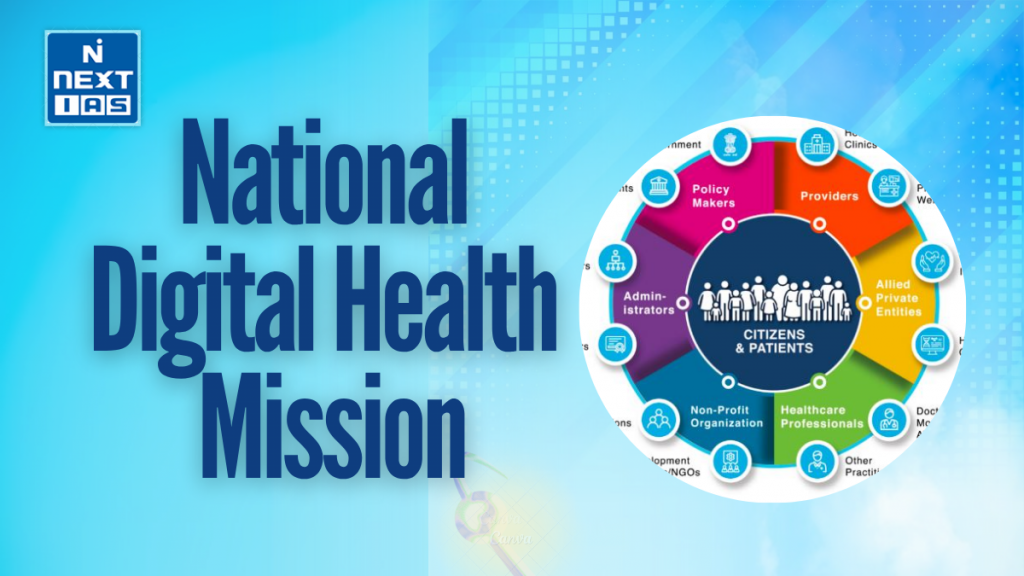
National Digital Health Mission is a visionary initiative to transform the Indian healthcare system through digital integration. It shall give the facility of a Health ID to each citizen so that they may access their medical records seamlessly and help healthcare delivery in the country on the basis of efficiency, transparency, and inclusivity.
About The National Digital Health Mission (NDHM)
The National Health Policy (NHP) 2017 has the following goal:
- Achieving the highest possible level of health and well-being for all at all ages through a preventive and promotive approach to health in all developmental policies, so that a person can enjoy universal access to good quality healthcare services without the threat of financial hardship.
- In furtherance of the objective for digital technologies adopted by the NHP, the Ministry of Health and Family Welfare attracted a committee under the chairmanship of Shri J. Satyanarayana to build an implementation framework for the National Health Stack.
- The committee came out with the National Digital Health Blueprint which articulated the building blocks and an action plan for the comprehensive and holistic implementation of digital health.
- Being a follow-up of the NDHB, this document describes the broad context, rationale, scope, and implementation arrangements for creating a digital ecosystem for healthcare services throughout the country.
- Since implementation is foreseen in mission mode, the program is named National Digital Health Mission (NDHM).
Features of The National Digital Health Mission (NDHM)
Unique Health ID
- Each citizen is given a unique Health ID, thereby providing him/her with a digital health account to store and share medical records securely.
Digital Health Records
- Individuals can store and access their health records from anywhere and share such EHRs with a healthcare provider for uninterrupted treatment of a patient across different healthcare provider facilities.
Healthcare Professionals Registry (HPR)
- This option creates a database of all doctors, nurses, and other healthcare professionals and provides verified practitioners to the public.
Healthcare Facilities Registry (HFR)
- Registering all the hospitals, clinics, and diagnostic centers digitally allows citizens to trace nearby healthcare facilities easily.
Telemedicine and e-Pharmacy Integration
- The mission promotes a teleconsultation service and e-pharmacies that offer remote access to doctors and medicines, thereby enhancing healthcare accessibility to the rural population.
Interoperability and Data Security
- NDHM ensures secure data exchange of information between patients, hospitals, and insurers based on consent mechanisms, protecting the data’s privacy and confidentiality.
Unified Health Interface (UHI)
- A common platform for various healthcare applications, ensuring seamless interaction between different digital health services.
Paperless and Cashless Healthcare
- By integrating with schemes like Ayushman Bharat, NDHM promotes cashless healthcare services, reducing administrative burdens.
Objectives of National Digital Health Mission
To strengthen the accessibility and equity of health services, including continuum of care with citizen as the owner of data, in a holistic healthcare programme approach leveraging IT & associated technologies and support the existing health systems in a ‘citizen-centric’ approach, the NDHM envisages the following specific objectives:
- To establish state-of-the-art digital health systems, to manage the core digital health data, and the infrastructure required for its seamless exchange;
- To establish registries at appropriate level to create single source of truth in respect of clinical establishments, healthcare professionals, health workers, drugs and pharmacies;
- To enforce adoption of open standards by all national digital health stakeholders;
- To create a system of personal health records, based on international standards, easily accessible to individuals and healthcare professionals and services providers, based on individual’s informed consent;
- To promote development of enterprise-class health application systems with a special focus on achieving the Sustainable Development Goals for health;
- To adopt the best principles of cooperative federalism while working with the States and Union Territories for the realization of the vision;
- To ensure that the healthcare institutions and professionals in the private sector participate actively with public health authorities in the building of the NDHM, through a combination of prescription and promotion;
- To ensure national portability in the provision of health services;
- To promote the use of clinical decision support (CDS) systems by health professionals and practitioners;
- To promote a better management of the health sector leveraging health data analytics and medical research;
- To provide for enhancing the efficiency and effectiveness of governance at all levels;
- To support effective steps being taken for ensuring quality of healthcare; and
- To strengthen existing health information systems, by ensuring their conformity with the defined standards and integration with the proposed NDHM.
Opportunity for the National Digital Health Mission
- The current suite of Public Digital Infrastructure under the JAM Trinity (JAM stands for Jan-Dhan, Aadhaar, and Mobile) provides a solid base for building the PD-HMIS.
- This existing infrastructure allows for digital identification of residents, doctors, and health facilities; electronic signatures; nonrepudiable contracts; paperless payments; secure storage of digital records; and telephonic communication with the people. All these together need to be channeled into streamlining health information through digital management.
- AB-PMJAY stands as evidence that available public digital infrastructure can be used for providing end-to-end services on an IT platform, beginning with identification of beneficiaries, and continuing through their admission and treatment at hospitals, discharge, and finally paperless payment to hospitals.
- The mechanism of AB-PMJAY can be taken as a reference for extending the reach of digital health to every resident and building an open and interoperable health management system that serves the purpose of residents, healthcare providers, the Government, and researchers.
- Emerging technologies such as artificial intelligence, the internet of things (IoT), Blockchain and cloud computing provide additional opportunities for facilitating a more holistic digital health ecosystem, that can increase the equitable access to health services, improve health outcomes and reduce costs.
Benefits and Impact
- The rollout of NDHM will act as a catalyst to augment the efficiency, efficacy, and transparency of the service delivery framework in the health ecosystem. Patients would be able to load, securely store their medical records (prescriptions, diagnostic reports, discharge summaries), and give their treating physicians access to the records to facilitate appropriate treatment and follow-up.
- More accurate information on facilities and Service Providers will be in their hands. On the other hand, they will have on-demand services, including tele-consultation and e-pharmacy. NDHM will cover the views of the individuals with accurate information on which to base their decisions and hold the healthcare providers accountable.
- The NDHM will make room for the individuals to select public and private health services, facilitate adherence to the stipulated guidelines and protocols, and ensure transparency in pricing of services and accountability for service delivery.
- Similarly, health care providers across disciplines will be able to access the medical history of a patient (with necessary informed consent) in order to implement the most appropriate and effective health interventions. In addition, such an integrated ecosystem will allow maintenance of continuum of care. Along with digitizing claims, NDHM will also fast-track reimbursements which will, ultimately, increase the ease of providing services among the health care providers.
- On the other hand, policy makers and programme managers, while providing access to data, will enable more informed decision making on the part of the Government. With better quality macro and micro-level data, advanced analytics can be performed; usage of health-biomarkers will be enhanced, and preventive healthcare strengthened. It will also allow for monitoring stratified by geography and demography, which will enable informed decisions concerning the design and implementation of health programmes and policies.
- And such an aggregative resource will certainly be very useful for researchers to study and evaluate the comparative effectiveness of different programmes and interventions.
- NDHM would facilitate a comprehensive feedback loop between researchers, policymakers, and providers.
Lacunae of The National Digital Health Mission (NDHM)
- Digital Divide – A large section of India’s population, especially in the rural and remote areas, does not have access to smartphones or stable internet connectivity and is devoid of digital literacy to avail NDHM services effectively.
- Data Privacy and Security – In the absence of a dedicated data protection law, the focus on the safety of health data rests under the scanner. With the risk of data breaches, unwarranted access, and misuse of sensitive medical information, it creates the highest challenge.
- Interoperability Issues – From private to government hospitals, linking all sorts of healthcare institutions into a common digital platform is technically difficult. Most of these institutions keep records using separate systems, thereby making data sharing very painful.
- Infrastructure Gaps – Deficiencies in the digital infrastructure, such as the EHR system, high-speed internet, and digital storage facilities, pose delays to mission objectives, some of which are targeted at smaller healthcare centers.
- Data Ownership and Consent – There is ambiguity regarding who owns the health data—patients, healthcare providers, or the government. Ensuring informed consent and control over data sharing remains a crucial concern.
- Adoption by Healthcare Providers – Many doctors and healthcare facilities are resistant to adopting digital health records due to added administrative burdens, potential workflow disruptions, and lack of incentives.
National Digital Health Mission (NDHM) for UPSC CSE Prelims
- Launch date: August 15, 2020, under the Ayushman Bharat initiative.
- Objective: To build a digital health ecosystem supporting smooth healthcare services.
- Key elements:
- Unique Health ID: Digital identification of an individual’s health records.
- DigiDoctor: National-level digital registrar of healthcare professionals.
- Health Facility Registry: Register of hospitals, clinics, and labs.
- Personal Health Records (PHR): For secure storage and easy retrievability of health data.
- e-Pharmacy and Telemedicine: For online healthcare services.
- Implementing Agency: National Health Authority (NHA).
- Voluntary in Nature: Citizens may opt-in and maintain control over their health data.
- Technology Used: Blockchain, cloud computing, and artificial intelligence.
- Data Privacy: Guarantees confidentiality under the Personal Data Protection Bill guidelines.
- Significance: Increased accessibility to healthcare while reducing paperwork and sharpening the effectiveness.
Way forward
Going forward, while reinforcing data security, the National Digital Health Mission also aims to diversify online health services and maintain interoperability across platforms. It will be important to continue the promotion of public awareness, improve rural healthcare accessibility, and cultivate collaboration between stakeholders towards developing a truly seamless, efficient, and inclusive digital healthcare ecosystem in India.
Conclusion
The National Digital Health Mission (NDHM) is an initiative to bring about a change in the healthcare arena by providing a seamless digital platform and access to medical records, thereby ensuring transparency, efficiency, and inclusivity. In integrating technology with healthcare services, NDHM improves patient care and data security, leading to an accessible, efficient, and patient-centric health ecosystem in India.