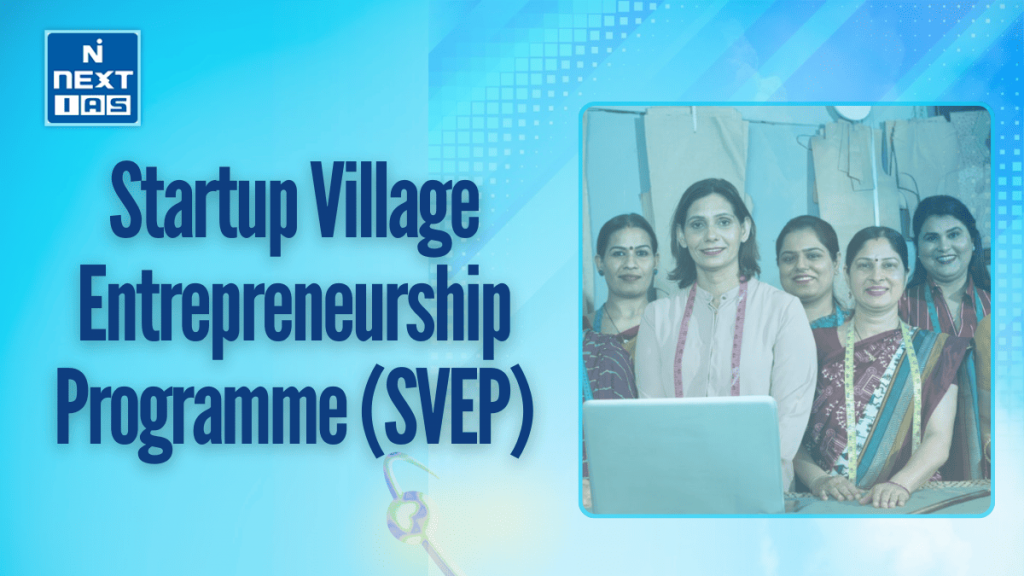
Start-up Village Entrepreneurship Programme (SVEP), the sub-scheme under Deendayal Antyodaya Yojana – National Rural Livelihoods Mission (DAY-NRLM) supports Self Help Groups (SHGs) and their family members to set-up small enterprises in the non-farm sector. SVEP projects are implemented in a block and are of four-year duration. The scheme was approved on 6th May, 2015 and the Action Plans for implementation of SVEP were invited from the State Governments during 2015-16. The Detailed Project Report (DPRs) preparation, approvals and fund release started in 2016-17.
About The Startup Village Entrepreneurship Programme (SVEP)
- The Start up Village Entrepreneurship Program is a sub componenet of Deendayal Antyodaya Yojana – National Rural Livelihoods Mission (DAY-NRLM) of the Ministry of Rural Development.
- SVEP aims to support entrepreneurs in rural areas to set up local enterprises.
- The long term vision of the SVEP is to provide support for start-up to 1 crore village enterprises and provide direct employment to 2 crore people.
- The SVEP shall help the rural poor come out of poverty by helping them set up enterprises and provide support till the enterprises stabilize.
- The programmatic intervention will address all three missing ecosystems – Knowledge, advisory and finance ecosystems.
- In its first phase of validating the concept, SVEP is expected to support creation and strengthening of about 1.82 lakh village enterprises in 125 Blocks across 24 States in the targeted four years i.e. 2015-19.
- This is expected to create employment for about 3.78 lakh persons.
Features of Startup Village Entrepreneurship Programme (SVEP)
- Entrepreneurial Development — SVEP fosters establishment of micro enterprises in rural areas with a focus on self-employment and economic sustenance.
- Finance — The program engineered provision of collateral-free loans through Community Enterprise Funds (CEF) ensuring access to affordable credit by entrepreneurs.
- Capacity Building and Training — SVEP offers training in business management, financial literacy, and marketing for enhancing the proficiencies of rural entrepreneurs.
- Business Support Services — Initiates access to expert advice, market linkages, and continuing handholding support for running businesses sustainably.
- Digital Technology Integration — Encouragement is given in the use of digital record-keeping and enterprise tracking by SVEP to facilitate transparency and efficiency in the conduct of business activities.
- Employment Generation: With the emphasis on encouraging micro and small enterprises, the program in reality works towards creating jobs in rural communities while preventing migration to urban areas.
- Implementing at the Community Level — The program is implemented through SHGs and other local institutions, ensuring participation & empowerment at the grassroots level.
- Focus on Women Entrepreneurs – SVEP actively promotes women-led businesses, enhancing economic inclusion and financial independence for women in rural areas.
Objectives of the Startup Village Entrepreneurship Programme (SVEP)
- To enable rural poor to set up their enterprises, in its proof of concept phase, by developing a sustainable model for Village Entrepreneurship promotion through integrated ICT techniques and tools for training and capacity building, enterprise advisory services and to provide loans from banks/SHG & federations.
- These enterprises may be individual or group enterprises and should cover manufacturing, services and trading.
- These enterprises should cover traditional skills as well as new skills. They should also cover existing consumption and production of rural areas and should also cover new consumption and production of the rural areas, including the new consumption driven by government’s priorities like RURBAN mission, Swachh Bharat Abhiyan, etc.
- Develop local resources by training a pool of village level community cadre (CRP EP) and build the capacity of the NRLM and SHG federations to monitor and direct the work of the CRP-EPs.
- Help the rural entrepreneurs to access finance for starting their enterprises from the NRLM SHG and federations, the banking systems including the proposed MUDRA bank.
- Handhold the rural entrepreneurs/ enterprises in the initial six months of start-up, with visits from the CRP-EP’s supported by guidance from an advisory panel of experts for the relevant enterprise.
Significance of Startup Village Entrepreneurship Programme (SVEP)
- Encourages Rural Entrepreneurship: SVEP offers both financial and technical assistance to rural entrepreneurs for the setting up and sustenance of their businesses. Thus, the focus remains on micro-enterprises involved in manufacturing as well as services and trade.
- Employment Generation: Nurturing local business establishments, SVEP fosters creation of sustainable work opportunities, thereby curbing the migration to cities in quest of work. This enhances the livelihoods of rural population, more so women and weaker sections.
- Capacity Building & Skill Development: Through entrepreneurial training, SVEP equips candidates with the know-how of business planning, managing finances, and marketing, thereby providing sustenance to the enterprise.
- Financial assistance and Digital Empowerment: The program sanctioned loans without collateral through the Community Enterprise Fund (CEF), while simultaneously integrating digital tools for monitoring the formation, thus maintaining transparency and informed decision-making.
- Strengthens Rural Economy: By supporting local businesses, SVEP enables villages to become self-supported entities contributing to economic development on the grassroots level and thus paving way for government ambitions of Atmanirbhar Bharat.
Lacunae of Startup Village Entrepreneurship Programme (SVEP)
The Startup Village Entrepreneurship Programme (SVEP) is a key initiative under the Deendayal Antyodaya Yojana – National Rural Livelihoods Mission (DAY-NRLM) aimed at promoting rural entrepreneurship. While the program has contributed to fostering rural startups, several lacunae hinder its full potential:
- Limited Financial Access: While the Community Enterprise Fund is operational, rural entrepreneurs suffer from not being able to access adequate finance since traditional financial institutions remain reluctant to support rural businesses without a proven track record.
- Inadequate Market Linkages: The absence of strong market linkages inhibits the entrepreneurs’ ability to market their products beyond local markets, thus impeding business growth and scaling.
- Skill Gaps and Training Challenges: Despite having skill training under SVEP, entrepreneurs have difficulty in business management, digital literacy, and financial planning, thus hampering their sustainability in the long run.
- Slow Implementation and Bureaucratic Delays: The implementation of SVEP runs into difficulties arising from administrative inefficiencies, holdups in fund disbursement, and complex paperwork, ultimately preventing rural entrepreneurs from benefiting from the scheme in good time.
- Limited Awareness and Outreach: Many entrepreneurs, especially in remote villages, have remained deprived of such programs due to ineffective awareness creation purchase and communications strategy.
- Technological Barriers: Digital adoption in rural areas is still low, making it challenging for entrepreneurs to leverage online platforms for marketing, sales, and business expansion.
Key Pointers for SVEP relevant for UPSC CSE Prelims
- Launched By: Ministry of Rural Development under DAY-NRLM (Deendayal Antyodaya Yojana – National Rural Livelihoods Mission) Eradication of rural entrepreneurship promoted by supporting small businesses and self-employment opportunities.
- Target Beneficiaries: Rural poor and marginal women and their SHGs.
- Financial Support: Seed capital supports financing and business development services.
- Implementation: Through Community Resource Persons for Enterprise Promotion (CRP-EPs).
- Technology Support: Mobile-I-Web-based MIS System for business tracking.
- Focus Areas: Skill development, market linkages, and financial literacy.
- Contribution to Economy: It promotes rural employment and sustains enterprises.
Way Forward
For the reinforcement of the Startup Village Entrepreneurship Programme (SVEP), focusing on increasing financing support and digital literacy along with market access for rural entrepreneurs is essential. Extending mentorship support to rural enterprises, supporting technology-driven solutions, and promoting sustainable business practices can help foster long-term economic growth and self-reliance at the village level.
Conclusion
In order for rural entrepreneurs to be able to carry on their businesses, the Startup Village Entrepreneurship Programme provides skill training, finance, and market linkages. By promoting self-employment and fighting poverty with sustainable enterprises, forcibly SVEP strengthens rural economies and improves incomes, thereby placing the welfare of inclusive growth and economic self-reliance in the lifeline of India’s village communities.