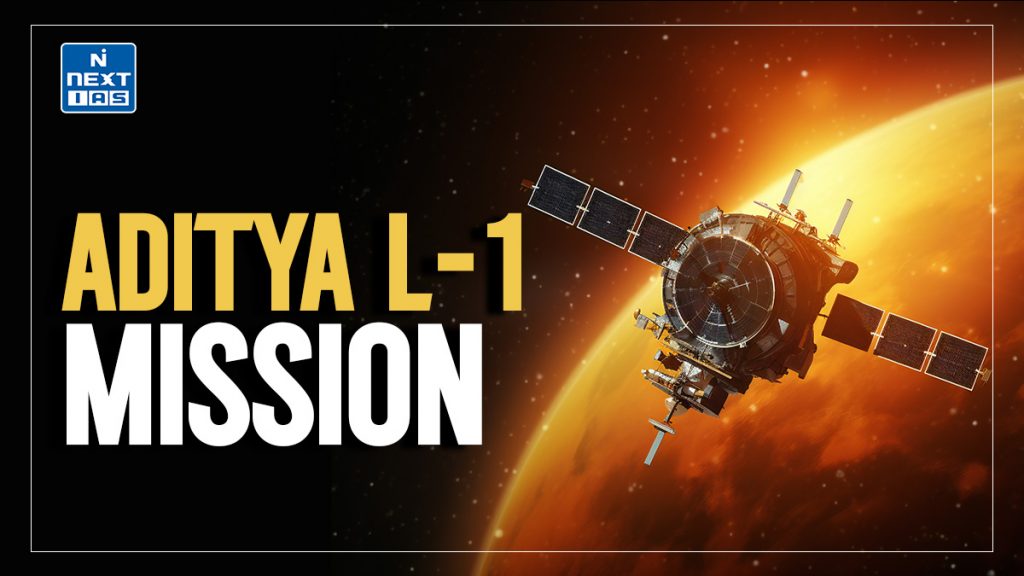
Aditya-L1 is the very first Indian planetary mission, which ISRO is carrying out to study the Sun, especially concerning the outermost layers, that is, the photosphere, chromosphere, and corona. Put at the L1 Lagrange point between Earth and the Sun, Aditya-L1 endeavors to deepen our understanding of solar activities and their bearing on space weather.
About the Aditya L-1 Mission
- Spacecraft Mission to study the sun.
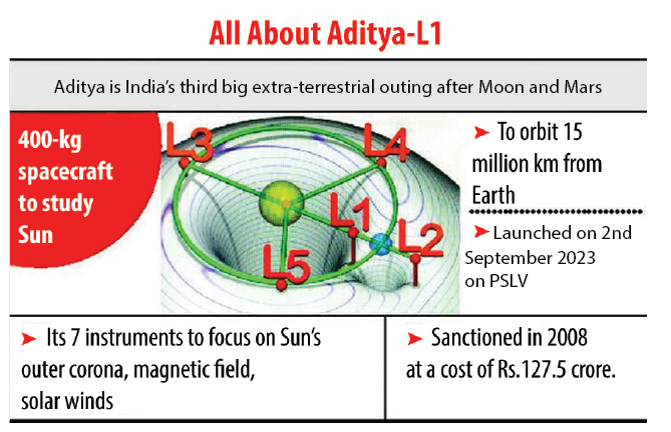
- The Aditya-1 mission will be inserted into a halo orbit around L1 point which is about million Km from Earth.
- Being placed in halo orbit around the Lagrangian point 1 (L1) of the Sun-Earth system has the major advantage of continuously viewing the Sun without any occultation/ eclipse.
- The satellite carries additional six payloads with enhanced science scope and objectives.
Read our detailed article on Satellites.
How is it different from Aditya 1 Mission?
- Aditva-1 was meant to observe only the solar corona.
- Aditya-L1 With additional experiments can now provide observations of Sun’s Corona (soft and hard X-ray, Emission lines in the visible and NIR), Chromosphere (UV) and photosphere (broadband filters).
- In addition, particle payloads of Aditya L1 will study the particle flux emanating from the Sun and reaching the LI orbit, and the magnetometer payload will measure the variation in magnetic field strength at the halo orbit around L1
Signification of Aditya L-1
The Aditya-L1 mission is significant for several reasons:
- First Indian Solar Mission: It marks the inaugural dedicated effort to study the Sun, underlining the expansion of ISRO’s scientific objectives.
- Understanding Space Weather: Observations of the Sun’s outer layers yield information about solar flares, coronal mass ejections, and their effects on Earth’s space weather, all important for satellite and communications safeguard.
- Position at L1 Lagrange Point: It is positioned at L1, almost 1.5 million kilometers from Earth, offering an uninterrupted view of solar happenings free of any obstructions.
- Global Collaboration: The findings from this mission will get shared internationally, enriching solar physics and space weather research.
- Technological Advancement: Aditya-L1 is strengthening ISRO’s R&D in the area of space observation, thereby enhancing the frontiers of India’s space exploration capabilities.
Some Key International Solar Missions
Here are some key international solar missions aimed at studying the Sun:
- Parker Solar Probe of NASA (2018): This is the nearest mission to the Sun, with a close view of the Sun’s outer corona, studying solar wind and high-energy particles and trying to solve some age-old solar mysteries.
- Solar Orbiter by ESA-NASA (2020): Solar Orbiter will look at the Sun’s poles and the solar wind and capture fine images of the Sun, aiding scientists in understanding the 11-year solar cycle of the Sun.
- Solar and Heliospheric Observatory (SOHO) of NASA (1995): A joint effort with ESA, SOHO studies the solar wind, the corona, and the interior structure of the Sun. It has been very important for solar research and provides realtime data on solar weather.
- Hinode of Japan (2006): A JAXA mission with some cooperation from NASA and ESA, Hinode works on studying magnetic fields on the Sun and workings of solar flare and sunspot formation.
- Aditya-L1 of India (2023): Aditya-L1, India’s first solar mission, is studying the outermost layers of the Sun to understand solar activities and their impact on space weather.
- China’s ASO-S (Advanced Space-based Solar Observatory, 2022): Also known as the Kuafu-1 mission, it focuses on studying solar flares, coronal mass ejections, and solar magnetic fields to understand their effects on Earth’s environment.
Each mission offers unique perspectives and data that collectively enhance our understanding of the Sun’s behavior and its effects on our solar system.
Way Forward
ISRO’s Aditya-L1 mission involves several key steps:
- Long-Term Data Collection: Instruments on board Aditya-L1 will continuously observe solar activity for long periods to gather data on phenomena such as solar flares and coronal mass ejections that are crucial for building a comprehensive understanding of the Sun.
- Improved Space Weather Forecasting: Data from Aditya-L1 can improve forecasting models for space weather events, thereby obstructing satellite operations, navigation systems, and power grids to better prepare for geomagnetic storms.
- Collaborative Research: ISRO can share data with other space agencies to foster international cooperation in solar research and pool insights from missions like Parker Solar Probe and Solar Orbiter.
- Evolution of Advanced Space Missions: The success of Aditya-L1 can lead to future Indian space-based observatories and usher in the development of more advanced missions studying other cosmic phenomena.
- Public Engagement and Awareness: By sharing mission insights with the public, ISRO can inspire educational outreach and boost interest in solar science, particularly in India, encouraging future generations of scientists.
- Technological Advancements: Learnings from the mission can contribute to refining technologies used in space observation, enhancing India’s capabilities for deep-space missions and potentially leading to multi-point solar monitoring networks.
Aditya-L1’s journey sets a foundation for ISRO’s growth in space science, expanding India’s role in cutting-edge solar research and space weather prediction.
Read our detailed article on ISRO.
Conclusion
Aditya-L1 is a monumental advancement in solar research for India, providing an opportunity to observe and understand the complex solar dynamics. Staying at the L1 Lagrange point, the mission can continuously monitor solar activities and therefore provide important data on solar radiation and channel weather. This mission ultimately broadens our knowledge and aids India in furthering its studies into space systems. Aditya-1 thus serves to compel the global community further towards joining hands in solar sciences involving the nearest star to all of us.
FAQs
What is L1 in Aditya-L1?
The Lagrange Point 1 (L1), a virtually stationary point in space about 1.5 million kilometers away from Earth, is where the gravitational pull of the Earth brings balance with that of the Sun. Aditya-L1 will stay in L1 to take observations of the nearest layer of the Sun and to relay vital solar data.
When will Aditya-L1 reach its destination?
The Aditya-L1 was supposed to take approximately four months to reach the L1 Lagrange point. Aditya L1 mission launch date on the 2nd of September, 2023, and its arrival is estimated to be around January 2024. Once it is there, it begins its study of the Sun’s outer atmosphere and solar activities.
What will Aditya-L1 do?
Aditya-L1 will study the Sun’s outermost layer, that is, the corona, and space weather phenomena there. It aims to comprehend solar radiation, solar wind, and its effects on the Earth’s climate and communication system. The mission would give useful data for predicting space weather and would help safeguard satellite infrastructure.
How much time will Aditya-L1 take to reach the sun?
Aditya-L1 would take around 4 months to reach the L1 point, about 1.5 million kilometers from Earth. It would closely follow a trajectory that would continually guide it towards L1 for the uninterrupted study of the Sun, with solar dynamics, space weather.
What is the current status of Aditya-L1?
As of January 2024, the mission Aditya-L1 has done well to move near its goal. The spacecraft arrived at its final destination, the L1 point, after a number of trajectory correction maneuvers had been completed. The spacecraft successfully entered the halo orbit around L1 on January 6, 2024, providing it with an unobstructed view of the Sun. Thus, it marks a significant stage in the mission to study the Sun’s atmosphere, solar winds, and their implications for space weather.
Which rocket is used for Aditya-L1?
The PSLV-C57 (Polar Satellite Launch Vehicle) rocket is used to launch the Aditya-L1 mission. It is a versatile and reliable rocket developed by ISRO, capable of placing satellites into various orbits, including the Lagrange Point 1 (L1) orbit, where Aditya-L1 will be positioned to study the Sun.
What is the significance and impact on day to day life of ISRO’s Aditya-L1 payloads?
ISRO’s Aditya-L1 mission, with its solar observation payloads, will enhance understanding of solar activity, solar winds, and their effects on Earth’s climate and satellite communication systems. This knowledge can improve space weather forecasting, safeguard communication networks, and advance climate research, directly impacting daily technology and infrastructure.
Who is the Aditya L1 mission director ?
The Aditya L1 mission director is Nigar Shaji, a senior scientist at ISRO who led India’s first dedicated solar observatory mission from its conception through launch and operation at the L1 Lagrange point.