These launch vehicle fuels, or propellants, impart energy on the spacecraft in order to have it rendezvous with a spacecraft in orbit or with other spacecraft or targets. Naturally, the four principal categories of propellants are generally spoken of as solid propellants, liquid propellants, hybrid propellants, and cryogenic propellants. Selection is made on the basis of mission requirements, emphasizing maximum thrust, stability, and efficient performance during the launch.
About the Launch Vehicle Fuels
- Launching vehicles into the upper atmosphere with propellant fuels is thus critical for space exploration. Broadly, they fall into the categories of solid, liquid, hybrid, and cryogenic.
- The solid is simple in its design and very reliable and safe, with ammonium perchlorate as an example.
- Liquid fuels are very efficient and are used generally in the more advanced stages because, for example, liquids might be hydrogen and oxygen (LOX).
- Hybrid technologies essentially combine solid and liquid propellants, allowing for better control.
- Cryogenic ones are kept at very low temperatures and are employed when high thrust is needed, such as for geostationary launches.
- In the end, it depends on the choice of fuel for its particular use, crafty cost, and performance for that function: energy, stability, and safety.
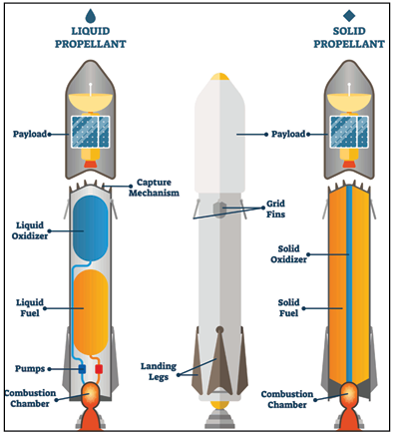
Types of Launch Vehicle Fuels
- Solid Propellants:
- Made of fuel and oxidizer in a solid state (e.g., Ammonium Perchlorate Composite Propellant).
- Simple and reliable, but lack control after ignition.
- Example: Used in boosters like PSLV’s first stage.
- Liquid Propellants:
- Separate fuel (e.g., Kerosene or Liquid Hydrogen) and oxidizer (e.g., Liquid Oxygen).
- Offer better control through throttle and shutdown capabilities.
- Example: Saturn V’s first stage used RP-1 (refined kerosene) and LOX.
- Cryogenic Propellants:
- Extremely cold liquid fuels like Liquid Hydrogen (LH2) and Liquid Oxygen (LOX).
- Provide high efficiency, used for upper stages and interplanetary missions.
- Example: GSLV’s upper stage uses cryogenic propellant.
- Hypergolic Propellants:
- Fuel and oxidizer ignite spontaneously on contact (e.g., Hydrazine and Nitrogen Tetroxide).
- Used in satellite thrusters and spacecraft due to reliability in space.
- Example: Apollo’s Lunar Module descent engine..
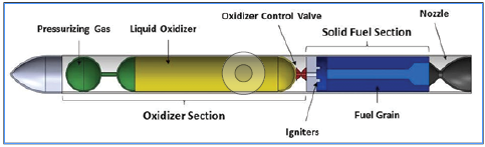
- Hybrid Propellants:
- Combine a solid fuel with a liquid or gaseous oxidizer.
- Offer better control than solid propellants with simpler design than liquid engines.
- Example: Used in some experimental rockets.
- There are 2 stages in a hybrid propulsion: solid propulsion and liquid propulsion
- This kind of propulsion compensates the disadvantages of both propulsion systems and has the combined advantage of 2 propulsion systems
Advantages of Different Launch Vehicle Fuels
- Solid Propellants:
- Simple and Reliable: With few moving parts, the minimalistic design reduces complexity and the opportunity for failure.
- Long Storage Life: Stable and stored for long periods without deteriorating.
- High Thrust: For first stages or boosters during liftoff.
- Liquid Propellants:
- Thrust Control: Can be throttled, shut down, or restarted as required.
- High Efficiency: More specific impulse than solid fuels.
- Versatile: With the entire mission regime from liftoff to orbit insertion.
- Cryogenic Propellants:
- High Energy Density: Better for performance in upper stages and heavy payloads.
- A Must for Deep Space Missions: Utilized in interplanetary missions for their high efficiency.
- Reusable Potential: Seen in latest reusable rockets such as SpaceX’s Raptor engines.
- Hypergolic Propellants:
- Instant Ignition: Because they ignite spontaneously, they are reliable when used in spacecraft thrusters.
- Operates in Vacuum: Efficient functioning in space without complicated ignition mechanisms.
- Precise Maneuvering: Suitable for making adjustments to satellites and conducting deep space missions..
- Hybrid Propellants:
- Better Control: Higher flexibility than solid fuels with simpler design than liquid engines.
- Safer Storage: Less hazardous compared to fully liquid propellant systems.
- Cost-Effective: Useful for experimental and smaller rockets.
- Better Control: Higher flexibility than solid fuels with simpler design than liquid engines.
Disadvantages of Launch Vehicle Fuels
- Solid Propellants:
- Limited in Control: Cannot be throttled or shut off once ignited.
- Lower Efficiency: They have less specific impulse than liquid fuels.
- Storage Issues: They degrade over time and hence are challenging to store.
- Liquid Propellants:
- Complex Handling: Requires intricate plumbing and pumps.
- Highly Volatile: Poses safety risks during fueling and launch.
- Storage Challenges: Cryogenic liquids must be kept at extremely low temperatures.
- Cryogenic Propellants:
- Temperature Limitation: Systems must be built to provide very efficient insulation and cooling.
- Boil-Off Problem: This means evaporation, limiting how long they can be stored.
- A More Expensive Stage of Infrastructure: Storage and handling of cryogenic substances require expensive equipment.
- Hypergolic Propellants:
- Toxic and Hazardous: Incredibly dangerous to handle and poses serious health hazards to those that do.
- Environmental and Genetic Threats: Toxic byproducts are released during their combustion.
- High Maintenance: Demands strict safety guidelines during storage and use.
- Hybrid Propellants:
- Low Performance: Low efficiency compared to liquid propellants.
- Design Complexity: Challenging to take advantage of interactions between solid and liquid sides.
- Slow Development: Considerably less mature in comparison to other systems.
Way Forward
- The future of launch vehicle fuels will lean heavily on efficiency, sustainability, and safety. The evolutionary scope of green propellants will perhaps include liquid methane and biofuels to keep the explosions clean. The reusable rockets with an increased burn efficiency will further shrink the price of the launch.
- Electric and nuclear propulsion research would be a new dawn for deep-space missions. Cryogenics storage and refueling innovations would aid longer missions while reducing losses due to boil off.
- And while hybrid engines with better control and more thrust are in the pipeline,
- The safety and automation technologies will reduce chances in years to come to ensure that we have a reliable and clean space exploration program.
Conclusion
- Depending on the circumstances of a given mission, launch vehicle fuels will be employed for space exploration and satellite deployment, each with its advantages and limitations. Solid, liquid, cryogenic, hypergolic, and hybrid propellants are used for different missions by weighing efficiency, control, safety, or environmental impact.
- Technological developments have improved fuel performance and berthed the costs. Meanwhile, however, issues concerning toxicity and handling problems alongside storage constraints have kept being highlighted.
- As the aerospace industry slowly goes through changes, it would be wise for continuing R&D to steal the launch vehicle fuels, make them safer, and look into initiatives that will open new opportunities for human space exploration.
Frequently Asked Questions (FAQs)
Which fuel is used in Chandrayaan 3?
Chandrayaan-3 primarily utilizes a combination of Liquid Propellant Systems, specifically using Liquid Oxygen (LOX) and Liquid Hydrogen (LH2) for its propulsion. These fuels are employed in the lander’s and propulsion module’s engines, providing the necessary thrust for maneuvers during its journey and landing on the lunar surface.
Which solid fuel is used in a launch vehicle?
The Polar Satellite Launch Vehicle (PSLV) uses a combination of solid and liquid fuels. The first stage employs a solid fuel called HTPB (Hydroxyl-terminated polybutadiene) for its Solid Rocket Motors (SRMs). The second stage uses a liquid fuel, a mixture of UDMH (Unsymmetrical Dimethylhydrazine) and N2O4 (Nitrogen Tetroxide), serving as the oxidizer. This combination allows the PSLV to effectively deliver payloads into polar orbits.
Which fuel is used in PSLV?
The Polar Satellite Launch Vehicle (PSLV) uses a combination of solid and liquid fuels. The first stage employs a solid fuel called HTPB (Hydroxyl-terminated polybutadiene) for its Solid Rocket Motors (SRMs). The second stage uses a liquid fuel, a mixture of UDMH (Unsymmetrical Dimethylhydrazine) and N2O4 (Nitrogen Tetroxide), serving as the oxidizer. This combination allows the PSLV to effectively deliver payloads into polar orbits.
What is the fuel used in GSLV?
– The Geosynchronous Satellite Launch Vehicle (GSLV) utilizes a combination of solid and liquid fuels. The first stage of the GSLV employs solid fuel in its Solid Rocket Boosters (SRBs), typically made from HTPB (Hydroxyl-terminated polybutadiene).
– The second stage uses liquid fuel, specifically a mixture of UDMH (Unsymmetrical Dimethylhydrazine) as the fuel and N2O4 (Nitrogen Tetroxide) as the oxidizer.
– The third stage features a cryogenic upper stage that uses Liquid Hydrogen (LH2) as fuel and Liquid Oxygen (LOX) as the oxidizer, enabling it to place heavier payloads into geostationary orbits.
What solid propellant is used in the GSLV?
The Geosynchronous Satellite Launch Vehicle (GSLV) uses a solid propellant known as HTPB (Hydroxyl-terminated polybutadiene) in its Solid Rocket Boosters (SRBs). This propellant is known for its high energy density and stability, providing the necessary thrust during the initial phase of the launch to help lift the vehicle into space.
Which fuel is used in ASLV?
– The Augmented Satellite Launch Vehicle (ASLV) primarily uses solid and liquid fuels. The first stage utilizes a solid propellant known as HTPB (Hydroxyl-terminated polybutadiene) for its Solid Rocket Motors (SRMs).
– The second stage employs liquid fuel, specifically a mixture of UDMH (Unsymmetrical Dimethylhydrazine) as fuel and N2O4 (Nitrogen Tetroxide) as the oxidizer. This combination allows the ASLV to effectively launch payloads into low Earth orbit.
Which propellant is used in PSLV?
An amalgamation of solid and liquid propellants is used by the Polar Satellite Launch Vehicle (PSLV). The first stage has some solid propellant called HTPB (hydroxyl-terminated polybutadiene) and the second stage uses a liquid propellant duo of UDMH (Unsymmetrical Dimethylhydrazine) as the fuel and N2O4 (Nitrogen Tetroxide) as the oxidizer. Such a hybrid propulsion system allows PSLV to provide efficient delivery of satellites into polar orbits.
Further Reading: Chandrayaan 3
GS - 3