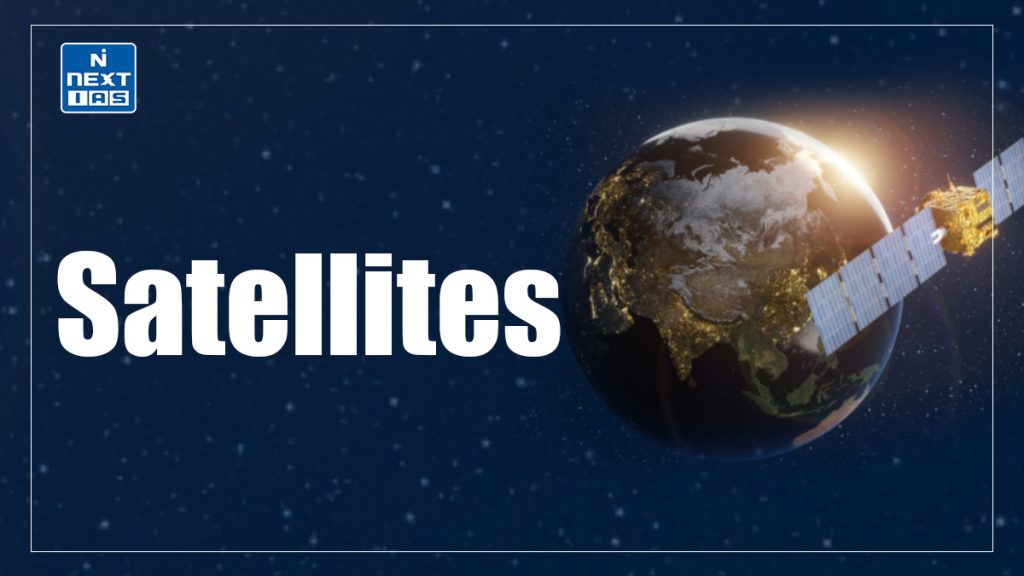
Satellites are human-made objects launched into space to orbit Earth or other celestial bodies. They serve various purposes, including communication, navigation, weather forecasting, Earth observation, and scientific research. They play a crucial role in modern life, enabling global connectivity, accurate GPS services, and environmental monitoring.
What are Satellites?
- A satellite is any object that orbits a planet or star. Satellites can be both natural and man-made. For example, Earth is a natural satellite of the sun. Likewise, the moon is a natural satellite of Earth.
- In space Science, the word “satellite” generally refers to a man-made machine that is launched into space and moves around Earth or any other celestial body like Moon or Mars.
- There are thousands of artificial, or man-made, satellites orbiting Earth. Sputnik 1 was the first satellite in space. The Soviet Union launched it in 1957.
Size of Satellites
The mass based classification of satellites are given below:
- Large satellites: >1000 kg
- Medium satellites: 500 to 1000 kg
- Small satellites: < 500 kg
- Minisatellites: 100 to 500 kg
- Microsatellites: 10 to 100 kg
- Nanosatellites: 1 to 10 kg
- Picosatellites: 100 g – 1 kg
- Femtosatellites: 10 g – 100 g
- Attosatellites: 1 g – 10 g
- Zeptosatellites: 0.1 g – 1 g
- CubeSat sizes:
- From ~0.2 kg to ~40 kg
- From 0.25U to 27U (1U CubeSat is 10×10×10 cm)
| ISRO NANO SATELLITE ISRO Nano Satellites (INS) is a versatile system envisioned for future science and experimental payloads. With a capability to carry up to 3 kg of payload and a total satellite mass of 11 kg, it offers immense opportunities for future use. The INS system is developed as a co-passenger satellite to accompany bigger satellites on PSLV launch vehicle. Its primary objectives include providing a standard satellite bus for launch on demand services and providing opportunity to carry innovative payloads. The primary objectives of INS system are to: • Design and develop a low cost modular Nano satellite. • Provide an opportunity for ISRO technology demonstration payloads. • Provide a standard bus for launch on demand services. • Provide an opportunity to carry innovative payloads for Universities / R&D laboratories |
Types of Satellite
- It can be classified by their function since they are launched into space to do a specific job.
- Generally, there are three different types of satellites i.e. Communications Satellite, Remote Sensing Satellite, and Navigation Satellite.
Communication Satellite
- Communication satellites are artificial satellites that relay and amplify radio telecommunication signals via a transponder. It creates a communication channel between a source transmitter and a receiver at different locations on Earth.
- Communications satellites are used for television, telephone, radio, internet, and military applications. Most communications satellites are in geostationary orbit about 35,900 km above the equator, so that the satellite appears stationary at the same point in the sky. Therefore the satellite dish antennas of ground stations can be aimed permanently at one spot.
Remote Sensing Satellite / Earth Observatory Satellite
- It is the one which observes or senses objects or phenomena on Earth. With the help of different payloads like camera, transponders, lasers they acquire information about the Earth and other planets.
- It is used in numerous fields, including geography, land surveying, Earth science disciplines (for example, hydrology, ecology, meteorology, oceanography, glaciology, geology), military, intelligence, commercial, economic, planning, and humanitarian applications, among others.
Navigation Satellite
- It is an artificial satellite that, together with other satellites, provide autonomous geo-spatial positioning. It allows electronic receivers to determine their location (longitude, latitude, and altitude/elevation) to high precision using time signals transmitted from it.
- The system can be used for providing position, navigation or tracking something fitted with a receiver (satellite tracking). The group of satellites also calculate the current local time to high precision.
Uses of Satellites
- Communication
- Make possible TV broadcast, Internet, and mobile services.
- Host global video-teleconferencing and telemedicine.
- Navigation
- GPS, Galileo, GLONASS gives correct position.
- Aviation, maritime maintenance, and personal navigation are about the users.
- Weather Forecasting
- Implementation of storm tracking, weather patterns and natural disasters.
- Issue warnings in advance for cyclones, floods and droughts.
- Earth Observation
- Track deforestation, crop-health-occurrences, and urbanization.
- Information on environmental change and natural resources.
- Scientific Research
- The study of space phenomena like solar winds and cosmic radiation.
- Conducts experimental projects on the ISS.
- Defense and Security
- Support military communication and reconnaissance.
- Monitor border areas and track missile activities.
- Environmental Monitoring
- Pollution, ocean currents and glacial melting.
- Disaster management and relief operations.
They impact daily life by enabling communication, navigation, environmental tracking, and scientific advancements.
Harmful Effects of Satellites
- Space Debris
- Decommissioned satellites add to space junk, which presents an imminent collision risk to the operative ones.
- Increases the chances of chain-like reaction collisions (Kessler Syndrome).
- Environmental Impact
- Rocket launches emit greenhouse gases and pollutants harmful to humans.
- Re-entering debris gives out toxic byproducts.
- Radio Signal Interference
- Signal interference can result when satellite congestion occurs in these orbits, thereby effecting communication and GPS services.
Read our detailed article on Orbits and Space Debris.
- Light Pollution
- Reflection from satellites, chiefly large constellations, blocks astronomical observations.
- Health Concerns
- The continuous radiation exposure from satellite signals has created concern regarding its long-term health effects.
- Security Threats
- They used for surveillance may raise privacy issues and lead to geopolitical tensions.
- Consumption of Space Resources
- Frequent satellite launches consume significant resources, contributing to space commercialization and environmental degradation.
While It provide essential services, they also create challenges that require responsible management and mitigation efforts.
Way Forward
- The future of satellites lies in sustainability and innovation. Establishing and implementing regulations for space debris, including deorbiting plans, recycling of satellites, and reusable rockets, are imperative.
- CubeSats offer cost-effectiveness and have a reduced environmental footprint; in parallel, AI is increasingly paving ways for more efficient satellite management. Stronger international regulations and cooperation are necessary to ensure that overcrowding is prevented and that climate challenges are addressed.
- Green technologies shall include environmentally-friendly fuels and low-emission rockets. Such measures allow in monitoring space traffic in real-time, while protection laws must also keep pace with surveillance technologies to find the optimal equilibrium between innovation and ethics. Adoption of these measures will ensure satellite systems remain a force for the good of humankind while minimizing the risk to space and Earth.
Conclusion
Communication, navigation, Earth observation, and scientific research are all areas in which satellites play a crucial role. Sustainable operations, effective regulations, and technological innovations are required to reduce environmental impact, to remove the existing space debris, and to find the contradictions between innovation and privacy.
If done correctly, these practices will accelerate the use of satellites for international developments while ensuring the protection of the space and Earth environments.