
 80813-00200


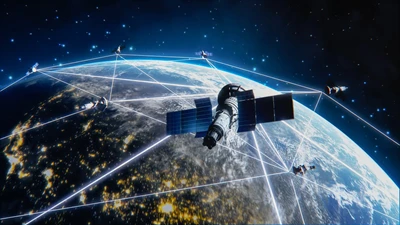
Starlink satellite is a high speed internet service developed and operated by an American aerospace company SpaceX. The traditional satellite service providers depend on a geostationary satellite which orbits over 35,000 kms. But Starlink uses a vast constellation of satellites which operates in Low Earth Orbit or LEO at about 550 kms above Earth. These low orbiting starlink satellites enormously reduce the travel time of signal and deliver high speed internet service with lower latency.
The Starlink satellites use inter-satellite laser links for data to travel directly to satellites without any requirement of nearby ground stations. The hardware or user terminals are weather resilient and can be operated via a mobile application. These terminals are built to melt snow, operate in extreme temperatures, heavy rains and harsh winds. Starlink covers the fast internet to any location on earth. They do not neglect the remote and rural regions where terrestrial fibre, cable or cell tower are unavailable and difficult to operate.
Background of Starlink Satellite Internet
- The CEO of SpaceX Elon Musk presented the starlink project in January 2015 during an event in Seattle in the United States of America.
- The starlink satellite Internet was launched to serve two primary objectives. Firstly, to provide high-speed and low-latency broadband internet service globally. Secondly, to generate funds for the long term goal of SpaceX for Mars colonisation plans and build Starship Rockets.
- The Dishy McFlatface is the nickname given for the SpaceX Starlink user terminal which is used to connect to the Starlink Low Earth Orbit (LEO) internet constellation.
- Moreover, the approval of the Federal Communications Commission (FCC) for 12,000 satellites in 2018 was a major achievement of the starlink project. It was further expanded to 42,000 satellites.
Comparison of Starlink with traditional Satellite Internet
| S.No. | Parameters | Starlink Satellite Internet | Traditional Satellite Internet |
|---|---|---|---|
| 1 | Satellite orbit |
|
|
| 2 | Latency |
|
|
| 3 | Download speed |
|
|
| 4 | Real time applications |
|
|
| 5 | Coverage |
|
|
| 6 | User equipment |
|
|
| 7 | Weather effects |
|
|
| 8 | Main advantages |
|
|
| 9 | Main limitations |
|
|
Challenges and Limitations of Starlink
Starlink has revolutionized access to the Internet for remote and rural people. The large scale and technical model demonstrates various limitations and challenges which are discussed below.
- Network Congestion: Starlink has a limited data capacity in their satellites. This is the reason densely populated or highly subscribed regions experience low bandwidth in peak hours.
- Line of Sight: The high frequency ku/ka radio signals used in starlink require an unobstructed line of sight to the sky. The tall trees, skyscrapers or buildings and mountains interrupt the signals.
- Weather disruption: The weather phenomena such as heavy rain, dense clouds, snowstorms can absorb or scatter radio signals which can result in temporary absence of network.
- Kessler Syndrome: Starlink uses thousands of satellites in the Earth's low earth orbit which can lead to the risk of satellite collision. A further cascading of such collisions which is also called as the kessler syndrome, may leave near- earth space unusable for future generations.
FAQs about Starlink Satellite
What is Starlink?
Starlink is the satellite internet service offered by an american company SpaceX which belongs to Elon Musk.
How fast is the Starlink internet?
Starlink internet speeds typically range from 50 to 500 Mbps download, 10 to 50 Mbps upload with 20 to 60 ms latency.
Does Starlink work everywhere?
Starlink provides near-global coverage except poles or deep ocean.
What are the main limitations of starlink?
The major limitations are rain fade, tree obstructions, data caps, high power use, and night-sky light pollution concerns for astronomers.
