
 80813-00200


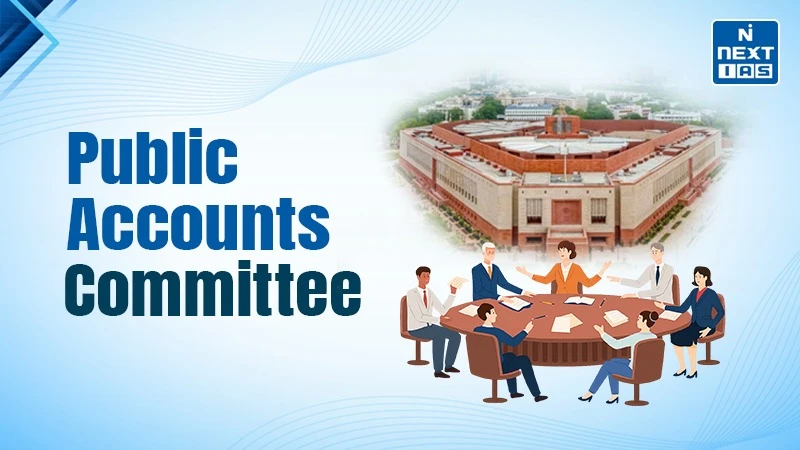
The PAC full form is Public Accounts Committee. PAC is the principal financial watchdog of the Parliament of India. It scrutinizes or examines the union appropriation accounts, finance accounts and the CAG reports. The PAC verifies the expenditure of public money occurred with the approval of the Parliament. It also re-checks the authorisation purpose and promotes executive accountability and transparency in the public expenditure. The Public Accounts Committee comprises a total of 22 members.
लोक लेखा समिति भारत सरकार द्वारा सार्वजनिक धन के खर्च की जांच-पड़ताल करती है। इस समिति में लोकसभा से 15 और राज्यसभा से 7 सदस्य होते हैं, जिससे कुल सदस्यों की संख्या 22 हो जाती है।
Historical Context of Public Accounts Committee
- The Public Accounts Committee (PAC) is the oldest and extremely important Financial Committee of Indian Parliament. The PAC was first formed in 1921 under the Government of India Act of 1919 to examine how public money was spent by the colonial government.
- After the Independence of India, the committee continued to function to ensure that the executives remained financially accountable to the Parliament. The role of PAC attained more importance with the expansion of welfare spending, public sector enterprises and government programmes.
- Initially, the Public Accounts Committee had only 15 members from the Lok Sabha. After 1954 to 1955, the PAC included 7 members from the Rajya Sabha which raised its total strength to 22 members.
- The committee emphasized on the principle of legislative control over public finance. The parliament authorises the expenditure through budget whereas the PAC examines whether the money was spent legally, economically, efficiently and for the intended purpose.
- The PAC relies on the reports of the Comptroller and Auditor General of India (CAG). Since 1967, by convention, its chairman is appointed from the opposition party which strengthens the impartial scrutiny of the government.
Composition of PAC Committee
| S.No. | Aspect | Details |
|---|---|---|
| 1 | Nature |
|
| 2 | Total membership | 22 members |
| 3 | Lok Sabha representation | 15 members elected from Lok Sabha |
| 4 | Rajya Sabha representation | 7 members from Rajya Sabha |
| 5 | Method of election | Proportional representation through the single transferable vote system |
| 6 | Tenure |
|
| 7 | Ministers as members |
|
| 8 | Chairperson | Appointed by the Speaker of Lok Sabha from among Committee members |
| 9 | Chairperson convention | Since 1967, conventionally chosen from the Opposition party |
| 10 | Technical assistance | CAG assists PAC as its 'guide, friend and philosopher' during audit-based scrutiny |
Functions of Public Accounts Committee
- The function of the Public Accounts Committee is to examine whether money granted by Parliament has been spent in accordance with the legislative procedure and rules. Its primary function is to scrutinize the Appropriation Accounts which show expenditure against the grants voted by the Parliament and the Finance Accounts of the Union Government. The Public Accounts Committee also studies the CAG audit reports to identify excess, wasteful, and unauthorised expenditure.
- The PAC examines cases of expenditure which exceeds the amount which is authorized by the Parliament and also reviews the accounts of autonomous or semi-autonomous bodies which were audited by the CAG.
- The committee can call officials, check department records and demand the explanations for audit objections. After an inquiry, the PAC submits reports with recommendations to the Parliament.
- The Ministries respond through 'Action Taken Notes' which allows PAC to take cognizance on corrective measures. An Action Taken Note (ATN) is a formal written response prepared by the government department.
Limitations and Challenges of the Committee
- The scrutiny done by PAC is largely post-facto which means the committee examines the expenditure after money has already been spent. Thus, it can detect irregularities but cannot ordinarily prevent them in advance.
- The recommendations of the Public Accounts Committee are advisory and not legally binding. It has no independent power to impose penalties, recover losses or order any implementation.
- The PAC handles a large volume of CAG reports and complex accounts but gets a limited tenure of only 1 year.
- The delay in the preparation of audit reports, departmental replies and Action Taken Notes (ATNs) usually weaken the scrutiny ineffective.
- The technical subjects such as defence procurement, telecommunications, digital systems and infrastructure contracts require specialised expertise and research support.
- The Public Accounts Committee cannot question the broader wisdom of an approved policy. It can only assess whether the policy was implemented within Parliament's financial authorisation or not.
FAQs about PAC
What is the Public Accounts Committee?
The Public Accounts Committee is the financial watchdog of the parliament. It examines the reports of Comptroller and Auditor General (CAG) and ensures that the government expenditure follows the authorised grants and rules of the Parliament.
Who is the Chairman of the Public Accounts Committee?
The Chairman of the Public Accounts Committee is K.C. Venugopal. He is the member of Parliament (MP) from the Congress party.
Who appoints the Chairman of the Public Accounts Committee (PAC)?
The Chairman of PAC is appointed by the speaker of the Lok Sabha. By convention, the chairperson is usually from the opposition party.
