80813-00200

G
GRASP
Mon, Tue, Thu, Fri
Read specific chapters and sources from the weekly reading list.

We are here to guide you!
Raise your enquiry and
get callback.
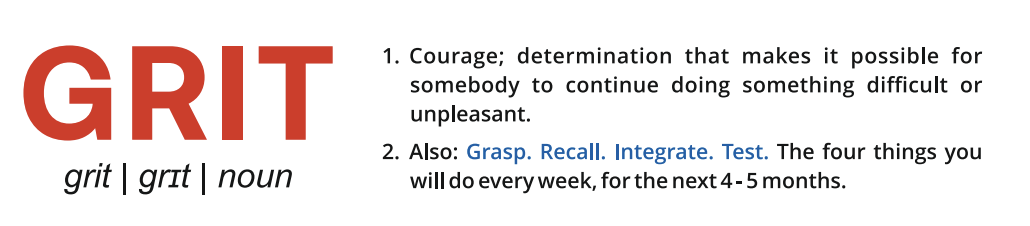
GRASP
Mon, Tue, Thu, Fri
Read specific chapters and sources from the weekly reading list.
RECALL
Wednesday
25 conceptual questions check whether the week's reading stayed.
INTEGRATE
Wednesday
25 UPSC
PYQs connect the same syllabus with the exam's questions.
TEST
Sunday
A full paper tests the week's subject, current affairs and governance.

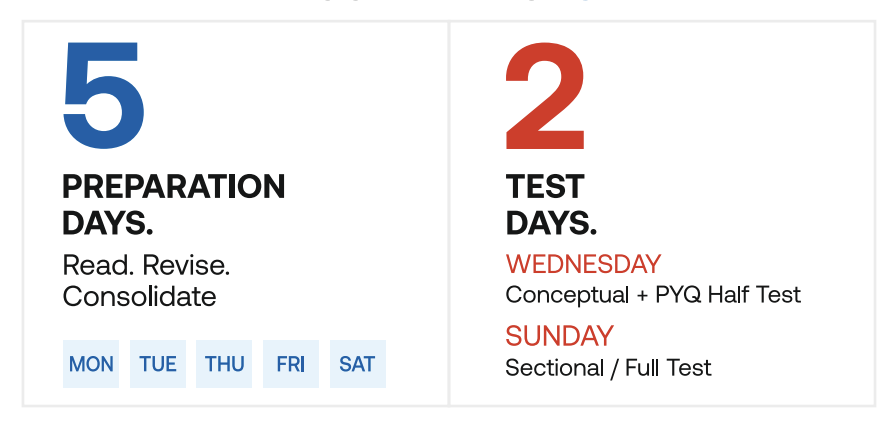
CONCEPTS + PYQ* HALF TEST (HLT)
25 conceptual questions based on the week's syllabus from NCERT and basics, plus 25 questions from UPSC PYQs on the same syllabus. Every Wednesday
WEEKLY FULL TEST (FLT)
A full format paper: 70 questions on the week's subject, 25 on current affairs, and 5 on governance and public policy. All new questions. Every Sunday through Phase 1.
CSAT FULL TEST
Fifteen full CSAT papers across the programme. In Phase 1 they fall on subject completion Sundays. In Phases 2 and 3 a CSAT paper runs every Sunday, GS in the morning and CSAT in the afternoon, the same way UPSC conducts the exam.
SUBJECT SIMULATOR
One complete subject in one sitting, on six Sundays from 28 March. These train you to link topics across a whole subject and hold accuracy over a longer paper, which is what UPSC asks when a question spans several sub-themes.
FULL SIMULATOR
The complete syllabus in UPSC exam timings. GS 9:30 to 11:30 AM, CSAT 2:30 to 4:30 PM. Three in all: the Phase 1 close on 21 March, then 9 May and 16 May.
ANUBHAV PRELIMS (ALL INDIA OPEN TESTS)
Anubhav recreates the actual UPSC exam environment. Conducted once every month, these tests simulate exam-day pressure, competition, and uncertainty, helping you benchmark yourself nationally and assess true readiness.
*In HLTs, where the weekly syllabus lacks sufficient PYQs, conceptual questions will be used. *FLT and CSAT papers in offline mode are non-flexible. *Visual explanation included for these tests.
Intensive, phased testing
Alternate-day tests build stamina, focus and consistency.
Complete syllabus coverage
End-to-end syllabus mapping helps you cover every topic.
PYQ-integrated preparation
Use UPSC PYQs to spot recurring themes and understand its approach.
UPSC-style question pool
Questions inspired by CSE, CAPF and Geo-Scientist build adaptability.
Clear, detailed solutions
Strengthen core concepts and improve option analysis with clear explanations.
Accuracy & attempt strategy
Track certainty, deduction and guesswork to make smarter attempts.
Online or offline access
Take tests online or offline, as convenient.
Daily rank lists
Benchmark performance daily to stay competitive & accountable.
Advanced portal analytics
Attempt tests, analyse performance and track topic-wise progress.
Subject-wise insight reports
Identify strengths, weak areas, recurring errors & peer standing.
Personalised remedial tests
Target wrong and unattempted questions to correct gaps and reduce repeat errors.
Online strategy workshops
Expert-led sessions refine attempts, time management and decisions under pressure.

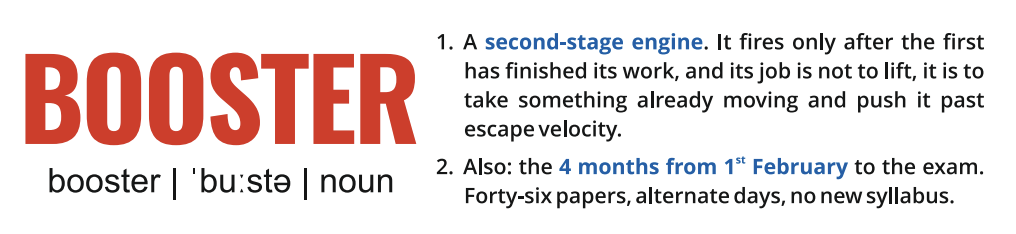
BOOSTER is a 4 months exam-conditioning programme. Nothing new is taught. By February the base is either in place or it is not, and what decides the paper from there is not how much you know but how fast and how accurately you can get it out with a clock running. Testing becomes the routine, not the checkpoint. Most aspirants spend February to May revising, because revision feels productive. It is the thing that moves the needle least.
BOOSTER exists so that what you know becomes what you score.
SECTIONALS
20 Half-length GS papers, 50 questions, 20 Half-length CSAT papers, 40 questions Alternate days from 1st February.
GS FLTS
100 questions, two hours, the exam's own shape. Where you learn what your accuracy does across a long paper.
80 questions, two hours. Ten full papers, because the one that eliminates people is the one they assumed they would clear.
3 GS and 3 CSAT, Anubhav Prelims All India Open Test run the way UPSC runs them. GS in the morning, CSAT in the afternoon.

Alternate-day testing at exam intensity, from 1st February to the CSE 2027 Prelims. Sectionals, full-length papers, CSAT papers and simulators, in that order of build.
New syllabus, new reading lists, new sources. The Booster assumes the base is already built. If it is not, start with GRIT.
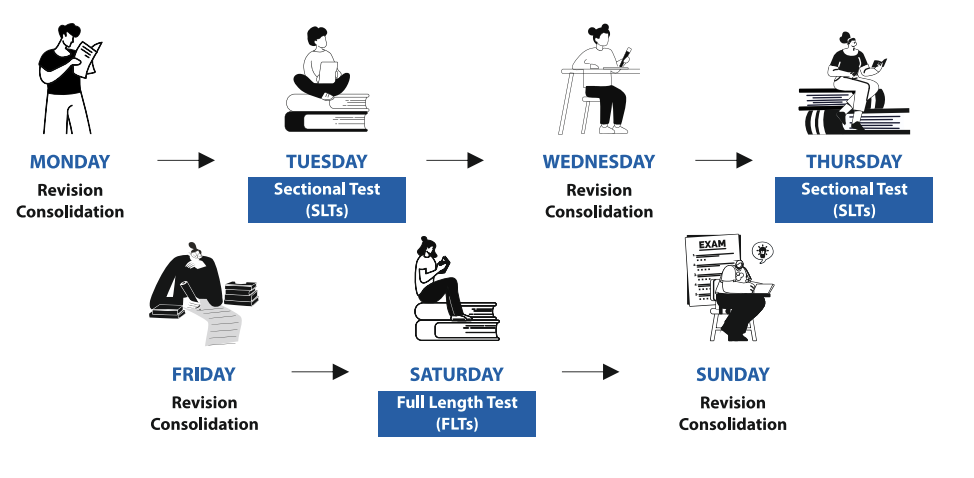
These half-length, topic-focused tests help you build depth and accuracy within a subject. By testing you soon after study and revision, they highlight conceptual gaps early, improve option elimination, and ensure each subject becomes a strength, not a liability.
These tests help you consolidate an entire subject in one sitting. They train you to link topics, manage fatigue, and maintain accuracy across a longer paper, exactly what UPSC demands when questions span multiple sub-themes of the same subject.
FLTs are designed to build the Prelims mindset. They train you in real-time decision-making, what to attempt, what to skip, and how to manage risk under time pressure. These tests are crucial for refining attempt strategy, elimination skills, and time management.
Anubhav recreates the actual UPSC exam environment. Conducted once every month, these tests simulate exam-day pressure, competition, and uncertainty, helping you benchmark yourself nationally and assess true readiness.
*Visual explanation included for these tests. *All tests in PTS-Booster phase are non-flexible.
Alternate-day, structured tests build mental stamina, sustain focus, and prevent performance dips as Prelims approaches.
End-to-end syllabus mapping ensures zero blind spots, eliminating last-minute surprises on exam day.
Continuous integration of UPSC Previous Year Questions helps internalise UPSC thinking, identify recurring themes, and avoid low-yield areas.
Questions inspired by CSE, CAPF, Geo-Scientist and other UPSC exams sharpen the ability to decode new and unconventional UPSC patterns.
Clear, structured explanations strengthen core concepts and improve option analysis, reducing blind guesses and careless errors.
Tracks attempts made with certainty, logical deduction & guess work enabling better risk management and an optimal attempt strategy.
Students enrolling in Prelims Booster Test Series can take tests either online or offline as per their convenience to ensure seamless access.
Daily benchmarking keeps preparation grounded, competitive, and accountable, reflecting real improvement over time.
A unified digital platform to attempt tests, analyse performance deeply, and track topic-wise progress, converting every test into actionable feedback.
Subject wise Post-test analytics clearly highlight strengths, weak areas, recurring mistakes, and peer comparison before moving ahead.
Targeted follow-up papers based only on wrong and unattempted questions ensure immediate correction and prevent error repetition.
Expert-led sessions refine attempt strategy, time management, and decision-making under pressure.
PTS-GRIT (Prelims Test Series)
Batch-3
| Mode | Start Date | Tests | Fee | Brochure | Admission Status |
|---|---|---|---|---|---|
| Offline/Online | 16th November, 2026 | 56 Tests | Rs. 10,000 (Incl. GST) | View Brochure | Enroll Now |
PTS-BOOSTER (Prelims Test Series)
| Mode | Start Date | Tests | Fee | Brochure | Admission Status |
|---|---|---|---|---|---|
| Offline/Online | Feb 2027 Onwards | 66 Tests | Rs. 8,000 (Incl. GST) | View Brochure | Enroll Now |
PTS-GRIT + PTS-BOOSTER (Prelims Test Series)
| Mode | Start Date | Tests | Fee | Brochure | Admission Status |
|---|---|---|---|---|---|
| Offline/Online | 12th October, 2026 | 104 Tests | Rs. 14,000 (Incl. GST) | View Brochure | Enroll Now |