


Syllabus: GS3/Agriculture
Context
- India’s agricultural sector continues to play a pivotal role in sustaining rural livelihoods, ensuring economic resilience, and safeguarding national food security.
Agricultural Sector in India
- Agriculture and allied activities account for nearly one-fifth of the country’s gross value added at current prices, employ approximately 46.1% of the workforce, and support close to 55% of the population.
- Over the past five years, the sector has achieved an average annual growth rate of around 4.4% at constant prices.
- In 2024-25, India recorded foodgrain output of 357.73 million metric tonnes (MMT), marking an increase of 25.43 million metric tonnes (MMT) over the preceding year.
- The increase was primarily driven by higher production of rice, wheat, maize, and coarse cereals.
- Total horticulture production reached 362.08 million tonnes (MT) in 2024-25, indicating a structural shift towards high-value crops.
- Agricultural export earnings increased from USD 34.5 billion in FY20 to USD 51.1 billion in FY25, reflecting a CAGR of 8.2%.
- The share of processed food exports has also risen consistently, from 14.9% in FY18 to 20.4% in FY25.
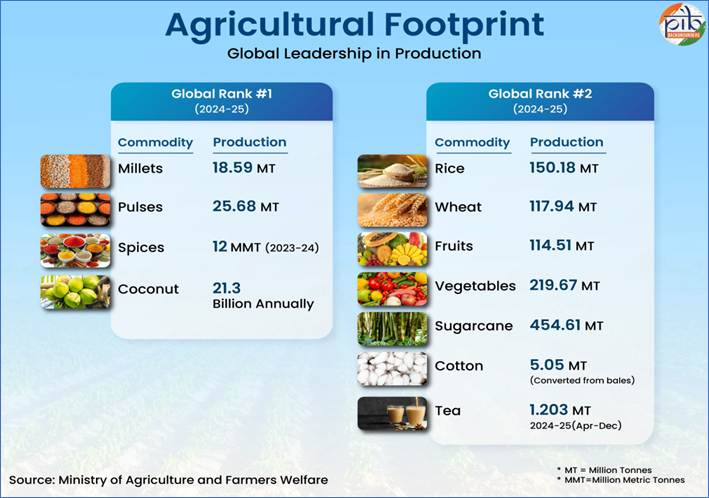
- Rice and Wheat: Rice production is primarily concentrated in states such as Uttar Pradesh, Telangana, and West Bengal.
- Uttar Pradesh, Madhya Pradesh, and Punjab constitute the leading wheat-producing regions.
- Pulses and Millets: In pulse production Madhya Pradesh, Maharashtra, and Rajasthan serve as the principal producing states.
- The country also ranks first worldwide in millet production largely driven by Rajasthan, Maharashtra, and Karnataka.
- Fruits and Vegetables: India is the world’s second-largest producer of fruits and vegetables.
- Fruit production is primarily concentrated in Andhra Pradesh, Maharashtra, Uttar Pradesh, Gujarat, Karnataka, and Tamil Nadu, while Uttar Pradesh, West Bengal, Madhya Pradesh, Bihar, and Gujarat lead vegetable output.
Public Policy Interventions Supporting Resilient Production Systems
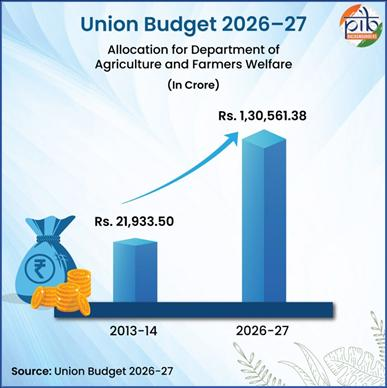
- Budget Allocation:
- The National Food Security and Nutrition Mission (NFSNM) is a centrally sponsored scheme to increase the production of rice, wheat, pulses, and nutri-cereals.
- The Mission for Aatmanirbharta in Pulses (2025–31) aims to achieve self-sufficiency in pulses by significantly enhancing domestic production, reducing import dependence.
- The National Mission on Edible Oils (NMEO), including the Oil Palm (NMEO-OP) and Oilseeds (NMEO-Oilseeds) initiatives, aims to achieve self-reliance in edible oil production by 2030-31.
- The Sub-Mission on Seeds and Planting Material initiative (SMSP) seeks to expand the supply of certified and quality seeds while improving the seed replacement rate and the standard of farm saved seeds.
- A Soil Health Card is issued to farmers for each landholding, detailing soil status based on 12 parameters including Nitrogen, Phosphorus, Potassium, Sulphur, Zinc, Iron, Copper, Manganese, Boron, pH, Electrical Conductivity, and Organic Carbon.
- Issued every two years, it guides farmers on suitable fertilisers and soil treatments to maintain long term soil health.
- Pradhan Mantri Krishi Sinchayee Yojana (PMKSY) aims to improve on farm water efficiency by promoting drip and sprinkler irrigation systems.
- Kisan Credit Card (KCC) scheme aims at providing adequate and timely credit support from the banking system under a single window with flexible and simplified procedures to the farmers for their cultivation.
Conclusion
- India’s agricultural transformation reflects a balanced approach that combines strong production growth, expanding global market presence, and targeted policy interventions across the farm-to-market value chain.
- As resilient production systems continue to evolve, the expanding role of agriculture provides a strong foundation for deeper integration with allied activities, further supporting rural livelihoods, and long-term economic stability.
Source: PIB
