


Indo–Lanka Accord (1987)
Syllabus: GS2/ International Relations
Context
- Tamil political parties in Sri Lanka have urged India to sustain pressure for full implementation of the Indo-Lanka Accord.
Indo–Lanka Accord (1987)
- The Indo-Lanka Accord was a bilateral agreement signed in July 1987 between Rajiv Gandhi and J. R. Jayewardene to address the ethnic conflict in Sri Lanka.
- Objectives: The Accord aimed to resolve the long-standing conflict between the Sinhalese-majority government and Tamil minorities.
- Key Provisions: It sought to ensure the devolution of political powers to provinces in order to provide greater regional autonomy.
- It granted official status to the Tamil language alongside Sinhala.
13th Amendment to the Sri Lankan Constitution (1987)
- The 13th Amendment was enacted in 1987 to operationalise the provisions of the Indo–Lanka Accord and provide a constitutional framework for devolution.
- Key Features:
- The Amendment established Provincial Councils in all nine provinces to facilitate decentralised administration.
- It introduced a three-fold distribution of powers through the Provincial List, Reserved List, and Concurrent List, broadly resembling the Indian federal structure.
- It enabled the transfer of several functional subjects such as education, agriculture, health, and local governance to the provincial level.
Source: TH
National Medical Commission (NMC)
Syllabus: GS2/ Governance
Context
- The National Medical Commission (NMC) has proposed amendments to the Registration of Medical Practitioners and Licence to Practice Medicine (Amendment), Regulations, 2026, aiming to expand medical education capacity while strengthening quality standards.
About National Medical Commission (NMC)
- NMC is India’s apex statutory body responsible for regulating medical education, professionals, and institutions.
- It was established in 2020, under the National Medical Commission Act, 2019, replacing the Medical Council of India (MCI) to streamline governance and improve the quality of healthcare nationwide.
- It operates through four autonomous boards;
- Under-Graduate Medical Education Board (UGMEB)
- Post-Graduate Medical Education Board (PGMEB)
- Medical Assessment and Rating Board (MARB)
- Ethics and Medical Registration Board (EMRB)
- Structure of NMC: The NMC consists of;
- A Chairperson.
- 10 ex-officio members (including representatives from ministries and institutions).
- 22 part-time members (including State representatives and experts).
Source: TH
India as a Centre of Jamun Evolution
Syllabus: GS3/ Agriculture
Context
- A recent study has revealed that Syzygium (Jamun) originated much earlier than previously believed, with India playing a central role in its evolution.
Origin and Evolution
- The origin of Syzygium was earlier believed to be limited to Australia or Southeast Asia.
- Recent fossil evidence from India has challenged this view and established a much older origin.
- Newly discovered Early Miocene fossils (~20 million years ago) from the Kasauli Formation in Himachal Pradesh, including 11 well-preserved leaves identified as Syzygium paleosalicifolium, confirm its continuous presence in India.
- The genus is now traced back to an East Gondwanan origin (~80 million years ago).
- India acted as a major centre of early diversification, from where the genus later dispersed to Southeast Asia and Australia.
About Jamun
- Jamun is a genus of flowering plants that belongs to the family Myrtaceae.
- The genus is widely distributed across tropical and subtropical regions and includes species of ecological and economic importance.
- Medicinal Properties: Jamun holds an important place in traditional systems of medicine such as Ayurveda and Unani.
- It is particularly known for its anti-diabetic properties due to compounds like jamboline.
- Distribution: Jamun is widely distributed across India, Bangladesh, Pakistan, Sri Lanka, Malaysia, and Philippines.
- Ecological significance: The species is often used in social forestry programmes as it plays a role in afforestation and reclamation of degraded lands.
Source: PIB
Fata Morgana
Syllabus: GS3/ S&T
In News
- Videos of ships appearing to float several metres above the ocean surface have gone viral on social media, reigniting scientific interest in the Fata Morgana.
About Fata Morgana
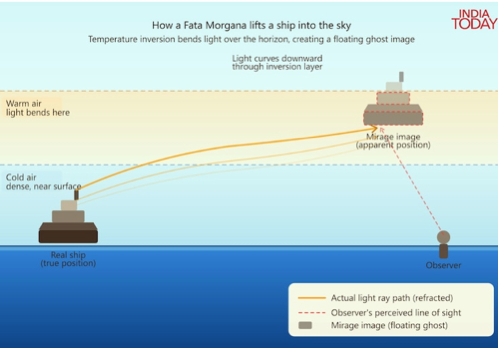
- Fata Morgana is a type of superior mirage, an optical phenomenon in which light from a distant object, such as a ship, coastline, or iceberg, is bent through layers of air with sharply different temperatures, causing the object’s image to appear displaced typically elevated high above its actual position.
- The name derives from the Arthurian sorceress Morgan le Fay, whose legends in Italian folklore described castles and cities rising from the sea.
The Physics Behind It
- Refraction of Light: Means the bending of light when it passes from one medium into another of different optical density.
- When light passes from a less dense medium (warm, thin air — where it travels faster) into a more dense medium (cold, dense air — where it travels slower), it bends toward the denser medium.
- Temperature Inversion: Under normal atmospheric conditions, air temperature decreases with altitude, the ground absorbs solar radiation, heats the air directly above it, and warmth diminishes as height increases. This is the standard atmospheric lapse rate.
- A temperature inversion is a reversal of this normal order where a layer of cold, dense air sits directly below a layer of warmer, lighter air. This inverted arrangement is the essential atmospheric precondition for Fata Morgana formation.
- Atmospheric Ducting and Beyond-Horizon Propagation: In a temperature inversion, as light from a distant ship travels toward an observer, it enters the inversion layer — the sharp thermal boundary between cold air below and warm air above. At this boundary, light continuously refracts downward — curving along the temperature gradient rather than escaping upward into the sky.
- If the temperature difference between the two layers is steep enough, light curves so dramatically that it bends around the curvature of the Earth — reaching an observer who is technically beyond the ship’s geometric horizon. Under normal conditions, an object 40 kilometres away would be completely hidden below the horizon.
Source: IT
Odisha: 1st State to Launch Marine Spatial Plan
Syllabus: GS3/Environment
Context
- The Odisha government recently signed a memorandum of understanding with the National Centre for Coastal Research under the Union Ministry of Earth Sciences to launch a Marine Spatial Plan (MSP) in the state for integrated coastal and marine planning.
About
- Sustainable ocean planning has been underway in India since 2019, with collaboration between India and Norway.
- In the first phase, it was taken up in two Union Territories, Puducherry and Lakshadweep.
- Odisha, with a coastline of over 550 km, has become the first state in the country to implement MSP in the second phase.
What is the Marine Spatial Plan (MSP)?
- Marine Spatial Planning is a tool for sustainable and integrated ocean management aimed at boosting the Blue Economy and strengthening climate resilience.
- It enables the sustainable utilisation of marine resources across sectors such as ports, fisheries, aquaculture, tourism, and industry.
- Under the plan, benthic mapping is carried out to study underwater ecosystems. Parameters such as salinity and temperature are also analysed to identify suitable zones for tourism, fisheries, seagrass, seaweed cultivation, and other economic activities.
Source: IE
Lumpongdeng Island
Syllabus: GS1/Geography
Context
- After protests by conservation groups, the Meghalaya government dropped the proposed luxury resort project on Lumpongdeng Island.
About
- Lumpongdeng Island is located in Umiam Lake, a manmade reservoir formed in the early 1960s by damming the Umiam River for a hydroelectric project, about 20 km from Shillong.
- The island is characterised by coniferous vegetation and lies near the centre of the lake.
Source: TH
Previous article
India’s Forest Carbon Storage May Nearly Double by 2100
Next article
18th Civil Services Day
