


Syllabus: GS1/ Society, GS3/ Economy
Context
- Women’s participation in India’s economy has improved in recent years, but their representation in leadership roles remains severely limited.
Status of Female Labour Force Participation
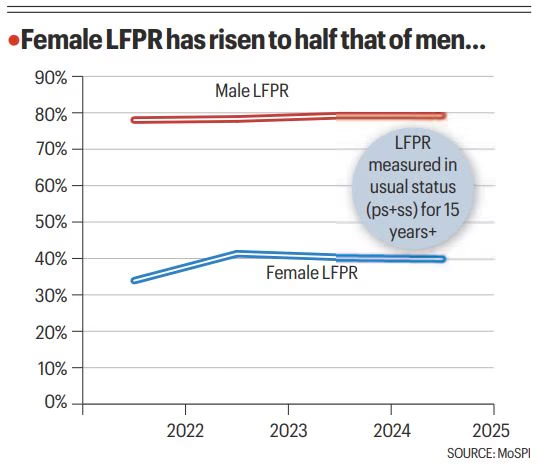
- India’s Female Labour Force Participation Rate (LFPR) increased from 33.9% in 2022 to about 40% in 2025, indicating gradual improvement.
- However, this level remains below the global average of 49% and significantly behind emerging economies such as Brazil (53%) and Vietnam (69%).
- The World Bank has highlighted that sustaining nearly 8% annual growth is essential for India to become a developed economy by 2047, which is unlikely without higher female workforce participation.
Economic Significance of Women’s Participation
- Higher participation of women in the workforce leads to greater labour supply, improved productivity, and inclusive growth.
- Women’s employment contributes to better household welfare, improved child nutrition, and enhanced educational outcomes.
- Empirical evidence suggests that constituencies represented by women legislators have experienced higher economic growth by nearly 1.8 percentage points annually, indicating the broader developmental impact of gender inclusion.
Underrepresentation in Leadership Positions
- Academia: At the national level, women in professor and equivalent positions have increased from 25.9% in 2011-12 to 29.5% in 2021-22, reflecting slow structural change.
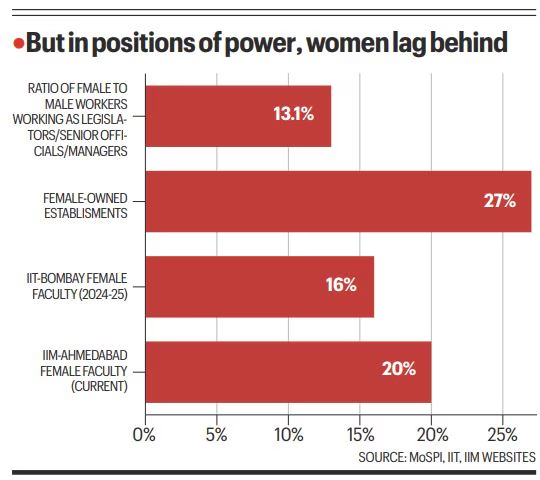
- In premier higher educational institutions female faculty constitute only about 14% in Indian Institutes of Technology (IITs) and 19% to 31% in Indian Institutes of Management (IIMs).
- Corporate Sector: The share of female-owned proprietary establishments stands at only 27%, indicating limited entrepreneurial control.
- According to labour force data, for every 100 men in senior roles, there are only 13 women, highlighting a sharp leadership gap.
- Women account for only 7% of board chairpersons in BSE 200 companies and 5% in NSE 500 companies, indicating limited influence in strategic decision-making.
- Issue of tokenism: The mandate of appointing at least one woman director on company boards often results in minimal compliance by firms, leading to tokenistic inclusion rather than substantive participation.
- Women remain too few to influence decisions meaningfully, as effective participation requires a critical mass of around 30% representation.
- The presence of a glass ceiling limits women’s upward mobility, as invisible institutional and social barriers prevent them from reaching top leadership positions despite adequate qualifications and experience.
Steps Taken by Government
- Nari Shakti Vandan Adhiniyam (2023): Ensures 33% reservation for women in the Lok Sabha and State Legislative Assemblies.
- Grassroots Representation: Over 20 states have implemented 50% reservation in Panchayati Raj Institutions (PRIs), with nearly 14.5 lakh elected women representatives.
- Financing Women-Led Businesses: Schemes like Stand-Up India and Pradhan Mantri Mudra Yojana (where 69% of beneficiaries are women) promote female entrepreneurs.
- Mentorship: The Women Entrepreneurship Platform (WEP) by NITI Aayog supports networking and mentorship.
- Gender budgeting has expanded significantly, increasing to ₹4.49 lakh crore in 2025-26, reflecting a shift towards women-led development, with greater focus on employment, employability, entrepreneurship, and welfare.
Key Challenges
- Structural barriers such as gender bias in hiring and promotions continue to persist.
- Women are disproportionately concentrated in informal, low-paying, and insecure jobs.
- Inadequate childcare infrastructure, safety concerns, and mobility constraints limit workforce participation.
- Weak enforcement of diversity norms and delayed political reforms further constrain progress.
Way Ahead
- The government should focus on job creation in labour-intensive sectors such as textiles, electronics, and food processing to absorb the growing female workforce.
- There is a need to strengthen childcare infrastructure, maternity support, and flexible work arrangements to enable sustained female workforce participation.
- Ensuring equal pay, safe working conditions, and prevention of workplace harassment is essential to improve retention and progression of women.
Source: IE
Previous article
High-Value Crop Diversification in India
Next article
India–Sri Lanka Relations: India’s VP’s Visit
