



Syllabus: GS1/ Indian Society
Context
- In India, caste remains a deeply rooted social structure, and ‘honour’ killings are emerging as a violent yet socially legitimised tool to preserve caste hierarchies, especially against inter-caste unions.
About Honour Killings
- Definition: Honour killings refer to the murder of individuals (mostly young couples) by family or community members for allegedly bringing “dishonour” through relationships that defy caste, community, or gender norms.
- Geographical Pattern: States like Tamil Nadu, Telangana, Maharashtra, and Kerala, where Dalit empowerment through education and jobs is higher, record both higher rates of inter-caste marriages and higher cases of honour killings.
- Paradox: Violence is most visible where caste hierarchies are being challenged, not where they remain unchallenged.
- According to NCRB (National Crime Records Bureau) data, India recorded 25 cases of honor killings in both 2019 and 2020, with a rise to 33 cases in 2021.
Reasons of Honour Killings
- Caste endogamy: Families act as gatekeepers of caste boundaries and women’s choice is policed to preserve lineage, land, and status.
- Khap/community sanctions: Informal councils/kin networks encourage or legitimise violence or social boycotts.
- Fear of Exclusion: Families who don’t conform to traditional marriage norms face pressure and fear of being ostracized by their communities.
- Anonymity in social media: Social media glorify caste pride and vigilante narratives, normalising punishment for defiance.
What are the Impacts?
- Constitutional rights: It violates Articles 14, 15, 19, 21 of Indian Constitution.
- Gendered violence: Disproportionately targets women asserting choice; also affects men from stigmatised castes/communities.
- Erosion of rule of law: When communities take law into their own hands, it weakens the state’s authority to use force legally and also scares the police and witnesses from doing their duty.
- Social fragmentation: It stokes caste/religious polarisation, discourages inter-group mobility and integration—hurting social capital and inclusive growth.
Measures taken against Honour’ Killings
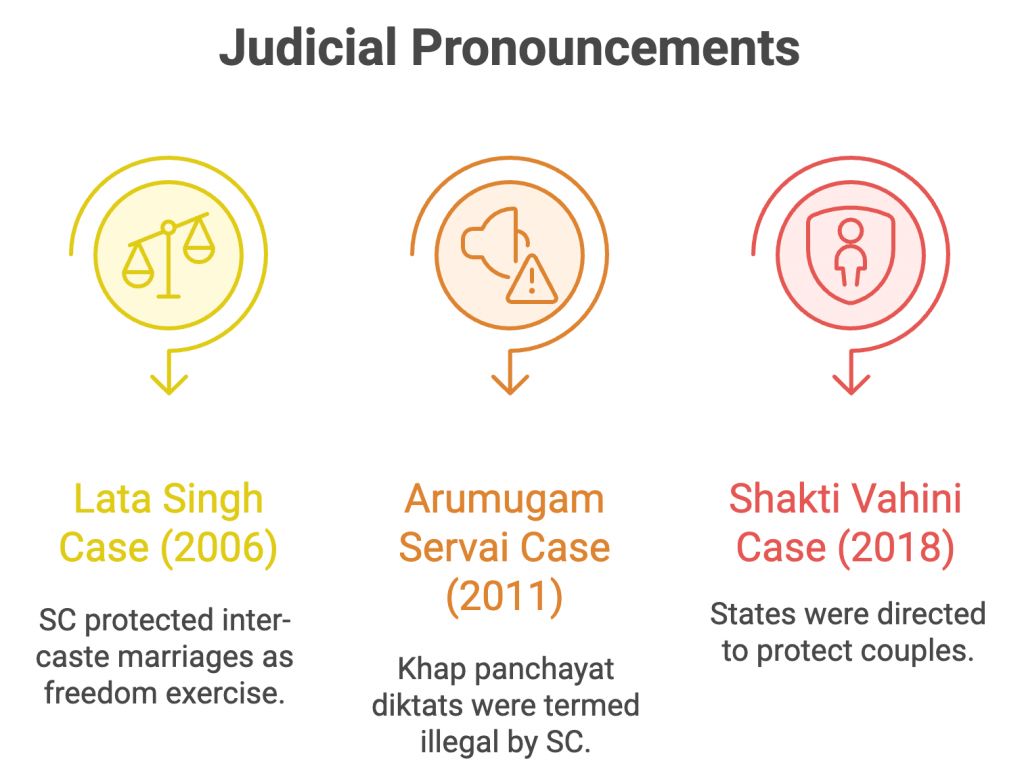
- There is no standalone central law on honour crimes yet; cases are prosecuted as murder/attempt etc. under Indian Penal Code (now replaced by BNS) and allied laws, along with SC/ST Atrocities Act where applicable.
- Law Commission (Report 242, in 2012) recommended a specific law to curb unlawful assemblies (Khap interference) in matrimonial choice.
- The Rajasthan government in 2019 enacted a special law prohibiting interference with matrimonial alliances in the name of honour/tradition—notable for criminalising collective/community pressure.
Way Ahead
- Dedicated Legislation: Enact a central law criminalising honour crimes and unlawful community interference, building on Law Commission recommendations and Rajasthan’s example.
- Data & Monitoring: Improve NCRB classification to capture all forms of honour crimes (murder, attempt, abetment, threats) with real-time reporting.
- Protection & Rehabilitation: Establish district-level safe shelters, legal aid, counselling, and financial support for inter-caste and inter-faith couples.
SOURCE: TH
Previous article
News In Short 14-August-2025
