



Syllabus: GS3/ Science & Technology (Space)
Context
- Astronomers have recently observed a previously unknown type of supernova, in which a massive star exploded under the gravitational influence of a black hole companion.
What is Supernova?
- Hydrostatic Equilibrium in a Star: A star survives because of a balance between;
- Gravity which is pulling matter inward and
- Nuclear Fusion, releasing energy outward by fusing hydrogen into helium, and later heavier elements.
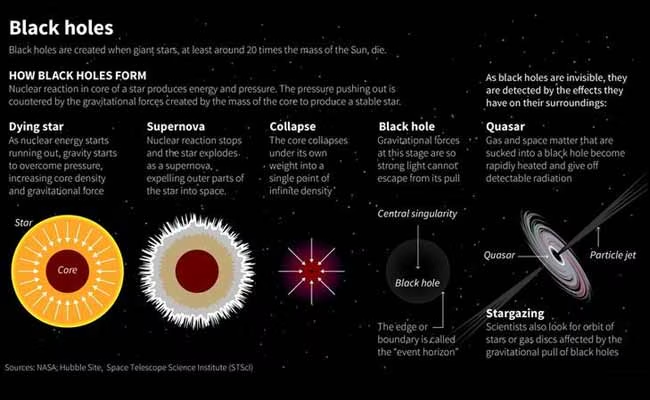
- A supernova is a powerful and luminous stellar explosion, occurring when a star reaches the end of its life. This happens when a massive star’s core collapses under gravity after it runs out of nuclear fuel.
- This collapse triggers a shockwave that blasts the star’s outer layers into space, creating a supernova.
Types of Supernovae
- Core-Collapse Supernova (Type II, Ib, Ic): These supernovae occur in massive stars that are at least eight times the mass of the Sun. When nuclear fusion stops, the core collapses and outer layers blast outward. It leaves behind;
- A neutron star (if mass is at least eight times as massive as the sun), or
- A black hole (if mass is at least 20 times that of the sun).
- Thermonuclear Supernova (Type Ia): It occurs in binary star systems where a white dwarf star accumulates matter from its companion.
- When the white dwarf exceeds the Chandrasekhar Limit of approximately 1.4 solar masses it leads to core compression and runaway nuclear fusion, resulting in a Type Ia supernova with no core remnant.
What is a Black Hole?
- A black hole is an extremely dense object whose gravity is so strong that nothing, not even light, can escape it.
- Characteristics: A black hole does not have a surface, like a planet or star. Instead, it is a region of space where matter has collapsed in on itself, resulting in a huge amount of mass being concentrated in an incredibly small area.
- The center of a black hole is a gravitational singularity, a point where the general theory of relativity breaks down. A black hole’s great gravitational pull emerges as if from the singularity.
- Event horizon is the boundary around a black hole. It marks the point beyond which nothing can return.
- The concept of black holes was theorized by Albert Einstein in 1915 through his General Theory of Relativity.
- The term “black hole” was later coined by John Archibald Wheeler in the 1960s.
About the recent phenomenon
- A binary star system, about 700 million light-years away, initially composed of two massive stars, was observed.
- One of the stars reached the end of its life, going supernova and collapsing into a black hole.
- The surviving companion star, at least 10 times as massive as the Sun, gradually spiraled closer to the black hole.
- The black hole distorted the star and pulled away its material. Eventually, the star exploded in a supernova-like event.
- Significance of the event:
- Triggered by a Black Hole: Unlike typical supernovae caused by internal instabilities, this explosion was likely induced by the tidal pull of a companion black hole.
- Pre-Explosion Signatures: Astronomers noticed bright emissions years before the explosion, likely due to the black hole stripping the star’s hydrogen layer.
Source: DD News
Previous article
S&P Upgrades India’s Sovereign Rating to ‘BBB’
Next article
News In Short 18-August-2025
