


Syllabus: GS2/Health
In Context
- India is emerging as a global health leader through visionary governance, universal healthcare, and strong infrastructure, aiming for a prosperous Viksit Bharat by 2047.
Present status of India’s Health care
- India has emerged as a global health powerhouse through strong government leadership, expanding healthcare infrastructure, and a focus on universal health coverage.
- Flagship schemes provide public health insurance, free healthcare services, and subsidised medicines, aiming to ensure affordable and quality healthcare for all, especially vulnerable populations, as part of the vision for a developed India by 2047.
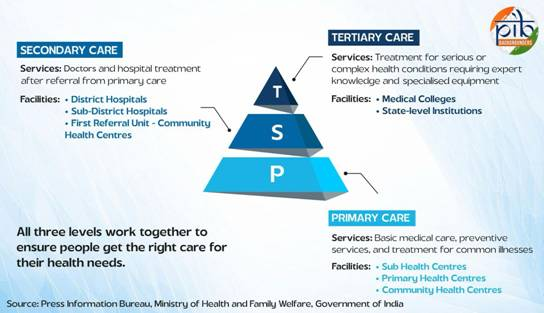
- The country’s medical education system has expanded significantly, while its pharmaceutical sector—third largest globally by volume—supplies affordable medicines worldwide, including COVID-19 vaccines.
- The rapidly growing biopharmaceutical industry is supported by public investment and private innovation.
- Medical tourism has also surged, rising from about 112,000 visitors in 2009 to over 600,000 in 2024.
- To strengthen this sector, the Union Budget 2026–27 announced five integrated medical hubs with advanced diagnostics and rehabilitation services. Overall, India is increasingly positioned as a major contributor to global public health.
Steps and Progress
- The Ayushman Bharat (AB) scheme is India’s flagship initiative for universal health coverage, targeting socio-economically vulnerable populations. It integrates four key components:
- AB-Pradhan Mantri Jan Arogya Yojana (PM-JAY) – the world’s largest public health insurance scheme, providing up to ₹5 lakh per family annually for secondary and tertiary care, covering over 120 million people with more than 434 million Ayushman cards issued.
- Budget 2026–27 allocates ₹9,500 crore (~$1.05 billion USD) to expand coverage and improve services.
- Ayushman Arogya Mandirs (AAMs) – upgraded sub-health and primary health centres providing preventive, promotive, and general healthcare close to communities.
- There are 1,84,235 AAMs nationwide, including extensive coverage in tribal and aspirational districts.
- Teleconsultations and wellness programs, including yoga, have reached millions, while screenings cover hypertension, diabetes, oral and breast cancers.
- Pradhan Mantri Ayushman Bharat Health Infrastructure Mission (PM-ABHIM) – strengthens health infrastructure from grassroots to district levels, including AAMs, block public health units, integrated district labs, and critical care hospital blocks.
- It also develops real-time disease surveillance for pandemic preparedness, with Rs. 32,928.82 crore (~$3.63 billion USD) approved for 2021–26.
- Ayushman Bharat Digital Mission (ABDM) – a citizen-centric digital health ecosystem assigning unique health IDs (ABHA) to securely store medical records.
- Over 863 million ABHAs have been created, enabling teleconsultations and last-mile healthcare access. Tele MANAS provides 24×7 mental health support across India in multiple languages.
- AB-Pradhan Mantri Jan Arogya Yojana (PM-JAY) – the world’s largest public health insurance scheme, providing up to ₹5 lakh per family annually for secondary and tertiary care, covering over 120 million people with more than 434 million Ayushman cards issued.
- Drone-Based Medical Services: Pilot projects under the i-DRONE initiative demonstrated the use of drones for delivering vaccines, TB and pathological samples, blood products, and other critical supplies, improving last-mile healthcare in remote and high-altitude regions.
- National Health Mission (NHM): NHM, including the National Rural and Urban Health Missions, strengthens public health through disease prevention, maternal and child care, adolescent health, and communicable/non-communicable disease management.
- Key programs: Universal Immunisation Programme (UIP) provides free vaccines to ~26.7 million newborns and 29 million pregnant women annually.
- HPV Vaccination (2026): Single-dose Gardasil-4 for 14-year-old girls, covering ~11.5 million girls to prevent cervical cancer.
- Mission Indradhanush: Targets children and pregnant women who missed routine immunisations, reducing zero-dose children from 0.11% (2023) to 0.06% (2024).
- Achievements & Infrastructure: COVID-19: 2.2 billion doses administered
- Maternal Mortality Ratio: 83% decline since 1990
- Under-5 Mortality Rate: 75% decline since 1990
- TB incidence: Reduced from 237 to 195 per 100,000 (2015–2023)
- Dialysis, sickle cell screening, measles-rubella immunisation, and tobacco control also show strong progress
- AI Integration (SAHI 2026): AI supports healthcare delivery via triaging, predictive analytics in TB, diabetic eye screening, and electronic prescriptions, improving efficiency and proactive care.
- Affordable Medicines: Pradhan Mantri Bhartiya Janaushadhi Pariyojana (PMBJP): 17,990 outlets offering 2,000+ medicines at 50–90% lower prices, saving ~₹30,000 crore (~$3.31B USD).
- AMRIT Pharmacies: Focus on tertiary care medicines and surgical products; 255 outlets with plans to expand.
- Pharmaceutical & Biopharma Leadership: India: 3rd largest pharma producer, supplying 20% of global generics and 70% of anti-retrovirals.
- Biopharma SHAKTI & National Biopharma Mission boost domestic biologics, clinical trials, and innovation, e.g., first DNA COVID vaccine ZyCoV-D, MRI scanner, and biosimilars.
- Health Education Expansion: 23 AIIMS institutes, 2,045 medical colleges (780 allopathy, 323 dental, 942 AYUSH)
- MBBS seats increased 130% (51,348 → 118,190); postgraduate seats 138% (31,185 → 74,306).
Challenges
- Public health spending in India remains under 2 per cent of GDP, despite repeated commitments to raise allocations.
- Infrastructure Deficits and Workforce Shortages: Healthcare infrastructure, especially in rural areas, remains inadequate with shortages of beds, medical equipment, and trained doctors, nurses, and paramedics.
- Urban-rural healthcare gaps remain, with rural areas lacking professionals and high private costs increasing out-of-pocket expenses.
- Private sector dominance leads to high out-of-pocket expenditure.
- Rising NCDs like diabetes, heart disease, and cancer are straining healthcare, highlighting the need for prevention and chronic care management.
Conclusion
- India’s healthcare has transformed through government initiatives, digital innovation, and public health programs, improving access and affordability.
- But challenges in funding, infrastructure, and equity remain, requiring continued investment to achieve universal, resilient healthcare.
Source :PIB
Previous article
Missile Defence Systems
Next article
PM Inaugurates India’s First Semiconductor Plant
