


Bab el-Mandab Strait
Syllabus: GS1/ Places in News
In News
- Concerns have risen over the possible disruption of the Bab el-Mandab Strait, following the entry of the Iran-backed Houthis of Yemen into the ongoing Middle East conflict.
About
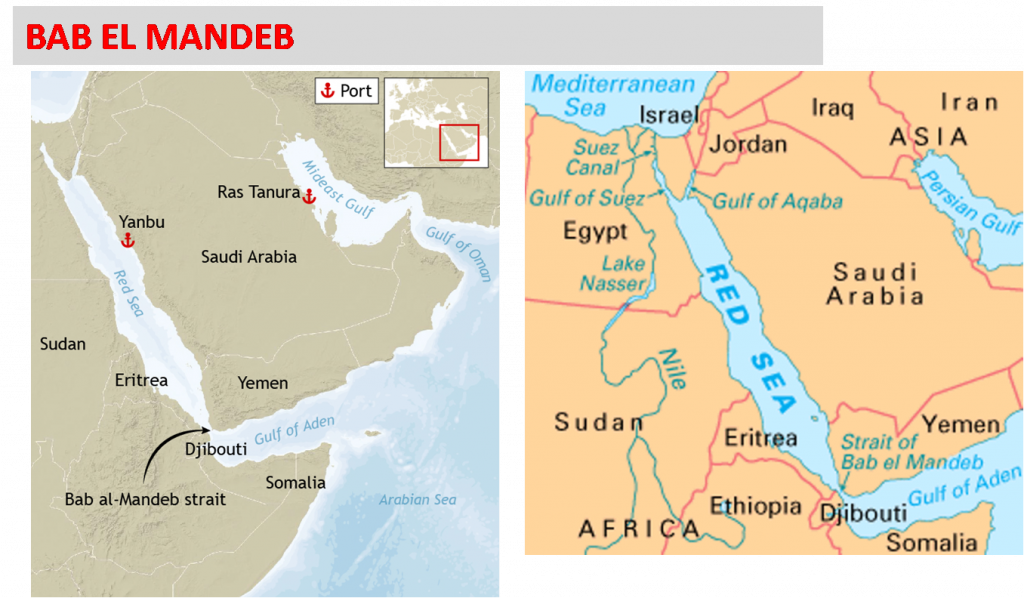
- The Bab el-Mandab Strait, also known in Arabic as the “Gate of Tears,” is located at the southern tip of the Red Sea.
- It lies between Yemen on one side and the Horn of Africa on the other.
- It connects the Red Sea with the Gulf of Aden, and further with the Indian Ocean.
- It is one of the world’s most important maritime chokepoints.
Strategic Importance
- The Bab el-Mandab accounts for roughly 10–12% of global oil and natural gas shipments.
- It is strategically important because it connects with the Suez Canal, which further links it to the Mediterranean Sea.
- It is also linked to the SUMED pipeline, making it a vital corridor for global energy and trade flows.
- According to the US Energy Information Administration, more than 30 million tonnes of natural gas passed through this strait in the first 11 months of 2023.
- It also carried large volumes of container traffic,and around 12% of total seaborne-traded oil.
Source: AIR
Samrat Samprati
Syllabus: GS1/ Culture
In News
- The Prime Minister inaugurated the Samrat Samprati Sangrahalay (Jain Heritage Museum) at Koba Tirth in Gandhinagar, Gujarat.
About Samrat Samprati
- A Mauryan emperor and grandson of emperor Ashoka.
- Also known by the names Indrapalit, Sangat, and Vigatashok.
- His life is described in Jain scriptures including Sampratikatha, Parishistaparva, and Prabhavakcharita.
- Referred to as ‘Jain Ashoka’ for his pivotal role in spreading Jainism and the principle of ahimsa (non-violence) across the subcontinent.
- PM Modi noted that Samrat Samprati expanded ahimsa from the throne and propagated Satya (Truth), Asteya (non-stealing), and Aparigraha (non-possessiveness) with detachment and selflessness — treating power as service and sadhana. Prime Minister of India
- Known to have built and repaired many Jain temples across the subcontinent.
Source: TH
CSIR Transfers Indigenous Bio-Bitumen Technology
Syllabus: GS3/Environment
Context
- The Council of Scientific and Industrial Research (CSIR) organised a Technology Transfer Event for its innovative technology titled “Bio-Bitumen from Lignocellulosic Biomass – From Farm Residue to Roads”.
Bio-Bitumen
- Developed By: Jointly CSIR-Central Road Research Institute and CSIR-Indian Institute of Petroleum.
- It has been developed for adoption by the Ministry of Road Transport and Highways (MoRTH) in road construction.
- The bio-bitumen technology utilises agricultural biomass and crop residues as feedstock through a thermochemical conversion process, producing a renewable and environmentally friendly alternative to petroleum-based bitumen.
- The technology has demonstrated performance equivalent to conventional bitumen while offering substantial environmental and economic benefits.
- Significance: The initiative will help in reducing pollution from crop residue burning.
- India currently imports nearly 50% of its bitumen requirement, and innovations like bio-bitumen would significantly reduce foreign dependence while strengthening domestic capabilities.
Bitumen
- Bitumen is a black, viscous mixture of hydrocarbons produced by the fractionation of crude oil, and it serves as a crucial binder in road construction.
- The process of making bio-bitumen involves collection of post-harvest rice straw, palletisation, pyrolysis to produce bio-oil, and subsequent blending with conventional bitumen.
Source: PIB
Ultraluminous x-ray Source (ULX)
Syllabus: GS3/ S&T
In News
- Scientists from the Raman Research Institute (RRI) have analysed rare, repeating bursts of energy from a distant ultraluminous X-ray source (ULX).
What is a ULX?
- The study focuses on ULX M74 X-1, located in the spiral galaxy M74, where astronomers observed irregular but recurring X-ray flares.
- ULXs are systems in which a compact object—such as a black hole or neutron star—pulls in matter from a companion star.
- This process, known as accretion, releases enormous amounts of energy.
- In some cases, these sources exceed the Eddington limit, the theoretical maximum brightness an object can achieve, by more than 100 times.
- ULXs (Ultraluminous X-ray Sources) are accreting binary systems, a compact object (black hole or neutron star) pulling in material from a companion star.
- The Eddington limit is the cap on how bright a celestial object can shine, and it depends mainly on the object’s mass.
- ULXs consume material so fast that they become more luminous than this critical limit — sometimes by over 100 times.
Source: DDNews
Indian National Space Promotion and Authorization Centre (IN-SPACe)
Syllabus: GS3/ Space
In News
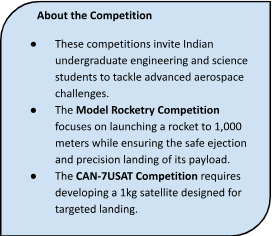
- The Indian National Space Promotion and Authorization Centre (IN-SPACe) has opened applications for the second edition of IN-SPACe’s Model Rocketry Competition.
About IN-SPACe
- It was an autonomous single-window nodal agency under the Department of Space (DoS) established in 2020 as part of India’s space sector reform announcements.
- It was established to promote, enable, authorise, and supervise various space activities of Non-Governmental Entities (NGEs).
- Its responsibilities include enabling the building of launch vehicles and satellites, supporting the provision of space-based services, facilitating the sharing of space infrastructure and premises under DoS/ISRO, and supporting the establishment of new space infrastructure and facilities.
Recent Initiatives
- Technology Adoption Fund (TAF): Announced in February 2025, a ₹500 crore fund to assist space technology companies, with focus on startups and MSMEs in developing commercially viable products.
- Satellite Bus as a Service (SBaaS): Launched in April 2025, enables Indian NGEs to develop indigenous small satellite bus platforms for hosted payload services.
- FDI Policy Reform: Government amended FDI policy to allow 100% FDI in most space sectors, attracting international investment.
Source: TH
Solid Waste Management (SWM) Rules, 2026
Syllabus: GS3/Environment
Context
- The Ministry of Environment, Forest and Climate Change has notified the Solid Waste Management (SWM) Rules, 2026.
About
- It replaced the 2016 framework, with effect from April 1, 2026.
- It is issued under the Environment (Protection) Act, 1986.
- Aim: To strengthen waste handling through the principles of circular economy and extended producer responsibility.
- Mandatory Segregation: It has the mandatory four-stream segregation of waste at source – wet, dry, sanitary and special care waste.
- Wet waste such as food and organic matter must be composted or processed locally.
- Dry waste including plastic, paper and metal will be routed to material recovery facilities for recycling.
- Sanitary and hazardous household waste will require separate handling through authorised channels.
- Accountability of Bulk Generators: The rules tighten accountability for bulk waste generators, mandating on-site processing where feasible and introducing an Extended Bulk Waste Generator Responsibility mechanism.
- Digital Governance: The Central Pollution Control Board is set to roll out a centralised online portal to track the entire waste lifecycle, from generation to disposal.
- The system will also streamline registrations, reporting and audits of waste facilities.
- Defined Role: Local bodies have been assigned a more defined role in collection, segregation and transportation, with material recovery facilities formally recognised as key sorting hubs.
- The rules also promote the use of refuse-derived fuel (RDF) in industries, raising the substitution rate from 5% to 15% over six years.
- It is a high-calorific fuel produced by processing non-recyclable municipal solid waste (MSW).
- Provisions for Hilly and Island Regions: It includes user fees for tourists and decentralised waste processing by hotels and establishments, aimed at reducing environmental pressure in ecologically sensitive areas.
Source: DD
Previous article
Energy Statistics India 2026
Next article
New Income Tax Act, 2025
