


Syllabus: GS3/Economy
Context
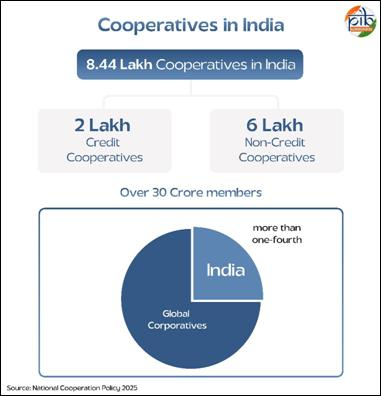
- Centre has informed Lok Sabha that of the 8.48 lakh societies, 2.11 lakh are in loss, 1.41 lakh non-functional and 47,688 under liquidation.
Major Highlights
- Only 3.49 lakh cooperatives are in profit.
- Uttar Pradesh has the highest percentage of defunct societies at 41.8% , followed by Madhya Pradesh, Rajasthan, Andhra Pradesh and West Bengal.
- The condition of smaller States is even worse Nagaland (72.7%), Delhi (67.1%), Sikkim (55.3%), Manipur (52%) and Chandigarh (46.4%).
- Among the top ten States with the highest number of cooperatives, southern and western States Maharashtra, Gujarat, Tamil Nadu, Karnataka and Telangana have managed to keep most of their societies afloat.
- West Bengal, U.P., Madhya Pradesh, Rajasthan have at least 25% of their societies defunct.
- The five States with the largest number of cooperatives are Maharashtra, Gujarat, Telangana, Karnataka and Madhya Pradesh amount to 93.44% of societies under liquidation.
Why are Cooperatives Performing Badly?
- Dairy Cooperatives: Act as income stabilizers for farmers, but post-COVID price crashes hurt viability; despite a 25% production rise, rising input and procurement costs due to climatic and global factors continue to strain the sector.
- Housing Cooperatives: Facing financial stress due to losses in scam-hit cooperative banks, along with internal issues like non-payment of dues, fund mismanagement, and delays in redevelopment.
- Credit & Thrift Societies: Weak regulation and small financial base lead to arbitrary lending practices, high interest burdens, and increased vulnerability due to scams and poor governance.
- Women’s Cooperatives: Growth constrained by limited financial access, social barriers, lack of networks, and high work-life stress, restricting effective participation and entrepreneurship.
What are Cooperatives?
- A cooperative (or co-op) is an organization or business that is owned and operated by a group of individuals who share a common interest, goal, or need.
- These individuals, known as members, participate in the cooperative’s activities and decision-making process, typically on a one-member, one-vote basis, regardless of the amount of capital or resources each member contributes.
- The main purpose of a cooperative is to meet the economic, social, or cultural needs of its members, rather than to maximize profits for external shareholders.
- The UN SDGs recognize cooperatives as crucial drivers of sustainable development, particularly in reducing inequality, promoting decent work, and alleviating poverty.
97th Constitutional Amendment Act 2011
- It established the right to form cooperative societies as a fundamental right (Article 19).
- It included a new Directive Principle of State Policy on the Promotion of Cooperative Societies (Article 43-B).
- It added a new Part IX-B to the Constitution titled “The Co-operative Societies” (Articles 243-ZH to 243-ZT).
- It authorizes the Parliament to establish relevant laws in the case of multi-state cooperative societies (MSCS) and state legislatures in the case of other cooperative societies.
Benefits of Cooperatives
- Democratic Control: Members have a voice in decision-making.
- Economic Participation: Profits are distributed based on usage or contribution, not capital invested.
- Community Focus: Co-ops often aim to benefit local communities by keeping resources and profits within the group.
- Better Services/Prices: By pooling resources, cooperatives often offer better services or prices than for-profit businesses.
Types of Cooperatives in India
- Agricultural Cooperatives:
- Dairy Cooperatives: Focus on the collective production, processing, and marketing of dairy products (e.g., Amul).
- Farmers’ Cooperatives: Provide services like access to seeds, fertilizers, and agricultural equipment, and help with marketing and processing crops.
- Fishermen Cooperatives: Support fishermen in managing resources and marketing their catch collectively.
- Consumer Cooperatives: These cooperatives are formed to provide goods and services to members at reasonable prices, reducing reliance on middlemen. Examples include consumer stores and fair-price shops.
- Worker Cooperatives: In these cooperatives, workers own and manage the business, sharing profits and decision-making. Examples include small-scale manufacturing cooperatives or artisan co-ops.
- Credit Cooperatives: Cooperative Banks and Credit Societies offer financial services, such as savings accounts, loans, and credit, to members, particularly in rural and underserved areas.
- Housing Cooperatives: These cooperatives help members collectively build or manage housing projects, providing affordable living spaces, especially in urban areas.
Challenges Faced:
- Weak Governance: There are issues of poor management, corruption, and political interference, leading to inefficiency and lack of transparency.
- Limited Access to Credit: Many cooperatives struggle with access to financing, which hinders their ability to expand or improve their operations.
- Competition from Private Sector: Cooperatives often face stiff competition from large private enterprises and multinational corporations, especially in sectors like retail and agriculture.
- Technological Gaps: Many cooperatives, especially in rural areas, lack access to modern technology or are slow to adopt new systems that could improve efficiency.
Legal Framework and Support for Cooperatives:
- In India, cooperatives are governed by the Cooperative Societies Act, which is implemented at both the state and national levels.
- The Multi-State Cooperative Societies Act (2002): This law regulates cooperatives that operate in more than one state.
- The National Cooperative Policy (2002): Aimed at creating an enabling environment for the cooperative movement, it focuses on improving governance, member participation, and financial sustainability.
- The Ministry of Cooperation: Established in 2021, this ministry focuses on supporting the growth of cooperatives in India, including reforming their governance and providing financial support.
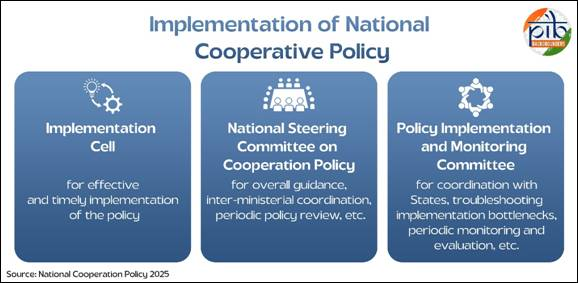
- National Cooperation Policy 2025: It aims to build on the unique strengths of India’s cooperative tradition, promote economic democratization, and uplift rural economies through collective participation.
Way Ahead
- Cooperatives in India have proven to be an essential tool for economic empowerment, especially for marginalized groups, and contribute significantly to rural development.
- With the rollout of the National Cooperation Policy, 2025, the Centre has shown intent to strengthen the cooperative system in India.
Source: TH
Previous article
Sanand as India’s Semiconductor Hub: ‘Bridge’ to Silicon Valley
Next article
Energy Statistics India 2026
