


Syllabus: GS1/ Geographical Phenomena
Context
- India is witnessing increasing weather extremes such as unseasonal rainfall, heatwaves, and humidity due to climate phenomena like Western Disturbances, El Niño, and La Niña, which significantly influence the country’s monsoon, agriculture, and public health.
What are Heat Waves?
- A heat wave is a period of unusually high temperatures departing from the normal, and varies from region to region depending on the historical temperatures observed in the region.
- The basic criteria for IMD to declare a heatwave are when a place’s temperature exceeds 40 degrees Celsius (°C) in the plains, 37°C in coastal areas, and 30°C in the hills.
Feels Like Temperature, Heat index and Wind chill index
- “Feels like” temperature or apparent temperature accounts for wind and humidity conditions to determine what the outdoor air temperature will feel like in relation to your body temperature.
- Heat index, a type of apparent temperature, measures how hot a human body feels when combining relative humidity with the actual temperature.
- Wind chill index, another type of apparent temperature which combines temperature and wind speed.
- It measures how cold it actually “feels” on exposed skin as wind takes away the thin layer of warm air your body naturally produces to insulate itself.
Wet Bulb Temperature and Dry Bulb Temperature
- Wet bulb temperature measures the lowest temperature achievable through evaporation. It reflects the combined effect of heat and humidity.
- Importance: Human bodies cool through sweating and evaporation. High humidity reduces evaporation efficiency, making it difficult for the body to cool itself.
- Dry bulb temperature refers to the actual air temperature measured using a standard thermometer.
- It does not account for atmospheric moisture.
What is a Western Disturbance?
- A Western Disturbance (WD) is an extra-tropical weather system that originates outside India and moves from west to east, bringing rain, snowfall, and storms to northern parts of the Indian subcontinent, especially during winter and early spring.
- Origin and Formation:
- Western disturbances originate over the Mediterranean region, Black Sea, or Caspian Sea.
- They form when cold polar air interacts with warmer, moist air, creating low-pressure systems.
- These systems are carried eastward by westerly winds in the upper atmosphere, particularly the subtropical westerly jet stream.
- Regions Affected in India: Jammu & Kashmir, Himachal Pradesh, Uttarakhand, Punjab, Haryana, Delhi, Rajasthan and Western Uttar Pradesh.
- Significance of Western Disturbances:
- 30% of annual precipitation over the North West Indian region (J & K, Ladakh, Himachal Pradesh &Uttarakhand) is received during winter and it is mostly associated with Western Disturbances.
- Precipitation associated with Western Disturbances (WDs) influences Himalayan climate, glaciers, snow-water storage, flora, fauna, agricultural crops and human inhabitants etc.
- Winter rainfall from western disturbances is vital for rabi crops, especially wheat, Mustard, Barley. Adequate rainfall improves soil moisture, crop yield, and food security.
What is ENSO (El Niño–Southern Oscillation)?
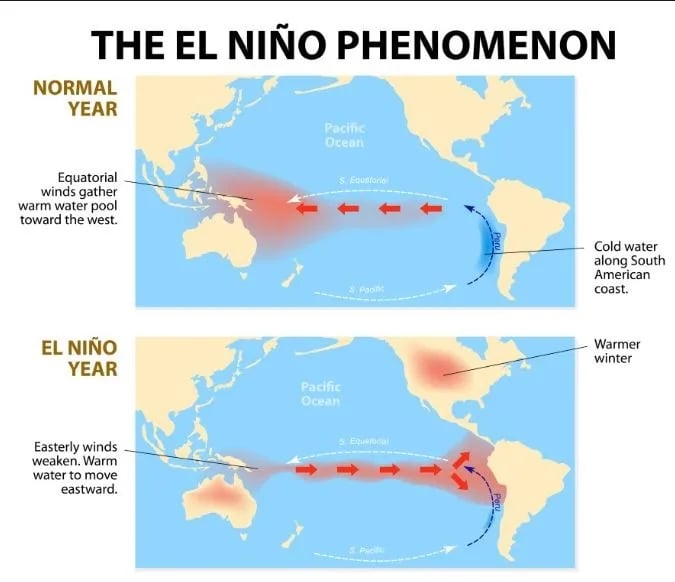
- ENSO is a periodic fluctuation in sea surface temperatures and atmospheric pressure in the equatorial Pacific Ocean. It has two opposite phases: El Niño and La Niña.
- ENSO influences Indian Monsoon, cyclone patterns, droughts and floods and global temperature variability.
What is El Nino?
- El Niño is the warming of seawater in the central-east Equatorial Pacific that occurs every few years.
- During El Niño, surface temperatures in the equatorial Pacific rise, and trade winds, east-west winds that blow near the Equator, weaken.
What is La Nina?
- La Niña is the opposite of El Niño. La Niña witnesses cooler than average sea surface temperature (SST) in the equatorial Pacific region.
- Trade winds are stronger than usual, pushing warmer water towards Asia.
- Impact: This leads to drier conditions in the Southern U.S., and heavy rainfall in Canada. It has also been associated with heavy floods in Australia.
How does it affect the Indian Monsoon?
- In El Niño years, India faces warmer temperatures and less rainfall, causing droughts in some regions.
- This affects agriculture, water resources, and ecosystems.
- The El Nino phenomenon led to 1.4% decrease in food grain production for the 2023-24 (July-June) crop year.
- La Niña brings cooler sea surface temperatures, leading to increased rainfall in certain parts of India.
Way Forward
- India must strengthen climate forecasting and early warning systems.
- Climate-resilient agriculture and water conservation measures should be promoted.
- Urban planning should include green infrastructure and heat mitigation strategies.
- Public awareness regarding heat stress and disaster preparedness must be enhanced.
Source: IE
Previous article
News In Short 11-05-2026
Next article
Saving Forex vs Sustaining Growth
