


Syllabus: GS2/ International Relation
In News
- The 10th Indian Ocean Dialogue (IOD) was held in New Delhi under the theme “Indian Ocean Region in a Transforming World.”
About
- India as IORA Chair (2025–27) used the platform to foreground maritime security, blue economy governance, and innovation all under its MAHASAGAR vision.
- The dialogue gained urgency in the backdrop of escalating West Asian conflict, disruptions in the Strait of Hormuz, and the sinking of the Iranian frigate IRIS Dena near Sri Lanka in March 2026.
Indian Ocean Rim Association (IORA)
- It is an intergovernmental organisation formed on 7 March 1997, born from a vision shared by late South African President Nelson Mandela during his 1995 visit to India.
- It was initially known as the Indian Ocean Rim Initiative (IORI) and later as the Indian Ocean Rim Association for Regional Cooperation (IOR-ARC), before taking its current name.
- The IORA Secretariat is based in Ebène, Mauritius, headed by a Secretary-General appointed for a fixed term.
- Its apex decision-making body is the Council of Ministers (COM), meeting annually.
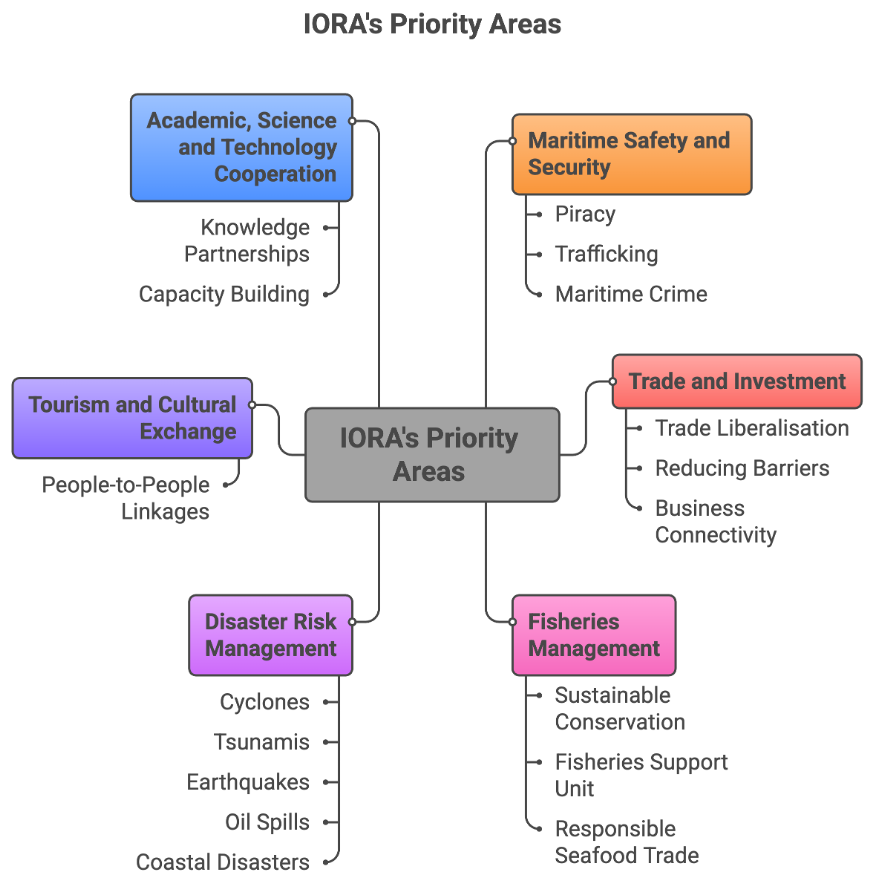
- It currently consists of 23 Member States and 12 Dialogue Partners.

Significance of IORA for India
- Platform to Assert Net Security Provider Role: India’s SAGAR doctrine (2015) and its successor MAHASAGAR vision (2025) both position India as the preferred security partner and first responder in the Indian Ocean. IORA gives this posture a legitimate multilateral home.
- Counterweight to Chinese Influence: China is only a Dialogue Partner in IORA, not a Member State. This structural reality gives India a leadership platform in the Indian Ocean that China cannot dominate from the inside. Unlike China;s BRI, IORA, under Indian leadership, provides an alternative framework for connectivity and cooperation that is not transactional or debt-laden.
- Energy and Trade Security: IORA is India’s institutional mechanism to keep these sea lanes stable through diplomacy before crises require naval deployments.
- Blue Economy and Economic Diversification: IORA’s Blue Economy focus area directly supports India’s ability to set regional standards, attract investment, and build partnerships for sustainable ocean resource use.
- Diplomatic Relevance: IORA is one of the few multilateral spaces where India is a founding voice and current Chair. It allows India to shape the rules of the maritime road on UNCLOS, on freedom of navigation, on sustainable fisheries, on maritime dispute resolution.
- Distinct Identity from Overlapping Groupings: India is simultaneously part of BIMSTEC, the Quad, SCO, IONS, and the G20. Each serves a different purpose. IORA’s value is its unique geographic coverage, it is the only grouping that brings together East Africa, the Arabian Peninsula, South Asia, Southeast Asia, and Australia under one roof.
- Soft Power and Civilisational Outreach: IORA’s Tourism and Cultural Exchange priority area gives India a legitimate platform to strengthen these historical ties, build goodwill, and project soft power across 23 nations in a way that is rooted in shared history rather than manufactured alignment.
- Disaster Diplomacy and Humanitarian Leadership: India has consistently been the first responder to natural disasters in the Indian Ocean from the 2004 tsunami to Cyclone Nargis in Myanmar. IORA’s Disaster Risk Management framework institutionalises this role, allowing India to coordinate regional response mechanisms rather than acting unilaterally.
- Leverage in the Indo-Pacific Narrative: IORA provides India strategic depth for its Indo-Pacific engagement by locking in partnerships with African and Gulf states that are increasingly important in the broader geopolitical contest.
Why Does the Indian Ocean Matter?
- Over 90% of India’s trade by volume and more than 85% of crude oil imports move by sea through the Indian Ocean.
- The Indian Ocean region facilitates roughly 25% of global maritime oil trade.
- Nearly 95% of India’s trade by volume and 68% by value moves through maritime routes.
- Approximately 30–35% of India’s total merchandise exports are shipped through the Red Sea–Suez Canal corridor, especially goods destined for Europe, North America, and North Africa.
Challenges Limiting IORA’s Effectiveness
- Institutional Weakness: IORA functions on voluntary commitments and consensus. It lacks enforcement mechanisms. Compare this to bodies like ASEAN or the Quad, which have more operational coordination capacity.
- Geopolitical Rivalries: India’s deliberate exclusion of Pakistan from IORA (Pakistan sought membership in the early 2000s but was denied on the grounds that it refused MFN status to India, violating IORA’s “sovereign equality” principle) reflects the same bilateral tensions that hobble SAARC.
- Fragmented Regionalism: IORA competes for member-states’ attention and resources with at least 14 other regional or international bodies. The overlap with BIMSTEC, ASEAN, Quad, and IONS can dilute IORA’s cohesion.
- Unequal Development: IORA brings together the UAE, Singapore, and Australia alongside Mozambique, Comoros, and Somalia. This disparity in economic weight creates uneven benefits from participation and can breed resentment.
- Limited Security Mandate: IORA’s charter explicitly excludes bilateral disputes from deliberations. This makes it difficult to address the very conflicts such as the West Asian war that are now reshaping maritime security across the region.
- No Military Dimension: Unlike the Quad or even IONS, IORA has no mechanism for joint naval operations or coordinated military response to threats.
Way Forward
- Strengthen Maritime Domain Awareness (MDA): Expand satellite surveillance, information-sharing mechanisms (building on IFC-IOR), and real-time coordination systems like MANTRA across more IORA members.
- Institutionalise the Blue Economy: Create enforceable standards for sustainable fisheries, marine pollution control, and ocean-based economic activities. The IORA Blue Carbon Hub (run by Australia’s CSIRO) is a good model to replicate.
- Deepen Cooperation on Non-Traditional Threats: Like Piracy, IUU (Illegal, Unreported, Unregulated) fishing, drug trafficking, and climate-induced disasters cross maritime zones.
- Expand IORA’s Budget and Governance: India has pledged to boost IORA’s institutional capacity through public-private partnerships especially from maritime sectors like shipping, oil, gas, and tourism.
- Build Maritime Human Capital: Academic partnerships to create marine-focused courses are needed to develop a skilled regional workforce particularly for blue economy sectors.
Source: TH
Previous article
Operationalisation of the Four Labour Codes
Next article
Sustainable Agriculture
