


Syllabus: GS3/Science and Technology
Context
- According to a report from the Organisation for Economic Co-operation and Development, China has overtaken the US in research and development spending, crossing the $1 trillion mark.
Major Highlights
- R&D Spending Parity Achieved: China’s R&D spending has matched and surpassed the US (Purchasing Power Parity terms).
- Both countries have crossed the $1 trillion research spending mark.
- Legacy of US Scientific Leadership: US breakthroughs include the internet, mRNA vaccines, semiconductors, microprocessors, and GPS.
- This dominance was built on strong public investment and open scientific culture.
- Scientific research contributed over 20% of US productivity growth since World War II, linking innovation directly with economic strength.
- China’s Low Base to Rapid Rise: In 1980, China was among the lowest R&D spenders globally. It has since pursued systematic, state-driven investment in science and technology.
- China Leading in Research Output:
- Surpassed US in top 1% highly cited papers (2019).
- Became global leader in total cited papers (2022).
- Overtook US in total scientific publications (2024).
- In 2024, China filed ~1.8 million patents, far exceeding the US (~603,000). This indicates a strong innovation ecosystem and commercialization push.
Reasons Associated with US Declining Share
- Declining Public Investment in R&D in USA: US federal R&D spending has steadily fallen from 1.86% of GDP (1964) to ~0.66% (2021). Shift from public to private funding has reduced support for basic, open science.
- Shift from Research to Development: Private sector dominates (~78% of R&D) but focuses on commercial development, no open research is leading to a shrinking pool of openly shared scientific knowledge.
- Policy-Induced Constraints on Scientific Openness: There are increasing restrictions on international collaboration, visas, and access.
- Security-driven policies undermine the open exchange system that fueled US scientific leadership.
- Talent Drain and Long-Term Risks: Immigrants contributed ~40% of US Nobel Prizes (since 2000), but inflow is declining.
- Cuts in funding, fewer grants, and reduced openness are causing scientist exodus, which is hard to reverse.
R&D Expenditure in India
- India’s Gross Expenditure on Research and Development (GERD) as a percentage of GDP remained between 0.6% to 0.7% which is below the global average and lower than countries like China, South Korea and the US.
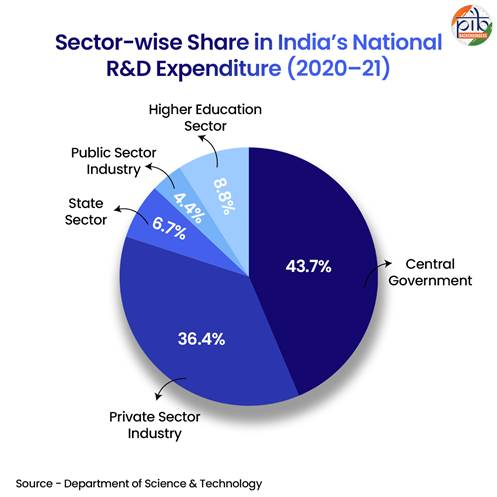
- Another factor contributing to this is the relatively low investment by India’s private sector, accounting for only around 36%, whereas in the aforementioned countries, private sector contributions are more than 70%.
- The Central Government contributes 43.7% of total R&D expenditure.
Need for Funding in R&D
- Economic Growth: Drives new industries, improves productivity, and enhances global competitiveness.
- Technological Advancement: Facilitates breakthroughs in fields like AI, biotechnology, and renewable energy.
- Social Challenges: Helps address poverty, healthcare, education, and environmental sustainability issues.
- Job Creation: Innovation generates employment opportunities and stimulates entrepreneurship.
- Global Positioning: Positions India as a global leader in science, technology, and knowledge.
- Attracts Investment: Promotes foreign and domestic investments in research-driven sectors.
Government Initiatives
- Research, Development and Innovation (RDI) Scheme: Approved with a ₹1 lakh crore corpus, this scheme aims to energise private-sector R&D and deep-tech startups.
- It offers long-term, low- or zero-interest loans, equity investments, and funds a new Deep-Tech Fund of Funds via the Anusandhan National Research Foundation (ANRF).
- Anusandhan National Research Foundation (ANRF): The ANRF established in 2023, provides high-level strategic direction for research, innovation, and entrepreneurship in science and technology.
- The Foundation aims to mobilise funds amounting to ₹50,000 crore during 2023–28 through multiple streams, including the ANRF Fund, Innovation Fund, Science and Engineering Research Fund, and Special Purpose Funds.
- National Geospatial Policy, 2022: It seeks to position India as a global leader in the geospatial sector by 2035.
- The policy liberalises access to geospatial data, encouraging its use in governance, business, and research.
- Indian Space Policy, 2023: It builds on the space reforms introduced in 2020, which opened the domain to non-governmental entities for end-to-end participation.
- It aims to enhance space capabilities, promote a flourishing commercial space industry, and foster collaboration between public and private entities.
- National Quantum Mission: Allocated ₹6,003.65 crore for 2023–31, to advance quantum technologies through scientific and industrial R&D.
- BioE3 Policy, 2024: It encourages the creation of Biomanufacturing and Bio-AI hubs, along with a national Biofoundry network, to accelerate technology development and commercialisation.
- National Supercomputing Mission (NSM): Launched in 2015, the initiative empowers universities, research institutions, and government agencies with state-of-the-art supercomputing systems connected through the National Knowledge Network.
- India Semiconductor Mission (ISM): Established in 2021, the mission seeks to build a robust ecosystem for semiconductor and display manufacturing.
- India has already approved 10 semiconductor projects across six states, including the first commercial Silicon Carbide fabrication facility in Odisha.
- India AI Mission: The IndiaAI Mission embodies the vision of “Making AI in India and Making AI Work for India.”
- It is advancing rapidly, having already increased computing capacity from an initial target of 10,000 GPUs to 38,000 GPUs, ensuring accessible AI infrastructure for startups, researchers, and industries.
- Atal Innovation Mission (AIM): To foster innovation at the grassroots level by providing support to students, startups, and entrepreneurs.
- The National Mission on High-Yielding Seeds will focus on strengthening the research ecosystem and developing high-yielding, pest-resistant, and climate-resilient seeds, aligning with DBT’s efforts in agricultural biotechnology.
Source: DTE
Previous article
India and New Zealand Signed FTA
