

Syllabus: GS3/ Economy
Context
- India is facing a significant fertilizer challenge due to rising global prices and supply disruptions triggered by geopolitical tensions, particularly around the Strait of Hormuz amid the US–Israel vs Iran conflict.
Nature of the Crisis
- Sharp Increase in Prices: Urea prices have nearly doubled within a short period, increasing from around $508 per tonne in February to about $935 per tonne in April.
- Input materials such as sulphur and ammonia have also witnessed steep price increases, significantly raising fertiliser production costs.
- High Import Dependence: India annually consumes 39-40 million tonnes (mt) of urea, of which 25% is imported.
- Gulf countries account for nearly 40% of India’s urea imports, making supply chains vulnerable to regional instability.
- India also relies on West Asia for more than 60% of its liquefied natural gas (LNG), which is a key input for domestic urea production.
- Structural Imbalance in Fertiliser Use: Urea accounts for nearly 55% of India’s total fertiliser consumption, reflecting a heavy imbalance in nutrient usage.
- Subsidy policies and price controls have encouraged excessive use of urea over other nutrients.
What are Fertilizers?
- Fertilizers are concentrated plant nutrients made from inorganic chemicals.
- Unlike organic manure, fertilizers contain nutrients in higher amounts and are applied in smaller quantities.
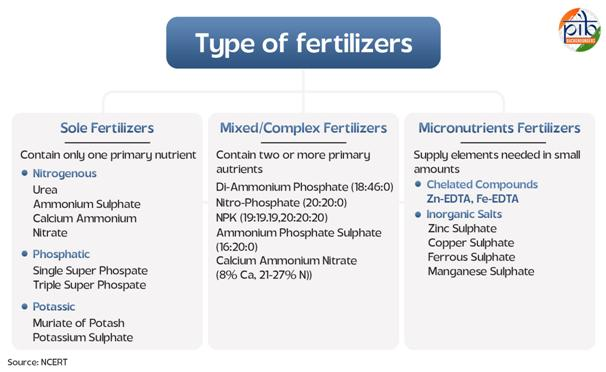
Subsidy Framework & Pricing Dynamics of fertilizers
- Urea Subsidy Scheme: Under the scheme, urea is provided to farmers at a statutorily notified maximum retail price (MRP).
- The MRP of 45 kg bag of urea is ₹242 per bag (exclusive of charges towards neem coating and taxes as applicable) while the actual cost is around ₹3,000 for 45 kg bag.
- Nutrient-based subsidy policy: It aims to promote the balanced use of fertilizers by linking subsidies to the nutrient content (nitrogen, phosphorus, potash, and sulfur) rather than the final product.
- Under this scheme, the government sets a fixed subsidy amount per kilogram for each nutrient in P&K fertilizers.
Government’s Initiatives in the Fertilizer Sector
- The Government introduced the Nutrient Based Subsidy (NBS) scheme in 2010 for phosphatic and potassic fertilizers.
- Under this scheme, a fixed subsidy is provided for subsidised P and K Fertilizers, including di-ammonium phosphate, based on their nutrient content.
- The One Nation One Fertilizer scheme was introduced to bring uniformity in branding and ensure transparency in the Fertilizer sector.
- PM PRANAM scheme: PM Programme for Restoration, Awareness Generation, Nourishment and Amelioration of Mother – Earth (PMPRANAM) was launched to incentivize States/ Union Territories to promote alternate fertilizers and balanced use of chemical fertilizers.
Way Ahead
- Capacity Expansion: Speeding up commissioning of domestic urea plants under “Atmanirbhar Bharat” will reduce import reliance.
- Sustainable Practices: Wider adoption of nano-urea, bio-fertilisers, and soil health cards can reduce chemical fertiliser intensity over time.
- Improving Supply Chain Resilience: India should diversify its import sources to reduce dependence on specific regions. Strategic reserves of fertilisers should be developed to manage future disruptions.
- Encouraging Biostimulants: Biostimulants should be promoted as they enhance nutrient uptake and improve plant metabolism.
- These products can reduce the effective requirement of chemical fertilisers by improving their efficiency.
Source: IE
Previous article
News In Short 20-04-2026
Next article
India-South Korea Special Strategic Partnership
