


Chandra Shekhar
Syllabus: GS1/History
In News
- The Prime Minister paid tribute to former PM Chandra Shekhar on his birth anniversary, marking his 100th birth year.
Chandra Shekhar (1927–2007)
- Birth: Chandra Shekhar was born on 17 April 1927 in Ibrahimpatti village, Ballia district, Uttar Pradesh, in a farmer’s family.
- Education: He completed a Master’s degree in Political Science from Allahabad University (1950–51).
- Early political involvement: He Joined the Socialist Movement during student life and worked closely with Acharya Narendra Dev.
- He held key positions in the Praja Socialist Party at district and state levels in Uttar Pradesh.
- Rise in politics (1950s–60s): He Became Secretary/General Secretary in the Uttar Pradesh Praja Socialist Party. Elected to the Rajya Sabha in 1962.
- Shift to Congress: He Joined the Indian National Congress in 1965 and became General Secretary of the Congress Parliamentary Party in 1967.
- Political ideology & reputation: He was Known as a “Young Turk” leader for strong ideology, integrity, and opposition to monopoly power and vested interests.
- He supported the politics of social change over personality-based politics.
- He was Influenced by and closely associated with Jayaprakash Narayan during the 1970s opposition movement.
- Journalism & writing: He Founded and edited Young Indian (1969), a weekly publication. Wrote Meri Jail Diary and Dynamics of Social Change.
- Emergency period (1975–77): He was Arrested under (Maintenance of Internal Security Act)MISA during the Emergency despite being in the ruling party; Young Indian was shut down during this time.
- Social work initiatives: He established around 15 Bharat Yatra Centres across India for training social and political workers.
- He undertook a 4260 km walk from Kanyakumari to Rajghat (New Delhi) to connect with people and understand grassroots issues.
- Parliamentary career: Member of Parliament for most of the period from 1962 onward, except 1984–1989. In 1989, won elections from Ballia and Maharajganj (later vacated one seat).
- Chandra Shekhar served as Prime Minister of India from 10 November 1990 to 21 June 1991.
Source :PIB
Marine Heatwaves
Syllabus: GS1/Physical Geography
In Context
- Tropical cyclones passing over marine heatwaves (MHWs) cause 60% more billion-dollar disasters through rapid intensification, warns a new study.
What Are Marine Heatwaves?
- A Marine Heatwave (MHW) is a prolonged period of anomalously high ocean surface temperatures in a specific region. They are characterised by two key parameters:
- Duration: Lasting anywhere from several days to several months.
- Intensity: Measured as a deviation from the long-term seasonal average, known as a temperature anomaly.
Key Drivers
- Climate Change: Oceans absorb 90%+ of excess atmospheric heat, raising baseline temperatures
- Ocean Currents: Warm water pools shift into cooler regions.
- Atmospheric Systems: High-pressure systems like the North Pacific High trap surface heat
- El Niño: Elevates Pacific sea surface temperatures, triggering the largest recorded MHWs.
Source: TH
Memory Price Inflation (Memflation)
Syllabus: GS3/Economy
In News
- Gartner’s 2026 global semiconductor revenue forecast of $1.3 trillion cited memflation as a key driver of the industry’s third consecutive year of double-digit growth.
About Memflation
- Inflation refers to a general rise in the overall prices of goods and services in an economy over time.
- Memflation refers to a structural economic trend where prices of semiconductor memory rise rapidly and persistently over time.
Source :TH
Amazon Rainforests
Syllabus: GS3/ Environment
Context
- A recent study shows that consecutive droughts in 2023–2024 pushed Amazon rainforest moisture and biomass to their lowest levels in over three decades, indicating severe ecological stress.
About Amazon Rainforest
- The Amazon Rainforest lies within the Amazon River Basin.
- The Amazon River is the world’s largest river by discharge volume and the second-longest river globally, after the Nile. It originates in the Peruvian Andes and drains into the Atlantic Ocean.
- Major Tributaries: Rio Negro, Madeira, and Xingu
- Watershed Coverage: Brazil, Peru, Ecuador, Colombia, Venezuela, and Bolivia
- The forest stretches across 9 countries, with approximately 60% of its cover located in Brazil. The remaining forest is distributed across Peru, Colombia, Venezuela, Ecuador, Bolivia, Guyana, Suriname, and French Guiana.
- The Amazon is one of the richest biodiversity hotspots on Earth, hosting approximately 10% of all known wildlife species.
Source: TH
Kerala Botanist’s Innovation in Tackling Invasive Species
Syllabus: GS3/ Environment
Context
- N. Alim Yusuf, a botanist from Malabar Botanical Garden and Institute for Plant Sciences, has received the World Wide Fund for Nature National Award for developing an application to detect invasive plant species in Kerala.
About the Innovation
- The application, Neophyte ID, is an AI-powered mobile tool that enables users to identify invasive plant species by capturing images.
- It is built using the advanced machine learning model YOLOv11, which allows real-time object detection.
- The app can identify nearly 100 invasive plant species found in Kerala.
- It is available in Malayalam and English, making it accessible to local communities.
- It integrates geospatial tracking to map the spread of invasive species, aiding scientific research and policy intervention.
What are Invasive Species?
- Invasive alien species are non-native plants or organisms that spread rapidly and disrupt local ecosystems. They often outcompete native species, leading to biodiversity loss and ecological imbalance.
- The characteristics of invasive alien species are:
- Rapid reproduction and growth,
- High dispersal ability,
- Phenotypic plasticity (ability to adapt physiologically to new conditions), and
- Ability to survive on various food types and in a wide range of environmental conditions.
- Example: Senna spectabilis, Lantana camara, Eupatorium and Dolichandra unguis-cati.
Source: TH
Shahtoosh Wool
Syllabus: GS3/ Environment
Context
- A Delhi court has convicted a Jaipur-based art gallery owner for attempting to illegally export Shahtoosh shawls.
About
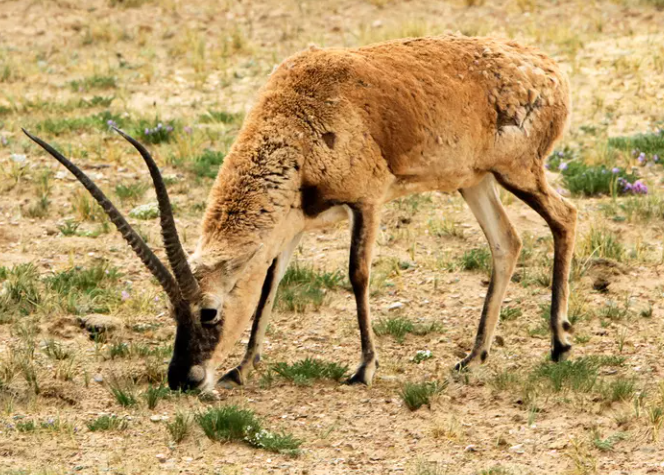
- Shahtoosh Wool is derived from the hair of the Tibetan Antelope, also known as Chiru. The animal is killed to obtain the wool.
- Trade in Shahtoosh is strictly prohibited in India and has also been banned globally.
Tibetan Antelope (Pantholops hodgsonii)
- The Chiru is a medium-sized bovid endemic to the high-altitude alpine steppes of the Tibetan Plateau (3,250–5,500m).
- Habitat: They inhabit the arid, cold grasslands of Tibet, Qinghai, and Xinjiang in China, with a small population in Ladakh (Changthang belt), India.
- Appearance: They have a pale fawn to a reddish-brown coat with a white belly. Males have black markings on their faces and legs, which are absent in females.
- Conservation Status: It is currently classified as Near Threatened (NT) on the IUCN Red List. It has been listed under
- Schedule I of the Wildlife (Protection) Act, 1972,
- Appendix I (prohibiting international trade) of Convention on International Trade in Endangered Species (CITES) since 1975.
Source: DD News
Mythos AI Model
Syllabus: GS3/Science & Technology
Context
- Anthropic has announced Mythos, its most advanced AI model, so powerful at detecting cybersecurity vulnerabilities that it will not be released publicly.
About Mythos
- Developed by Anthropic, creators of the Claude LLM family.
- Builds on earlier models like Opus, which detected bugs missed by human reviewers.
- Focuses specifically on cybersecurity and vulnerability detection, beyond general coding tasks.
- Capable of identifying previously undetected bugs in legacy software systems.
- Access restricted to a consortium of 40+ companies.
Do you know?
- Project Glasswing is a defensive cybersecurity initiative by Anthropic, in partnership with Microsoft, Apple, and Cisco, aimed at identifying and patching vulnerabilities before malicious exploitation.
Source: TH
Operation Numkhor
Syllabus: Miscellaneous
Context
- Operation Numkhor, a nationwide crackdown on vehicle smuggling and forged registration rackets, is likely to be discussed in the upcoming Indo–Bhutan Joint Customs Group meeting.
About Operation Numkhor
- Launched by the Customs (Preventive) Commissionerate, Kochi in September 2025.
- Targets the smuggling of premium second-hand vehicles via Bhutan and the use of forged registration documents, allegedly involving Motor Vehicle Department (MVD) officials.
- Involves state-wide raids and seizures across multiple states.
Source: TH
Previous article
EU Planning to Include 180 More Products Under CBAM
Next article
India Slips To Sixth Spot In World Economy
