


Syllabus: GS2/Health
Context
- A new study has found that to escape a drug called lenacapavir, HIV has to damage one of its own components, the capsid.
More about the News
- Lenacapavir inhibits the HIV capsid protein, blocking viral replication, and requires just two subcutaneous injections per year. This biannual dosing markedly improves adherence over daily oral PrEP pills.
- Recently, Zimbabwe has rolled out Lenacapavir as a long-acting injectable PrEP option that addresses key challenges like adherence in high-burden regions.
Background
- First HIV Drug: In 1987,four years after the discovery of HIV as the causative agent of AIDS, scientists reported the first drug effective against the virus, called zidovudine.
- Zidovudine targeted a viral enzyme called reverse transcriptase, and prevented the virus from completing its life-cycle.
- But HIV quickly learned to outsmart it, and the resulting drug resistance meant many patients soon lost the drug’s protective effect.
- Development of Drugs: The insight led to the development of multiple antiretroviral drugs targeting different viral proteins, including reverse transcriptase, protease, and integrase.
- It laid the foundation for combination therapies that could suppress the virus far more effectively and durably.
- Lenacapavir: The U.S. Food and Drug Administration (FDA) approved lenacapavir, the world’s first capsid-based HIV inhibitor.
- Lenacapavir is injected under the skin of the abdomen just once every six months and steadily delivers the drug into the bloodstream.
- In clinical trials, it prevented HIV infection in high-risk individuals with 100% effectiveness.
HIV AIDS
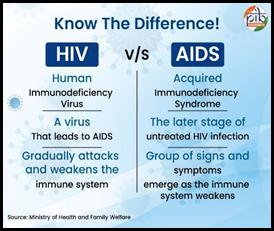
- Human immunodeficiency virus (HIV) is a virus that attacks the body’s immune system.
- HIV targets the body’s white blood cells, weakening the immune system. This makes it easier to get sick with diseases like tuberculosis, infections and some cancers.
- Acquired immunodeficiency syndrome (AIDS) occurs at the most advanced stage of infection.
- Spread: HIV is spread from the body fluids of an infected person, including blood, breast milk, semen and vaginal fluids. It can also spread from a mother to her baby.
- Treatment: There is no cure for HIV infection. It is treated with antiretroviral drugs, which stop the virus from replicating in the body. Untreated HIV can progress to AIDS, often after many years.
Do you know?
- World AIDS Day is observed on December 1 every year.
- It is observed every year to raise awareness about the HIV/AIDS epidemic.
- It was first marked in 1988 by the World Health Organization (WHO).
- Theme 2025: Overcoming disruption, transforming the AIDS response.
HIV AIDS in India
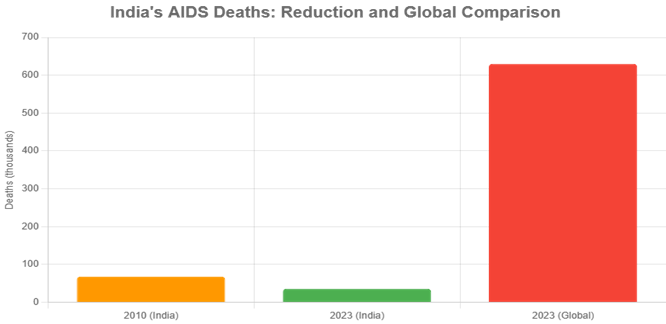
- There has been a decline in infection from 0.33% in 2010 to 0.20 in 2024.
- India’s prevalence is significantly lower than the global average of 0.7%.
- India’s new infections represent only about 5% of the global total (1.3 million in 2024).
The National AIDS Control Programme (NACP)
It has evolved through five phases, shifting from basic awareness to comprehensive prevention, testing, treatment, and sustainability.
- NACP I (1992–1999): It was India’s first comprehensive HIV/AIDS prevention and control programme.
- Aim: Slow the spread of HIV and reduce morbidity, mortality, and overall impact of AIDS.
- NACP II (1999–2006): Strengthen long-term national capacity to respond to HIV/AIDS.
- NACP III (2007–2012): Halt and reverse the HIV epidemic by 2012.
- Strategy: Scale up prevention among High-Risk Groups (HRGs) and the general population.
- NACP IV (2012–2017): 50% reduction in new infections (compared to 2007 baseline).
- Extended (2017–2021) to advance the goal of Ending AIDS by 2030.
- Major initiatives during extension: HIV/AIDS (Prevention and Control) Act, 2017)- It prohibits discrimination against people living with HIV (PLHIV).
- Mission Sampark: Its purpose was to “bring back” people living with HIV (PLHIV) who had stopped antiretroviral therapy (ART).
- Routine Universal Viral Load monitoring.
- NACP V (2021–2026): Launched as a Central Sector Scheme, aims to build on past achievements and address persistent challenges.
- The goal of this Phase is to support the United Nations’ Sustainable Development Goal 3.3 by helping end the HIV/AIDS epidemic as a public health threat by 2030.
Conclusion
- India’s AIDS decline is more prominent than the global average, supported significantly by broadened testing, enhanced access to antiretroviral therapy, focused outreach to high-risk groups, and initiatives to combat stigma, all implemented through collaborative state and community actions.
Source: TH
Previous article
UN Launches Road Safety Project in Four Indian States
