

Syllabus: GS3/ Agriculture/ Science and Technology
Context
- India, ranked third in the world in artificial intelligence by Stanford University’s 2025 Global AI Vibrancy rankings and is increasingly using Artificial Intelligence to strengthen sustainability, and resilience in its agriculture sector.
How is AI in Agriculture Critical for India?
- Indian agriculture faces structural constraints such as fragmented landholdings, climate variability, price volatility, and low productivity.
- Climate change has increased the frequency of extreme weather events, making predictive technologies essential.
- Small and marginal farmers (over 85% of total farmers) require affordable, data-driven advisory systems.
- Efficient risk management and market access are necessary to enhance farmer incomes in line with national development goals.
Role of Artificial Intelligence in Agriculture
- Soil Health Diagnostics: AI uses deep learning and image recognition to monitor soil health by analysing signals from satellite imagery, drone-based observations, and farm-level images.
- Farm Mechanisation Efficiency: AI technologies, such as machine learning, drone applications, and remote sensing, are revolutionizing farming efficiency.
- In horticulture, where crops require continuous monitoring across multiple growth stages, AI-based systems offer round-the-clock surveillance of high-value crops.
- Price Realisation for Farmers: AI-driven predictive analytics leverage large datasets from platforms such as e-NAM, AGMARKET, the Agricultural Census, and the Soil Health Card programme to assess price movements, arrival trends, and regional demand patterns.
- Climate-Smart Agriculture: AI can predict weather patterns and provide early warnings for extreme weather events, enabling farmers to take preventive measures.
- Integration with platforms like WINDS (Weather Information and Network Data System) strengthens risk assessment.
Government Initiatives in AI-Driven Agriculture
- Kisan e-Mitra, launched in 2023, is a voice-enabled, AI-powered chatbot designed to support farmers by answering queries on key government schemes, including PM Kisan Samman Nidhi, the Kisan Credit Card, and the Pradhan Mantri Fasal Bima Yojana.
- The platform operates in 11 regional languages and currently addresses over 8,000 farmer queries each day.
- The National Pest Surveillance System (NPSS), launched in 2024, utilises AI and Machine Learning (ML) to enable early detection of pest infestations and crop diseases.
- The Union Budget 2026-27 proposed Bharat-VISTAAR, a multilingual AI tool to integrate the AgriStack portals and the ICAR package with AI systems.
- AI-Enabled Crop Insurance:
- CROPIC (Collection of Real-Time Observations and Photographs of Crops) uses geotagged, time-stamped images uploaded via mobile apps, enhancing transparency in crop damage assessment.
- YES-TECH (Yield Estimation System based on Technology) uses remote sensing and AI analytics for scientific yield estimation.
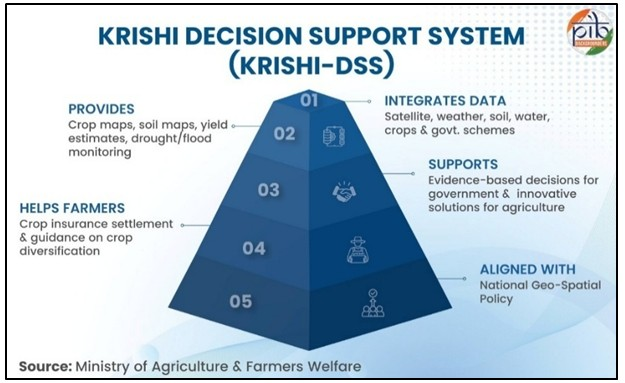
- The Krishi Decision Support System (KDSS) integrates data from multiple sources, to generate comprehensive analytical outputs such as digital crop maps, soil maps, yield estimates, and drought and flood monitoring assessments.
Challenges in AI Adoption in Indian Agriculture
- Rural Connectivity Gaps: Small and marginal farmers often lack access to smartphones, IoT devices, or digital infrastructure, creating an access asymmetry.
- Power supply disruptions in rural areas further constrain the effective use of AI-enabled devices.
- Data Privacy: AI systems rely on large datasets including land records, crop patterns, financial details, and yield data collected under platforms like AgriStack.
- Absence of a clearly defined farmer-centric data ownership framework may lead to misuse or commercial exploitation of farm-level data.
- High Cost of Advanced Technologies: Precision agriculture tools such as drones, AI-based sensors, robotics, and automated machinery involve high initial capital investment.
- Small landholdings (average size ~1–1.2 hectares) reduce economies of scale, making individual adoption financially unviable.
Way Ahead
- While Artificial Intelligence holds transformative potential for Indian agriculture, its success depends on addressing structural inequities, governance gaps, and capacity limitations.
- There is a need to strengthen rural digital infrastructure along with establishing a robust agricultural data governance framework ensuring farmer consent, data security, and transparency.
- Also promote shared-service models through FPOs and cooperatives to reduce technology costs.
Source: PIB
Previous article
Bridging a Divide with an ‘Indian Scientific Service’
