

Syllabus: GS2/IR
Context
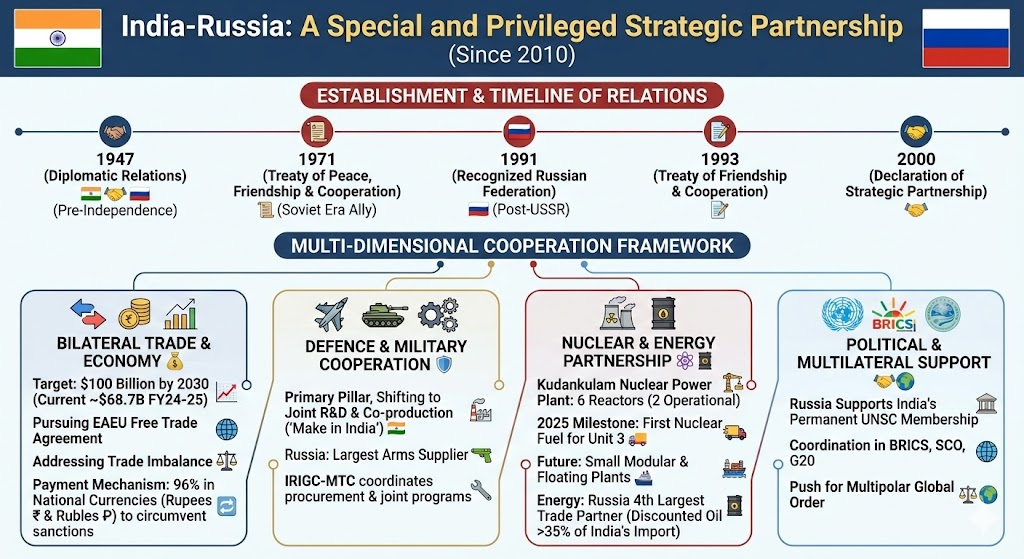
- India and Russia held their 23rd annual bilateral summit, marking a major milestone — 25 years of the Declaration on Strategic Partnership (2000).
Key Outcomes of the Visit
- Economic Programme 2030: The Leaders welcomed the adoption of the Programme for the Development of Strategic Areas of India – Russia Economic Cooperation till 2030 (Programme 2030).
- Trade Target: Both Sides emphasised that addressing tariff and non-tariff trade barriers, for timely achievement of the revised bilateral trade target of USD 100 billion by 2030.
- Strategic Agreements Signed: India and Russia exchanged sixteen agreements in areas related to defence, trade, economy, healthcare, academics, culture and media.
- Free Trade Agreement (FTA) Push: Both sides are working towards the early conclusion of a Free Trade Agreement with the Eurasian Economic Union.
- Migration Cooperation: India will soon be launching a free 30-day e-tourist visa and a 30-day Group Tourist Visa for Russian citizens.
- Cooperation in Global and Multilateral Platforms: The Russian side has decided to adopt the Framework Agreement to join the International Big Cat Alliance.
- Both reiterated cooperation in BRICS, SCO, G20 etc
Significance of the Visit
- Strategic Autonomy of India: The visit underscores India’s unwavering commitment to independent decision-making in foreign policy.
- By hosting the Russian President despite Western pressure, India signals its own geopolitical alignment independent of external pressure.
- Defence Cooperation: Russia still provides 60–70% of India’s defence inventory, making the partnership vital for India’s military readiness.
- Both sides agreed to reformulate defence cooperation by advancing joint R&D, co-development, and Make in India manufacturing of next-generation systems.
- Economic and Trade Transformation: Due to India’s defence and energy imports from Russia there has been a massive trade deficit that has prompted both governments to diversify cooperation.
- A 2030 Economic Cooperation Plan was adopted to expand collaboration in technology, manufacturing, agriculture, pharmaceuticals, and investment.
- Energy Security and Strategic Supply Chains: Russia remains India’s leading crude oil supplier, providing substantial discounts despite Western sanctions.
- During the visit, President Putin assured India of consistent fuel supplies, though India exercised caution, noting that energy procurement decisions are based on changing market dynamics.
- Long-Term Resilience and Adaptability: Marking 25 years of the 2000 Strategic Partnership Declaration, the visit reflects continuity through global shifts—from the post-Cold War era to Russia’s current isolation.
- This resilience suggests the relationship is not transactional but fundamentally grounded in mutual strategic interest.
How India–Russia Partnership Can Help India Overcome US Tariff Challenges?
- Energy Security and Cost Advantage: Russian crude oil imports at discounted rates help India keep its energy basket stable despite US penalties.
- Market Diversification: Russia (and the wider Eurasian region) offers alternative markets for Indian exports reducing over-dependence on the US.
- The proposed India–Eurasian Economic Union (EAEU) FTA can provide preferential access to a large market across Russia, Belarus, Armenia, Kazakhstan, and Kyrgyzstan.
- Connectivity & Logistics Advantage: Projects like the International North-South Transport Corridor (INSTC), Chennai–Vladivostok maritime corridor, and Northern Sea Route can reduce transport time and costs for exports to Europe and Central Asia. This offsets the loss of competitiveness caused by US tariffs.
- Trade in National Currencies & Payment Mechanisms: Strengthening rupee–ruble settlement systems shields India from dollar-dominated trade restrictions imposed by the US.
- Defence & Strategic Tech Cooperation: Russia continues to be a key supplier of defence technology and nuclear energy cooperation, areas where the US could impose restrictions.
- Strong ties with Russia ensure India maintains strategic autonomy and is not dependent on the US for critical technologies.
- Strategic Balancing in Geopolitics: Deepening the Special and Privileged Strategic Partnership with Russia sends a signal to the US that India has viable alternatives.
- This can improve India’s negotiating position in seeking tariff relief from the US.
Conclusion
- The India–Russia partnership provides India with energy security, market diversification, and strategic autonomy at a time of tariff and geopolitical pressure from the US.
- By leveraging Russian ties, India can reduce vulnerability to American trade restrictions while continuing to pursue its long-term trade target of $100 billion with Russia by 2030.
Source: TH
Previous article
News In Short 05-12-2025
Next article
70th Mahaparinirvan Diwas
