

Mahad Satyagraha
Syllabus: GS1/ History
In News
- Mahad marks the birthplace of one of India’s first human rights movements initiated by Dr. B. R. Ambedkar.
About Mahad Satyagraha (1927)
- Mahad Satyagraha, launched by Dr. B.R. Ambedkar on 20 March 1927 at Chavdar Tale, Mahad (Maharashtra), was the first major civil rights movement of Dalits.
- Its objective was to secure the right of untouchables to access public drinking water denied due to caste discrimination.
- Ambedkar, along with key associates such as Anandrao Chitre, Bapu Sahastrabuddhe, Sambhaji Gaikwad and Ramchandra More, led thousands to drink water from the public tank, asserting that essential resources cannot be monopolised by upper castes.
- The movement conveyed a powerful ideological message that water is a basic human right, not a caste privilege, challenging the social exclusion embedded in untouchability.
- On 25 December 1927, Ambedkar publicly burned the Manusmriti, symbolically rejecting caste-based hierarchies.
- In 1937, the Bombay High Court affirmed that the tank was public, validating the satyagraha.
Source: TH
Turkiye’s “Stone Hills” Project
Syllabus: GS1/Ancient History
Context
- Recent archaeological discoveries on Turkiye’s southeastern hills reveal life 11,000 years ago, during the emergence of early settled communities.
About
- Findings are part of the “Stone Hills” project (launched 2020), covering 12 sites in Sanliurfa province—described as the world’s Neolithic capital.
- It includes Göbekli Tepe, a UNESCO World Heritage Site and oldest known megalithic structures in Upper Mesopotamia.
- In India the Neolithic settlements have been found in the North-Western part (Such as Kashmir), Southern part (Karnataka, Tamil Nadu, and Andhra Pradesh), North East(Meghalaya), and Eastern part (Bihar and Odisha) of India.
- Some of the important Neolithic settlements are Burzahom (Kashmir), Gufkral (Kashmir), Chirand (Bihar), and Utnur (Andhra Pradesh).
Stone Age
- It is a prehistoric period marked by the use of stone tools, divided into three major periods: Paleolithic, Mesolithic, and Neolithic.
- Paleolithic Age: Also known as the Old Stone Age.
- Began around 2.6 million years ago and lasted until around 10,000 BCE.
- Humans were hunter-gatherers, using stone tools for hunting, butchering, and food processing.
- Mesolithic Age: Occurred between 10,000 BCE and 5,000 BCE (varies by region).
- Characterized by specialized tools, environmental adaptations, and the early domestication of plants and animals.
- Neolithic Age: Began around 12,000 years ago and ended between 4500 BCE and 2000 BCE.
- Marked by the adoption of agriculture, animal domestication, and settled communities.
- Led to the development of pottery, weaving, and complex social structures.
- Agriculture revolutionized human societies and led to the rise of civilizations.
Source: TH
RELOS Agreement
Syllabus: GS2/IR
In News
- Russia’s lower house of parliament has ratified the Reciprocal Exchange of Logistic Support (Relos) Agreement with India.
- Relos is similar to logistics agreements India has signed with countries like the US, UK, Japan, Australia, France, Singapore, South Korea, and Vietnam.
India–Russia Reciprocal Exchange of Logistics Support (Relos) Agreement
- It is a bilateral military logistics pact that enables both countries’ military aircraft, ships, and personnel to use each other’s bases for refueling, maintenance, spare parts, training, joint exercises, humanitarian missions, and disaster relief.
- It streamlines logistics by reducing paperwork, ensuring quicker support, and allowing rolling settlement of costs.
- It also grants mutual access to each other’s airspace and ports, which will provide India with strategic entry to the Arctic region along the Northern Sea Route, where Russia has an extensive military presence.
- For Russia, Relos offers access to Indian Ocean facilities, helping it maintain global reach despite Western sanctions and allowing power projection in Asia without costly overseas bases.
Source :TOI
Digital Hub for Reference and Unique Virtual Address (DHRUVA)
Syllabus: GS2/ Governance
Context
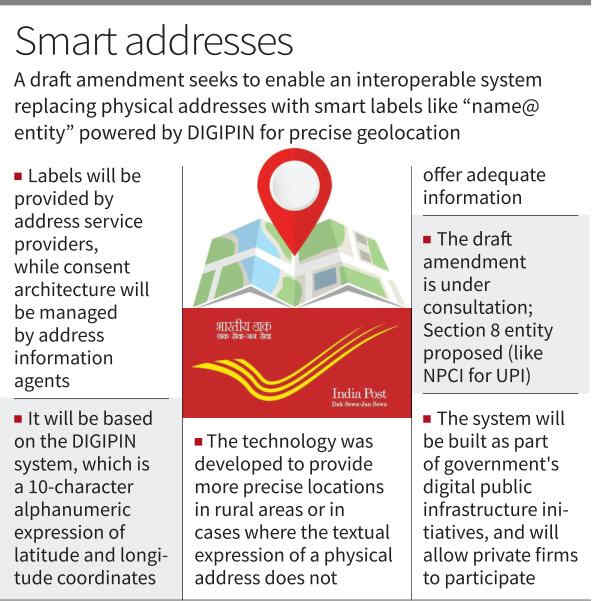
- The Department of Posts (DoP) under the Ministry of Communications has proposed Digital Hub for Reference and Unique Virtual Address (DHRUVA), an interoperable, standardized and user-centric Digital Address System for India.
What is DHRUVA?
- A national framework to create virtual, UPI-like address labels such as “name@entity” that serve as proxies for physical locations.
- The system is built as a part of its Digital Public Infrastructure initiatives and will allow private firms to participate.
- At its core is the concept of Address-as-a-Service (AaaS) — the array of services associated with address data management to support secure, consent-driven sharing of location information.
Source: TH
Leprosy
Syllabus: GS2/Health
Context
- The Supreme Court has directed the NHRC to address discrimination against persons affected by leprosy.
Leprosy in India
- India continues to report about 57 % of leprosy cases worldwide, with genetic predisposition and living in unsanitary conditions raising the susceptibility.
- The five states in India with the highest prevalence of leprosy are Bihar, Chhattisgarh, Jharkhand, Maharashtra, and Odisha.
- The Union Health Ministry launched the National Strategic Plan (NSP) and Roadmap for Leprosy (2023-27) in 2023, to achieve zero transmission of leprosy by 2027.
- The Sustainable Development Goal (SDG) 3.3 aims to end leprosy by 2030.
| Do you Know? The World Health Organization (WHO) declared Jordan as the first country in the world to eliminate leprosy in 2024. |
Leprosy
- Leprosy is also known as Hansen’s disease, it is a chronic infectious disease caused by a type of bacteria, Mycobacterium leprae.
- It is known to occur at all ages ranging from early childhood to old age.
- Symptoms: The disease predominantly affects the skin and peripheral nerves.
- Loss of sensation in affected areas.
- Left untreated, the disease may cause progressive and permanent disabilities.
- Transmission: Through droplets from the nose and mouth.
- The disease is not spread through casual contact with an infected person.
- Treatment: Leprosy is a curable disease through the multi-drug therapy (MDT).
Source: TH
Inhalable Microplastics (iMPs)
Syllabus: GS2/ Health
In News
- Recent study has revealed the presence of inhalable microplastics (iMPs) in the air of major Indian markets, marking them as a new class of pollutants comparable to PM2.5 and PM10.
Inhalable microplastics (iMPs)
- They are plastic particles less than 10 micrometres (microns) in size, as compared to microplastics (less than 5 millimetres), and can thus enter human lungs through the nose.
- It found the highest concentrations in Kolkata and Delhi, with iMPs contributing up to 5% of urban particulate matter, largely from synthetic clothing, packaging, tyre wear, and footwear.
- Inhalable microplastics (iMPs) can penetrate deep into the lungs, enter the bloodstream, and act as carriers for toxic chemicals like diethyl phthalate and heavy metals such as lead, as well as pathogenic microbes including antibiotic-resistant strains, posing risks of cancer, respiratory, hormonal, and neurological disorders.
Source :DTE
Large Exposures Framework
Syllabus: GS3/ Economy
In News
- RBI tightened Large Exposures Framework (LEF rules) for foreign banks, ensuring:
- Their exposure to their own head office or overseas branches is strictly capped.
- All overseas-related exposures must be counted under LEF.
What is Large Exposures Framework (LEF)?
- Large Exposures Framework (LEF) is an RBI rule that prevents banks from giving too much money or exposure to any single borrower or group of connected borrowers.
- Banks sometimes lend huge amounts to large corporations. If that company defaults, the bank can face heavy losses. LEF limits this risk by capping how much exposure is allowed.
- Typically, a bank’s exposure to a single borrower must not exceed 20 % of its eligible capital base (Tier-1 capital), though in some cases an additional 5 % cushion may be allowed.
- Exposure to a group of related borrowers (connected counterparties) must not exceed 25 % of capital base.
Source: PIB
Invasive Alien Plants in India
Syllabus: GS3/Environment
In News
- Invasive alien plants are rapidly transforming India’s ecosystems, nearly doubling their range in sensitive regions like the Western Ghats, Himalayas, and the north-east, driven by climate change, land-use shifts, and biodiversity loss.
About
- Invasive alien species are plants, animals, pathogens and other organisms that are non-native to an ecosystem, and which may cause economic or environmental harm or adversely affect human health.
- The recent study warns that by 2022, 144 million people, 2.79 million livestock, and 200,000 sq km of farmland will be exposed to new invasions, with species such as Lantana camara, Chromolaena odorata, and Prosopis juliflora dominating landscapes.
- Chromolaena is expanding fastest, while Prosopis has displaced native vegetation across dry regions, and many species are now spreading into Himalayan and wet evergreen forests.
Environmental Impacts
- Invasive species alter fire regimes, soil moisture, and native vegetation, with wet-biome invaders thriving in warming temperatures and frequent fires, while dry-biome invaders benefit from higher rainfall and reduced fires.
- Entire ecosystems could shift from native to invasive dominance within a generation. Vulnerable areas include the Shivalik-Terai belt, Duars, Aravalli ranges, Dandakaranya forests, and Nilgiri region.
Socioe-conomic Impacts
- Invasions reduce fodder, fuelwood, soil fertility, and access to pasture and water, forcing rural and pastoral communities to migrate or travel longer distances.
- Economic losses in India from invasive species between 1960 and 2020 are estimated at $127.3 billion.
- Invasive plants also pose health risks, including respiratory issues.
Recommendations
- India currently lacks a national mechanism or database for managing invasive species.
- Therefore, researchers recommend creating a National Invasive Species Mission to integrate monitoring, management, quarantine, and funding, linking control efforts to climate adaptation, poverty alleviation, and ecological restoration.
Source :DTE
World Soil Day
Syllabus: GS3/ Environment
Context
- World Soil Day is observed annually on December 5 to raise awareness about the importance of healthy soil and to advocate for sustainable management.
About World Soil Day
- The initiative is endorsed by the FAO and the UN General Assembly, following a proposal by the International Union of Soil Sciences (IUSS) in 2002.
- The FAO Conference unanimously endorsed World Soil Day in 2013 and requested its official adoption at the 68th UN General Assembly.
- In December 2013, the UN General Assembly responded by designating 5 December 2014 as the first official World Soil Day.
- Theme for World Soil Day 2025: “Healthy Soils for Healthy Cities”.
| Initiatives for Soil Conservation – Soil Health Card Scheme: It provides farmers with soil nutrient status reports to encourage balanced fertilizer use and improve productivity. – Promotion of Organic Farming: Initiatives like Paramparagat Krishi Vikas Yojana (PKVY) encourage organic farming practices to maintain soil health. – Global Initiatives 1. Global Soil Partnership (GSP): It is an FAO-led initiative to improve global soil governance and promote sustainable soil management. 2. United Nations Convention to Combat Desertification (UNCCD): It works to prevent land degradation and promote sustainable land management globally. It has a pledge for land degradation neutrality (LDN) by 2030. |
Source: TH
Kuno National Park (KNP)
Syllabus: GS3/Environment
Context
- On International Cheetah Day (December 4), the Madhya Pradesh Chief Minister released three cheetahs into the wild at Kuno National Park.
About Kuno
- Located in Sheopur district, Madhya Pradesh, in central India.
- Named after the Kuno River, a perennial tributary of the Chambal that flows through the park.
- Notified as Kuno Wildlife Sanctuary in 1981; also known as Kuno Palpur due to the 7th-century Palpur fort of the Scindia rulers. In 2018, it was given the status of a national park.
- Forest type: Northern Tropical Dry Deciduous, with Kardhai, Khair, Dhawa, Salai and savannah woodland.
Do you know?
- Twelve years after the Supreme Court’s 2013 order to shift some Asiatic lions from Gujarat to Madhya Pradesh’s Kuno as a second home, the translocation still hasn’t materialised.
Source: TH
Previous article
BNHS to Reintroduce Two Vulture Species in Assam
Next article
23rd India-Russia Annual Summit
