


Syllabus: GS2/Govt Policy & Intervention; GS3/Environment
Context
- Recently, the Union Government has expanded the scope and timeline of the Pradhan Mantri Jaiv Indhan–Vatavaran Anukool Fasal Awashesh Nivaran (JI-VAN) Yojana, reaffirming its commitment to sustainable development and energy security.
About PM JI-VAN & Its 2024 Upgrades
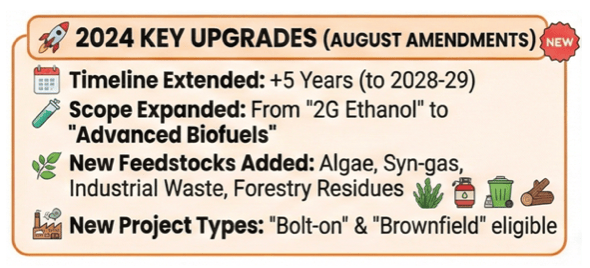
- It was launched in 2019 under the Ministry of Petroleum and Natural Gas (MoP&NG).
- It is implemented by the Centre for High Technology (CHT) that operated under the MoP&NG.
- Financial Outlay: ₹1,950 crore (Total Allocation)
- ₹1,800 crore for 12 commercial-scale projects
- ₹150 crore for 10 demonstration-scale projects
- Support Mechanism: Viability gap funding and capital assistance to make projects commercially viable.
Objectives of the Scheme
- Establishment of commercial and demonstration-scale advanced biofuel projects using lignocellulosic biomass and other renewable feedstocks.
- Providing remunerative income to farmers for agricultural residues that would otherwise go to waste.
- Creating employment opportunities in rural and urban areas.
- Addressing air pollution caused by stubble burning and reducing soil and water pollution from municipal solid waste.
- Contributing to the Swachh Bharat Mission and supporting the Ethanol Blended Petrol (EBP) Programme.
- Reducing India’s dependency on crude oil imports and supporting the nation’s climate goals.
Key Biofuel Projects Under PM JI-VAN
- Second Generation (2G) Bio-Ethanol Projects: Indian Oil Corporation Ltd. (IOCL) has set up a 2G paddy straw-based feedstock bio-ethanol project at Panipat, Haryana.
- A 2G bamboo-based biorefinery has been established at Numaligarh, Assam by Numaligarh Refinery Ltd., through Assam Bio-Ethanol Private Limited (ABEPL).
- Third Generation (3G) Ethanol Project: IOCL has commissioned a 3G ethanol plant at Panipat, utilizing refinery off-gas as feedstock — marking a leap towards innovative carbon utilization.
Policy Framework Supporting Biofuel Expansion
- The National Policy on Biofuels (Amended 2022) promotes the use of diverse feedstocks such as:
- Damaged and surplus food grains (broken rice, maize, cassava, rotten potatoes).
- Agricultural residues (rice straw, corn cobs, cotton stalk, sawdust, bagasse).
- Sugarcane juice and molasses, regulated through the National Biofuel Coordination Committee (NBCC) to avoid food security conflicts.
- Feedstock utilization is calibrated annually based on availability, cost, market demand, and sustainability considerations.
Impact on Sugar and Maize Sectors
- Sugar Sector: In Sugar Season (SS) 2024–25, sugar production reached 340 LMT, with 34 LMT diverted for ethanol production.
- Domestic sugar demand stood at 281 LMT, and ethanol production helped stabilize sugar inventories and ensure timely payments to sugarcane farmers.
- Maize Production Growth: Maize output increased by nearly 30%, from 337.30 LMT in 2021–22 to 443 LMT in 2024–25, driven by government encouragement for crop diversification from water-intensive crops like rice and sugarcane.
Achievements of the Ethanol Blended Petrol (EBP) Programme
- Since Ethanol Supply Year (ESY) 2014–15 up to October 2025, the EBP Programme has achieved:
- Payments to farmers exceeding ₹1,36,300 crores.
- Foreign exchange savings of more than ₹1,55,000 crores.
- Net CO₂ reduction of approximately 790 lakh metric tonnes.
- Substitution of over 260 LMT of crude oil imports.
Conclusion
- The Pradhan Mantri JI-VAN Yojana represents a cornerstone of India’s clean energy and circular economy vision.
- It paves the way for a sustainable and self-reliant biofuel ecosystem by linking farmers’ livelihoods, waste management, and energy security.
- The initiative strengthens India’s journey toward a low-carbon, energy-secure future together with supportive policies and technological innovations.
Previous article
News In Short 4-12-2025
