

Syllabus: GS3/Economy
Context
- Recent rupee’s depreciation against major currencies like the dollar, euro, and yen signals global volatility and deeper structural concerns.
About Rupees Depreciation
- It refers to the decline in the value of the Indian rupee relative to foreign currencies, particularly the US dollar.
- It means that more rupees are needed to buy a unit of foreign currency, when the rupee depreciates.
Key Drivers of Rupee Depreciation
- Trade Deficit: When imports exceed exports, demand for foreign currency rises, putting downward pressure on the rupee.
- Capital Outflows: Foreign investors pulling money out of Indian markets reduce the supply of foreign currency, weakening the rupee.
- Global Dollar Strength: A strong US dollar, often due to high interest rates in the US, can lead to depreciation of emerging market currencies like the rupee.
- Inflation Differentials: Higher inflation in India compared to its trading partners can erode the rupee’s purchasing power over time.
- Geopolitical and Economic Uncertainty: Global crises or domestic instability can reduce investor confidence, leading to currency depreciation.
Reasons For Current Depreciation
- Nominal Depreciation: The rupee has weakened against most major currencies, including the Chinese yuan (11.66 to 12.63). The NEER’s fall below 85 reflects this broad-based depreciation.
- Lower Domestic Inflation: India’s CPI inflation in October 2025 stood at 0.25%, far below that of major economies like US & Japan (3%); UK (3.6%); Euro Area (2.1%); Indonesia (2.9%); and Brazil (4.7%)
- The combination of nominal depreciation and low inflation has led to a decline in REER, implying that the rupee is now undervalued and Indian exports may gain price competitiveness.
- Decline in NEER & REER:
- NEER: Dropped from 90.75 (Jan 2025) to 84.58 (Oct 2025) — a 6.8% decline in just nine months.
- REER: Fell sharply from its record high of 108.06 (Nov 2024) to 97.47 (Oct 2025) — a 9.8% correction, shifting the rupee from being overvalued to undervalued.
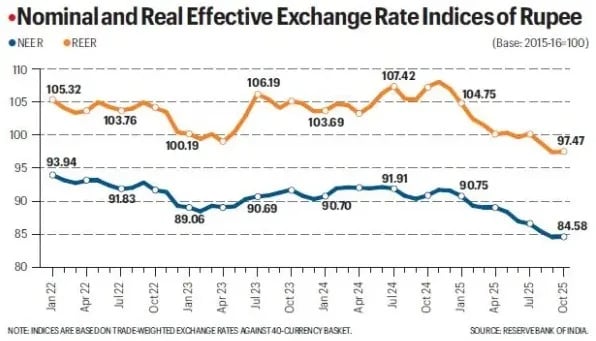
| About NEER and REER – Economists look beyond bilateral exchange rates to two indices — Nominal Effective Exchange Rate (NEER) and Real Effective Exchange Rate (REER) to assess the rupee’s real competitiveness. 1. NEER: Weighted average of the rupee’s exchange rates against a 40-currency basket (base year: 2015–16). 2. REER: NEER adjusted for inflation differentials between India and its trading partners. – A fall in NEER or REER indicates a weaker rupee, while an increase shows appreciation. |
Implications of a Weaker Rupee
- Inflationary Pressures: Imported goods, including electronics, fuel, and essential commodities, are becoming costlier, affecting household budgets.
- Since India imports over 80% of its oil needs, fuel prices rise, triggering a domino effect on transportation, food, and manufacturing costs, thereby stoking inflation.
- Corporate Profitability: The rupee’s depreciation is expected to erode India’s corporate sector’s (India Inc) profits, particularly for companies with high import dependencies or foreign currency borrowings.
- Trade Balance and Export Competitiveness: While a weaker rupee can boost export competitiveness by making Indian goods cheaper abroad, the benefit is often offset by global demand slowdowns or supply chain disruptions.
- Moreover, India’s structural trade deficit, driven by high-value imports like oil and electronics, limits the positive impact of currency depreciation.
- Capital Flows and Investor Sentiment: Currency volatility can deter foreign investors, especially in equity and debt markets.
- Capital outflows driven by global risk aversion and higher US interest rates have exacerbated the rupee’s decline.
IMF’s Reclassification and RBI’s Exchange Rate Policy
- IMF, in its November 26, 2025 report, reclassified India’s exchange rate regime as a ‘crawl-like arrangement’, following its earlier shift from a ‘floating’ to ‘stabilised’ arrangement in November 2023.
- A crawl-like regime allows gradual adjustments in the currency’s value within a 2% band around a defined trend, providing flexibility while avoiding abrupt movements.
- RBI’s Current Stance: RBI has adopted a more flexible approach, intervening only occasionally to smooth excessive volatility. It is driven by:
- Easing inflation, reducing the need for a strong rupee.
- The need to preserve export competitiveness, particularly amid global trade tensions and shifting supply chains.
- RBI has intervened in the forex marketto stabilize the rupee. It may impact:
- Foreign Exchange Reserves: Continued intervention has led to a drawdown in forex reserves, limiting the RBI’s ability to defend the rupee indefinitely.
- Inflation Risks: A weaker rupee makes imports more expensive, potentially stoking inflation and complicating the RBI’s monetary policy stance.
What Lies Ahead?
- The rupee’s REER may decline further, keeping it undervalued if the trend of gradual nominal depreciation and subdued inflation continues.
- Such a position could benefit exporters but may raise import costs over time if global inflation pressures resurface.
- The current undervaluation may offer temporary benefits to trade with India’s inflation under control and external competitiveness improving.
- However, sustaining stability will require careful balancing between currency flexibility, inflation control, and capital flow management in the months ahead.
Previous article
The Many Roles of Sugarcane in India and the World
Next article
Private Sector Entry in India’s Nuclear Sector
