


Syllabus: GS3/Environment
Context
- The Supreme Court recalled its May 16 judgment that had banned ex post facto environmental clearances (EC) — meaning you cannot start a project first and take EC later.
About
- The May judgment had held that granting retrospective clearances in any form to regularise illegal constructions was clearly illegal.
- The court had struck down a 2017 notification and 2021 office memorandum (OM) of the Union government, which in effect recognised the grant of ex post facto ECs.
- Huge public money at stake: If the May 16 judgment remained many completed/near-complete buildings would have to be demolished then rebuilt after taking EC.
- The public projects worth Rs 20,000 crore will have to be demolished if the clearance is not reviewed.
- The SC has recalled that judgment, directing that the issue be placed before an appropriate bench for fresh consideration.
Environment Impact Assessment (EIA)
- EIA can be defined as the study to predict the effect of a proposed activity/project on the environment.
- EIA systematically examines both beneficial and adverse consequences of the project and ensures that these effects are taken into account during project design.
- It also proposes measures to mitigate adverse effects.
- Significance: Protection of environment, optimum utilisation of resources and saving of time and cost of the project.
- It also lessens conflicts by promoting community participation, informing decision makers, and helping lay the base for environmentally sound projects.
EIA in India
- 1994: The Union Ministry of Environment and Forests (MEF), under the Environmental (Protection) Act 1986, made Environmental Clearance (EC) mandatory.
- EIA 2006 Regime: It is the governing legal instrument to grant green clearance for establishment or expansion of an industry on the basis of the expected environmental impact of the project.
- It made it mandatory for various projects such as mining, thermal power plants, river valley, infrastructure and industries to get environment clearance.
- However, unlike the EIA Notification of 1994, the new legislation has put the onus of clearing projects on the state government depending on the size/capacity of the project.
Legal and Institutional Framework
- EIA Notifications: Issued by the Ministry of Environment, Forest and Climate Change (MoEFCC) using powers under the Environmental (Protection) Act 1986.
- Institutional Authorities:
- Central Expert Appraisal Committee (EAC): For Category A projects (national level).
- State Expert Appraisal Committees (SEACs): For Category B projects (state level).
- State Environment Impact Assessment Authorities (SEIAAs): Grant environmental clearance at state level.
- Categorisation of Projects
- Category A: National-level projects with significant impacts (e.g., large dams, major highways).
- Category B1: Moderately sized projects with regional impact.
- Category B2: Small-scale projects with less impact.
Concerns
- One positive of the 2006 EIA notification is its dynamism to accommodate changes in its provisions and processes as per the requirement of the changing times.
- However, this characteristic of the legal instrument seems to have been exploited.
- Over 110 changes were made in just 5 years — most of them without public consultation.
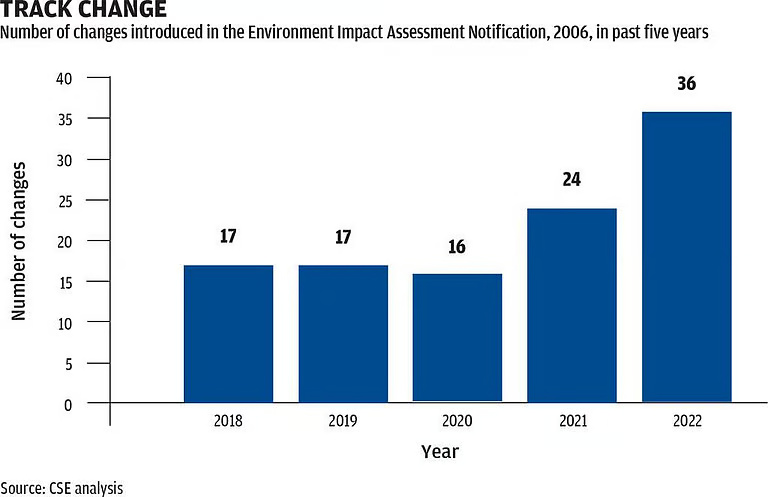
- This flexibility has been misused and industries get approvals — even if they pollute or harm the environment.
Best Practices to Improve EIA Process
- Create an independent EIA authority to avoid conflict of interest.
- Strengthen public consultation, especially in local languages.
- Ensure scientific and transparent baseline data.
- Regularly update the list of exempted projects based on environmental concerns.
Source: IE
Previous article
Removing of Ineligible Beneficiaries from NFSA List
Next article
News in Short – 19 November, 2025
