
The Rules for Sustainable Harnessing of Fisheries in the EEZ

Syllabus: GS3/ Environment

In News

  • The Government of India has notified new Deep-Sea Fishing Rules, 2025, aimed at realizing the vision of a prosperous and inclusive Blue Economy and unlocking the vast potential of India’s 11,099 km coastline and Exclusive Economic Zone (EEZ).

Key Highlight of the Rules

  • Empowering Fishermen and Cooperatives: Exclusive priority is given to Fishermen Cooperative Societies and Fish Farmer Producer Organisations (FFPOs) for deep-sea fishing licenses using advanced vessels. 
  • Ban on Foreign Vessels: Foreign fishing vessels are completely prohibited from operating within India’s EEZ to protect resource sovereignty and small-scale fishers.
  • Mother-and-Child Vessel Model: Introduced to enable mid-sea transshipment under Reserve Bank of India regulations, this model uses large “mother” vessels supporting smaller “child” boats to reduce shore congestion, extend fishing operations, and improve efficiency.
  • Prohibition of Harmful Fishing Practices: Fishing methods such as LED light fishing, pair trawling, and bull trawling are banned to protect marine ecosystems.
  • Fisheries Management and Legal Measures: Minimum legal sizes for fish species will be prescribed, and Fisheries Management Plans developed in consultation with state governments and stakeholders to ensure sustainable exploitation.
  • Digital Access and Monitoring: Mechanized and large motorized vessels require free access passes through the online ReALCRaft portal, which is integrated with the Marine Products Export Development Authority and Export Inspection Council. 

Significance

  • Boost deep-sea fishing revenue and reduce dependence on near-shore fisheries.
  • Empower coastal communities through cooperative governance.
  • Promote sustainable resource use and prevent over-exploitation.
  • Strengthen India’s strategic presence and maritime security in the EEZ.
  • Enhance global trade competitiveness of Indian seafood under the “Indian origin” label.
About Exclusive Economic Zone (EEZ)
Legal Basis: Established under the 1982 United Nations Convention on the Law of the Sea (UNCLOS).
Extent: Extends up to 200 nautical miles from the baseline of a country’s coastline.
Rights: A nation has sovereign rights for exploration, exploitation, conservation, and management of natural resources (living and non-living) in its EEZ.
Significance: The EEZ is critical for securing marine resources, promoting food security, and ensuring strategic maritime interests.
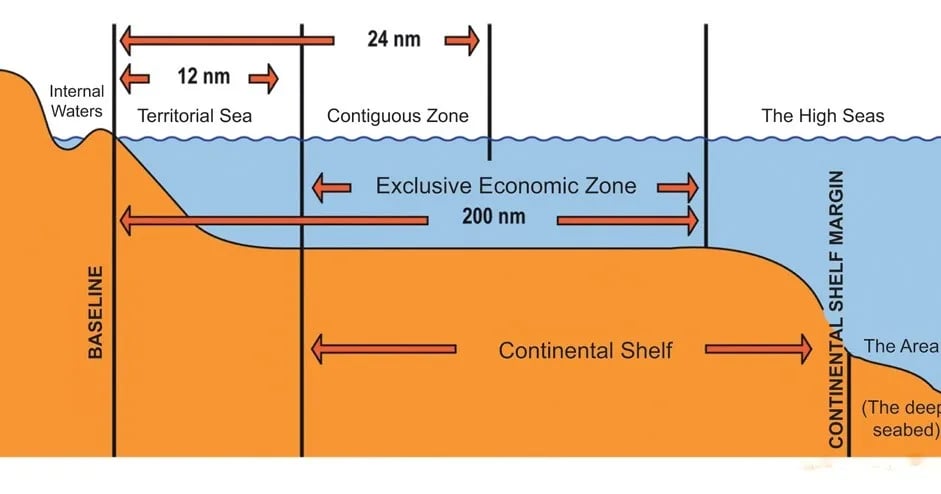
Source: TH


Other News of the Day

Syllabus: GS1/Places /GS2/IR In News India has shut down its operations at the Ayni airbase in Tajikistan, a key overseas facility that had provided its strategic influence in Central Asia.  Ayni Airbase The airbase, originally built during the Soviet era, was in poor condition following the split of the Soviet Union. India invested around $80...
Read More

Syllabus: GS3/Economy In News Society’s approach to food is changing, with the next major shift focusing on functional foods and smart proteins that promote better health and sustainability. Functional Foods They are enriched foods that promote health or prevent disease, such as vitamin-enriched rice or omega-3-fortified milk.  They leverage several technologies such as nutrigenomics (the...
Read More

Syllabus: GS3/Economy Context Currency with the public has more than doubled since the demonetisation in 2016 was announced by the government.  Demonetisation The Prime Minister announced demonetisation on November 8, 2016. It declared that all existing Rs 500 and Rs 1,000 notes which together accounted for about 86% of the currency in circulation would cease...
Read More

Syllabus: GS3/Space In News Scientists from the Indian Institute of Astrophysics and NASA have made the first-ever spectroscopic observations of a coronal mass ejection (CME) in the visible wavelength range, close to the Sun’s surface  using the VELC payload on Aditya-L1. Aditya-L1  It is  India’s first space-based solar observatory, designed to study the Sun from...
Read More

Syllabus: GS3/Agriculture Context Recently, the Indian Council of Agricultural Research (ICAR) has revealed alarming evidence that unscientific fertilizer use and climate change are causing significant degradation of organic carbon in India’s arable soils. Key Findings Unbalanced Fertiliser Use: The study found that imbalanced and excessive fertiliser use—particularly of urea and phosphorus—has degraded soil carbon levels....
Read More

Syllabus: GS3/Agriculture/Artificial Intelligence Context The World Economic Forum, in collaboration with stakeholders from both industry and academia, has launched a new insights report ‘Shaping the Deep-Tech Revolution in Agriculture’. About The report identifies seven deep-tech domains with the potential to drive agricultural transformation:  Generative AI: Using large-language models, predictive analytics for pest, yield, labour optimisation. ...
Read More

Chittaranjan Das Syllabus: GS1/ Personalities In News Lok Sabha paid floral tribute to freedom fighter Deshbandhu Chittaranjan Das, on his birth anniversary. About Chittaranjan Das (1870 – 1925) Overview: He was popularly known as “Deshbandhu (Friend of the Nation),” and was a key nationalist leader, lawyer, freedom fighter, and social reformer of the Indian independence...
Read More
scroll to top