


Syllabus: GS3/Agriculture
Context
- Recently, the Indian Council of Agricultural Research (ICAR) has revealed alarming evidence that unscientific fertilizer use and climate change are causing significant degradation of organic carbon in India’s arable soils.
Key Findings
- Unbalanced Fertiliser Use: The study found that imbalanced and excessive fertiliser use—particularly of urea and phosphorus—has degraded soil carbon levels.
- Haryana, Punjab, and Western Uttar Pradesh showed the most severe declines due to intensive, unscientific fertilisation.
- Bihar, with more balanced fertiliser application, exhibited better soil carbon health.
- Correlation Between Organic Carbon and Elevation: Soils in hilly regions contain higher organic carbon, whereas lowland soils exhibit depletion.
- Low soil carbon leads to increased heat reflection, amplifying the greenhouse effect and global warming risks.
- Temperature’s Negative Impact: The study warns that rising temperatures could further reduce soil organic carbon, worsening soil health and climate impacts.
- Hotter regions such as Rajasthan and Telangana showed lower soil organic carbon (SOC) content due to accelerated organic matter decomposition.
- Influence of Rainfall and Cropping Systems:
- Rice and pulse based systems maintain higher carbon levels due to increased microbial activity from water-intensive cultivation.
- Wheat and coarse-grain systems showed lower carbon levels.
| Why Soil Health Matters? – Supports Agriculture: Over 54% of India’s workforce depends directly or indirectly on agriculture. – Healthy soil ensures higher crop yields and better nutritional quality. – Food Security: Soil rich in organic matter and nutrients produces more resilient and nutritious crops. – Environmental Balance: Healthy soils regulate water, store carbon, and support biodiversity and act as a buffer against floods, droughts, and climate change impacts. – Economic Impact: Poor soil health leads to reduced productivity, increased input costs, and long-term land degradation—affecting farmers’ incomes and national GDP. 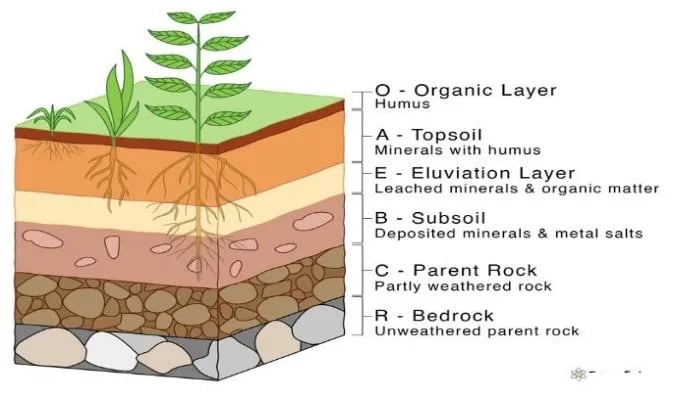 Image: Layers (Horizons) of Soil Profile |
Related Efforts & Initiatives
- Soil Health Card (SHC) Scheme (2015): It aims to provide every farmer with a detailed report on the nutrient status of their soil. It aims to promote balanced and judicious use of fertilizers.
- The government has strengthened soil testing facilities to support the SHC scheme, like Mobile Soil Testing Labs, School Soil Health Programme, and Digital Tracking.
- Soil Health Management (SHM): It is a part of National Mission for Sustainable Agriculture (NMSA), aims to promote integrated nutrient management and organic farming.
- Integration with Rashtriya Krishi Vikas Yojana (RKVY): SHC and SHM schemes have been merged into the Soil Health & Fertility component of RKVY for better coordination and impact.
Policy Recommendations
- Organic Carbon Sequestration Programs: Promote sequestration in soils with less than 0.25% organic carbon through improved cropping systems and irrigation support.
- Carbon Credit Incentives: Encourage farmers who trap and store carbon dioxide in soil through sustainable practices by offering financial incentives.
- Climate-Resilient Crop Management: Develop region-specific crop management strategies for climate change mitigation and soil restoration.
- Nationwide Vegetative Cover: Expand plantations and cover crops to reduce soil exposure and carbon loss.
Conclusion
- The ICAR study underscores an urgent need for balanced fertiliser use, adaptive cropping systems, and climate-responsive soil management to restore and preserve India’s soil organic carbon.
- The continuing decline could threaten food security, land productivity, and climate stability in the years ahead without corrective action.
Previous article
Aditya-L1 Mission Tracks Coronal Mass Ejections (CMEs)
