
Aditya-L1 Mission Tracks Coronal Mass Ejections (CMEs)

Syllabus: GS3/Space

In News

  • Scientists from the Indian Institute of Astrophysics and NASA have made the first-ever spectroscopic observations of a coronal mass ejection (CME) in the visible wavelength range, close to the Sun’s surface  using the VELC payload on Aditya-L1.

Aditya-L1 

  • It is  India’s first space-based solar observatory, designed to study the Sun from Lagrange Point 1, located about 1.5 million km from Earth.
    • This position allows uninterrupted observation of solar phenomena without eclipses or occultation.
  • It launched in September  2023 to enhance understanding of solar dynamics, including coronal mass ejections (CMEs), solar flares, and their impact on space weather — crucial for satellite operations, communications, and power grids on Earth.
  • The mission carries seven indigenously developed payloads, five by ISRO and two in collaboration with Indian academic institutions. 
  • These instruments are designed to observe the photosphere, chromosphere, and corona of the Sun,Solar emissions and magnetic field variations and Solar wind and energetic particle fluxes.
Lagrange Points
– Lagrange Points are positions in space where the gravitational forces of two massive bodies (like the Sun and Earth) and the centripetal force of a smaller object (like a spacecraft) balance each other.
– This allows the smaller object to remain relatively stable with respect to the two larger bodies.
– There are five such points (L1–L5) in the Sun-Earth system.
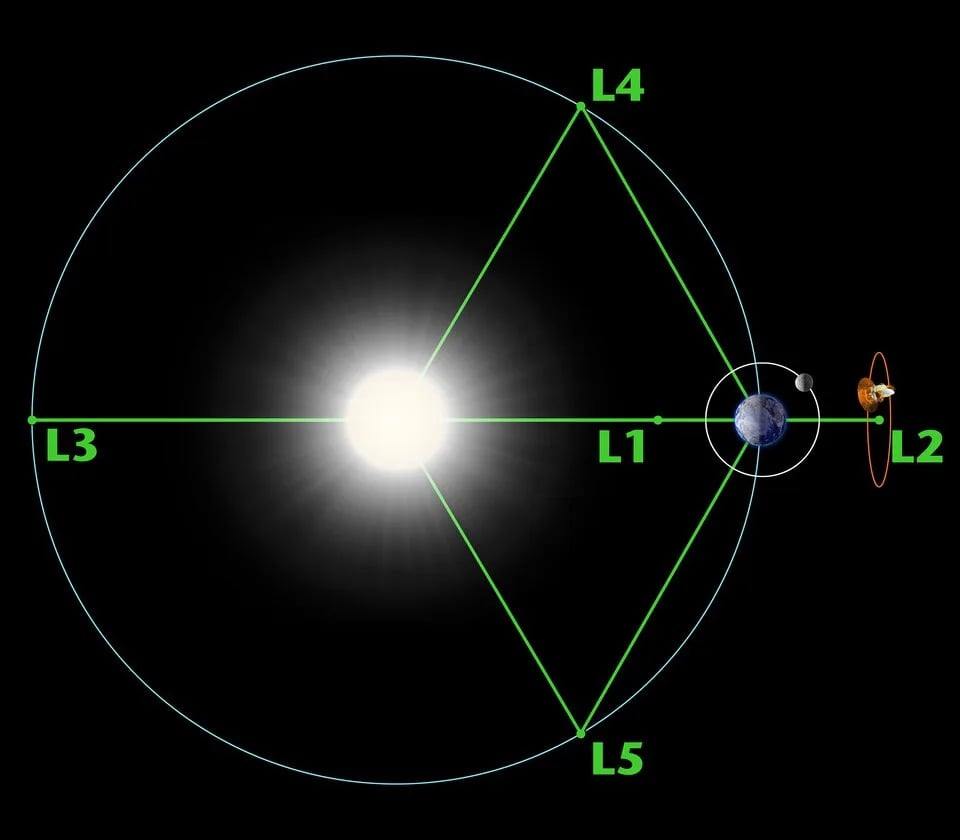
Halo Orbit
– A three-dimensional periodic orbit around a Lagrange point. Unlike a simple circular orbit, it forms a loop-like path (halo) around L1.
– It helps spacecraft avoid direct shadowing by Earth or Moon while maintaining a stable position with minimal fuel consumption.

Strategic Significance

  • Aditya-L1 will provide continuous solar monitoring, helping predict space weather events and their terrestrial impacts.
  • It supports global solar research and complements missions like NASA’s Parker Solar Probe and ESA’s Solar Orbiter.
  • It showcases India’s growing capability in observatory-class space science.
  • It aligns with India’s broader space ambitions, including the upcoming Gaganyaan human spaceflight mission and interplanetary exploration.

Sources:TH


Other News of the Day

Syllabus: GS1/Places /GS2/IR In News India has shut down its operations at the Ayni airbase in Tajikistan, a key overseas facility that had provided its strategic influence in Central Asia.  Ayni Airbase The airbase, originally built during the Soviet era, was in poor condition following the split of the Soviet Union. India invested around $80...
Read More

Syllabus: GS3/Economy In News Society’s approach to food is changing, with the next major shift focusing on functional foods and smart proteins that promote better health and sustainability. Functional Foods They are enriched foods that promote health or prevent disease, such as vitamin-enriched rice or omega-3-fortified milk.  They leverage several technologies such as nutrigenomics (the...
Read More

Syllabus: GS3/Economy Context Currency with the public has more than doubled since the demonetisation in 2016 was announced by the government.  Demonetisation The Prime Minister announced demonetisation on November 8, 2016. It declared that all existing Rs 500 and Rs 1,000 notes which together accounted for about 86% of the currency in circulation would cease...
Read More

Syllabus: GS3/Agriculture Context Recently, the Indian Council of Agricultural Research (ICAR) has revealed alarming evidence that unscientific fertilizer use and climate change are causing significant degradation of organic carbon in India’s arable soils. Key Findings Unbalanced Fertiliser Use: The study found that imbalanced and excessive fertiliser use—particularly of urea and phosphorus—has degraded soil carbon levels....
Read More

Syllabus: GS3/ Environment In News The Government of India has notified new Deep-Sea Fishing Rules, 2025, aimed at realizing the vision of a prosperous and inclusive Blue Economy and unlocking the vast potential of India’s 11,099 km coastline and Exclusive Economic Zone (EEZ). Key Highlight of the Rules Empowering Fishermen and Cooperatives: Exclusive priority is...
Read More

Syllabus: GS3/Agriculture/Artificial Intelligence Context The World Economic Forum, in collaboration with stakeholders from both industry and academia, has launched a new insights report ‘Shaping the Deep-Tech Revolution in Agriculture’. About The report identifies seven deep-tech domains with the potential to drive agricultural transformation:  Generative AI: Using large-language models, predictive analytics for pest, yield, labour optimisation. ...
Read More

Chittaranjan Das Syllabus: GS1/ Personalities In News Lok Sabha paid floral tribute to freedom fighter Deshbandhu Chittaranjan Das, on his birth anniversary. About Chittaranjan Das (1870 – 1925) Overview: He was popularly known as “Deshbandhu (Friend of the Nation),” and was a key nationalist leader, lawyer, freedom fighter, and social reformer of the Indian independence...
Read More
scroll to top